






































In the mainstream science news, I routinely encounter fossil stories touching on the Cambrian Explosion and have reported many of them at Science and Culture Today over the years (for example, here, here, here, and here). Earlier in 2026, a paper was published about a major new Cambrian fossil site in China rivaling the famous Burgess Shale (read my response here). And in May, Casey Luskin responded to claims of putative transitional forms in Ediacaran strata in China, which turned out to be far less convincing than initial statements claimed.
Among other recent news about the Cambrian:
- A discovery of polychaete annelid fossils from the earliest Cambrian in south China was announced in PNAS, but no internal organs were discernible. The specimens are estimated to be 535 million years old. Polychaetes (marine worms) have as many complex body systems as their living counterparts today, including a gut, senses, muscles, and reproductive organs.
- Chelicerates comprise a large group of arthropods including spiders, mites, and scorpions. Nature announced “unequivocal evidence of large predatory chelicerates in the Cambrian” in Utah.
- In an article titled “Cambrian origin of the arachnid brain,” Current Biology announced a stem chelicerate from the mid-Cambrian. “Its prosomal nervous system corresponds to that of living spiders and scorpions,” the article says.
- Four vertebrate species with camera-type eyes were announced in Nature. These represent “earliest known fossil vertebrates (approximately 518 million years ago),” the report says.
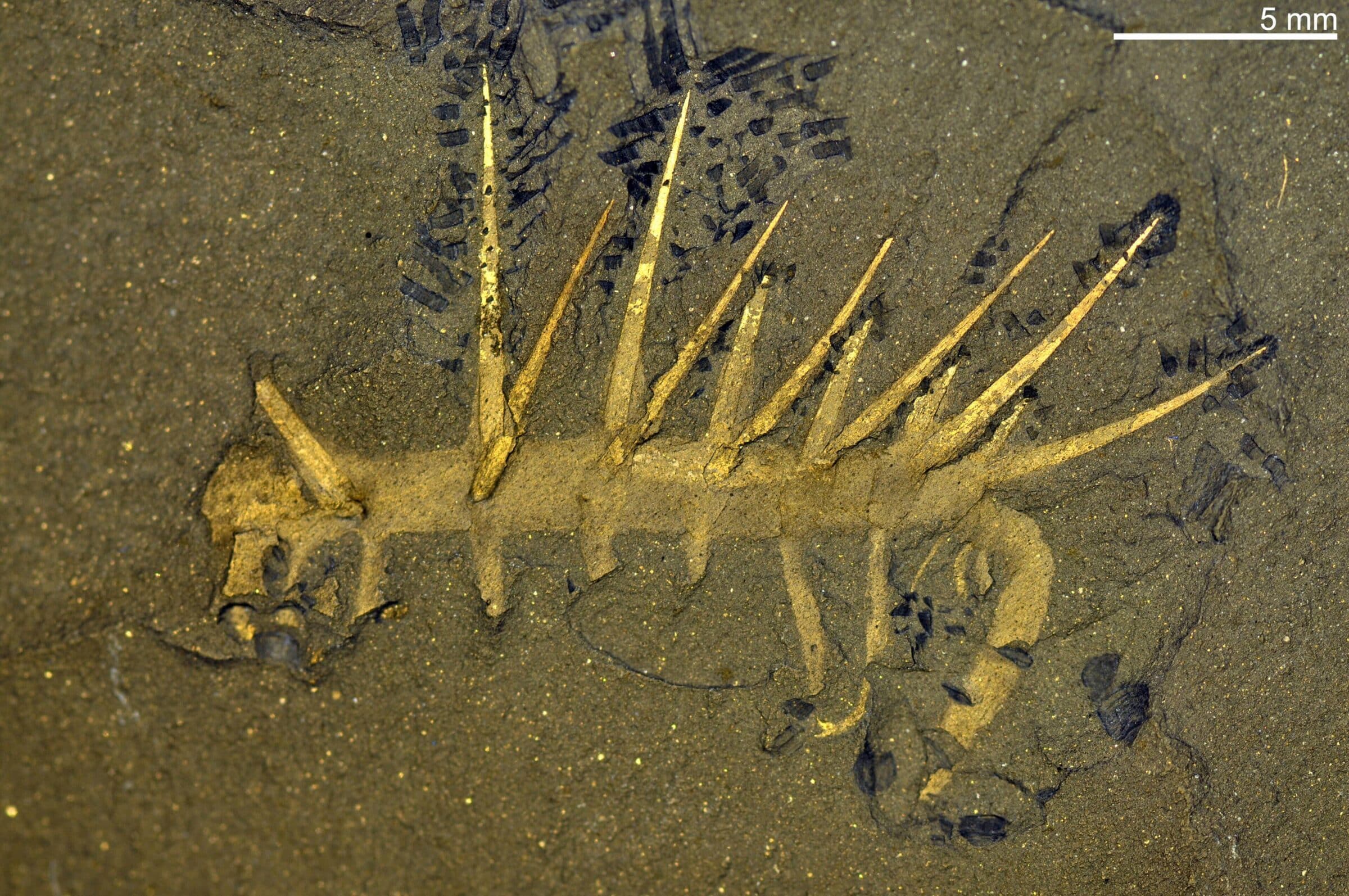
- The strange Cambrian animal Hallucigenia might have been a suction feeder that scavenged soft parts of dead animals, according to a study in bioRxiv.
- Exceptionally well-preserved Cambrian biota in the Grand Canyon’s Bright Angel Shale contains “a range of functionally sophisticated metazoan consumers: suspension-feeding crustaceans, substrate-scraping molluscs, and morphologically exotic priapulids with complex filament-bearing teeth,” says a paper in Science Advances.
- A rich bed of exceptionally preserved fossils in South Australia, said to be part of the Cambrian Explosion, was also reported in Science Advances. Among some 25,000 recovered specimens include trilobites and jellyfish. Details of muscle fibers and compound eye lenses were found.
These representative papers show that the Cambrian Explosion remains a huge enigma for evolutionists. Darwin would still struggle with his doubt on the subject today, 167 years after he wrote his woeful complaint in The Origin of Species, “The case at present must remain inexplicable; and may be truly urged as a valid argument against the views here entertained.”
You Were Always on My Mind
The Cambrian Explosion has been on my mind for a long time. I’ve been on the board of Illustra Media since its founding in 1997, and am proud of one of the company’s finest documentaries on intelligent design, Darwin’s Dilemma (2009).
On the subject of that Cambrian classic, I have good news to share. It has been behind a paywall for 17 years — unless you speak a foreign language. Versions in German and Mandarin Chinese have been on Illustra’s YouTube channel since 2019, but English speakers could only buy the DVD or stream it. That all changed this year. The excellent full-length video, sharing much material with Stephen Meyer’s later New York Times bestselling book Darwin’s Doubt (2013), is now freely available on YouTube. And that’s not all: there are Bonus Features, too.
The heroes of Illustra are producer Lad Allen and his incomparable editor Jerry Harned whose lifetime output of high-quality films is second to none. My work with Lad and his staff for 29 years has been a great joy to me, and Illustra has been a boon for the ID movement with its other acclaimed films, including Unlocking the Mystery of Life (2002) and The Privileged Planet (2004). As their primary science consultant, I have been assigned to research details of everything from salmon olfactory organs to the number of stars in the cosmos. When I don’t know the answer to a question, I have access to scientists who do, including writers for Science and Culture Today.
Darwin’s Dilemma is one of my favorite Illustra films even though I worked very little on it, listed only as a script consultant in the credits. It was the third film in the Intelligent Design Collection after Unlocking and Privileged Planet. Many copies of this trilogy were sold as three-DVD sets.
Unique Qualities of the Film
In Darwin’s Dilemma, the opening animation of Cambrian animals escaping burial is accompanied by dramatic music, followed by majestic timelapse shots of clouds passing over the Canadian Rockies. That is enough to get you hooked, and it gets even better as the film unrolls. This was one of the first Illustra films to use HD resolution instead of SD. The wide-screen, higher-resolution format with improved sound quality made this a standout work. The crew also used improved animation techniques, and the presentation was enhanced with one of Mark Edward Lewis’s finest musical scores.
For the film, Lad and Jerry hiked the seven-mile trail (2,600 feet elevation gain) up to the Burgess Shale to take original photos of its remarkable Cambrian fossils. The documentary includes interviews with leading paleontologists like Simon Conway Morris and James Valentine in addition to Stephen Meyer and other ID leaders. Darwin’s Dilemma set a high bar.
With that in mind, a few months ago, I gingerly asked Lad and Jerry if the film could be uploaded in English. Knowing they are always thinking ahead and busy on the next project, I hesitated to have them look back at an earlier film. There could be licensing and contract issues, too. After consulting with their CEO, they were assured there were no business restrictions. I offered my assistance writing captions for the episodes. Jerry found moments in his workload to upload the film in six segments. Now Darwin’s Dilemma can be enjoyed and shared again in the most convenient possible way.
But Wait; There’s More
Another request I had been making of Lad and Jerry over years was to rescue some of the Bonus Features in their documentaries from the memory hole. Bonus Features were only available on the DVD versions. There were some real gems among them. Jerry went the extra step of uploading a key Bonus Feature from Darwin’s Dilemma: 22 questions about the Cambrian Explosion, biological information, and the positive case for intelligent design, answered by five ID leaders: Douglas Axe, Paul Nelson, Richard Sternberg, Jonathan Wells, and Stephen Meyer. It’s good to revisit the eloquence of our distinguished late colleague Dr. Jonathan Wells.
These short clips, one to four minutes in length, can be very useful for sharing on social media in response to evolutionary claims. Friends of the ID movement will enjoy seeing how these ID spokesmen looked back in the day! And now, the Q&A features from Unlocking are up, too.
The Cambrian Explosion Today
Has anything changed since 2009? Scientific investigations of Cambrian fossils since then show that Darwin’s Dilemma is still up to date for addressing the current situation. I encourage you to refresh your memory of this powerful film and to draw attention to it in your sphere of influence.