






































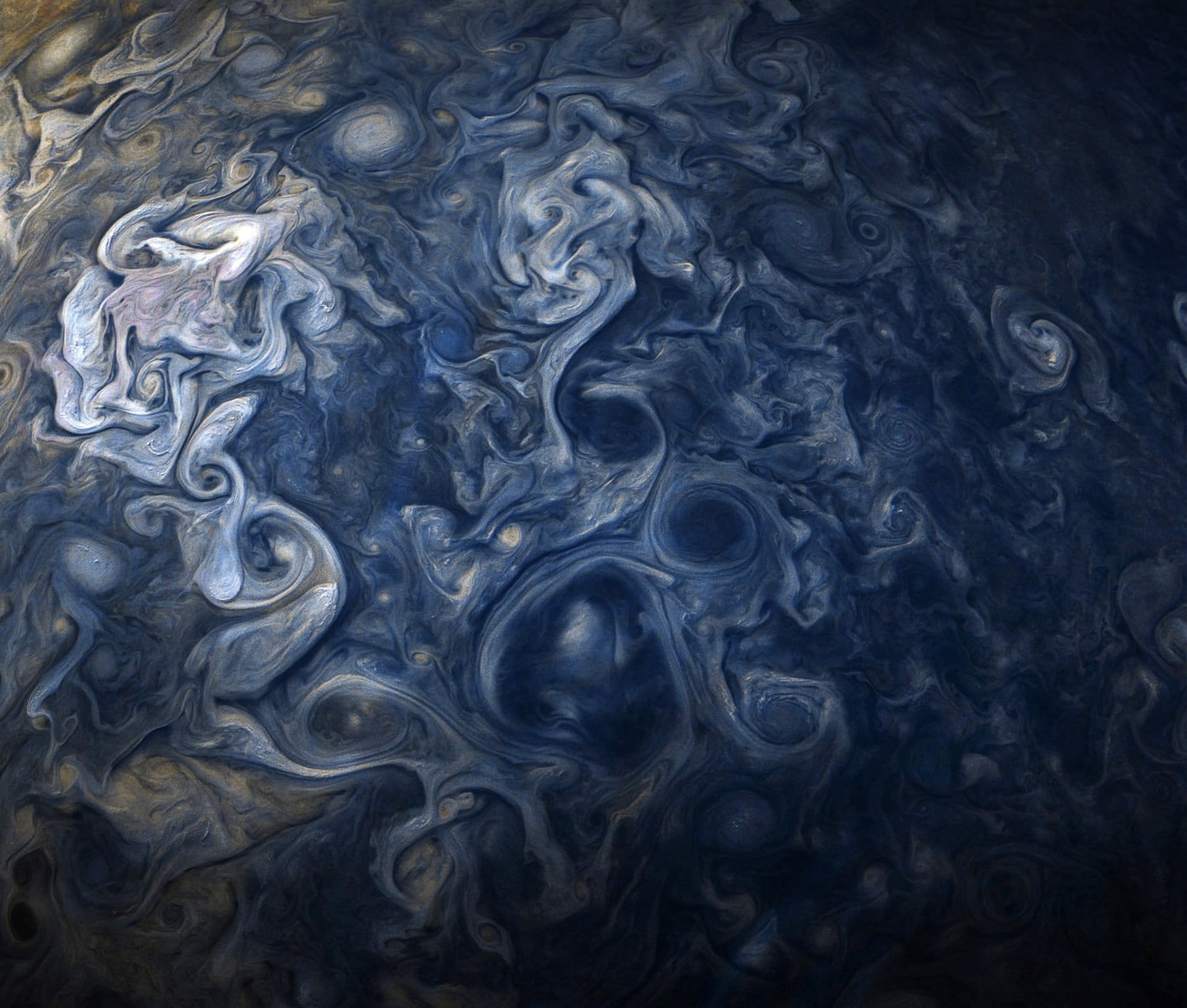
Sarah Salviander is an astrophysicist featured in The Story of Everything (which you can now see on Amazon Prime). Posting on X, she writes aptly and with photographic evidence, “Just your periodic reminder that God made our Solar System a stunner.”
There’s no arguing with that, and it raises an issue treated movingly at the end of the documentary: the problem of beauty. Stephen Meyer told me the other day that that brief sequence receives comments, positive ones, from people who’ve seen the film far out of proportion to the amount of time that’s devoted to it. The beauty of the cosmos and of nature generally cannot be explained in materialist terms. Or more positively, they prompt an inference to design.
Problem of the Peacock’s Tail
Charles Darwin sighed in an 1860 letter to Asa Gray, “The sight of a feather in a peacock’s tail, whenever I gaze at it, makes me sick!” He would later comfort himself with the theory of sexual selection, detailed in The Descent of Man, and Selection in Relation to Sex (1871). But sexual selection cannot explain the stunning beauty of the Solar System, or why the beauty of a peacock’s tail, the iconic ocellus pattern, is striking not only to the peahen but to you and me.
Here is what they say about the problem in Story of Everything:
Douglas Axe: Let’s take a look at what’s around us on planet Earth. Do we see what looks like the bare bones, minimalistic cobbling together something by accident, for the sheer purpose of ruthless survival. Or do we see something much more extravagant, beautiful in its expression?
Stephen Meyer: This is actually a big problem in evolutionary biology. It’s called the problem of gratuitous beauty. Many organisms have beauty beyond anything that’s relevant for their survival.
Richard Sternberg: This deserves an explanation. Many people have tried to give a utilitarian explanation. Oh, yeah, well, it’s some adaptive reason, or there’s some sexual selection, but I think the answer requires something more. The one who realized the answer requires something more was Aristotle. He said, no, it’s the result of some kind of rational structure to the universe. Dare we say, even an intelligence. So the exuberance is one that appears to be designed to elicit our attention. It’s one that seems to be reaching out to us. Now here I am waxing, it would seem to be, mystical.
David Berlinski: I must say that these are observations. They’re appeals to intuition, but not to be dismissed. For that reason, not to be dismissed. There’s something interesting going on.
Stephen Meyer: There’s something in science called the beauty principle that says true theories often convey a mathematical beauty, or structural harmony. Upon looking at their model of the DNA molecule, Francis Crick was quoted as saying, it’s so beautiful, it’s got to be right.
Robert Sheldon: You find all the time in the literature today, people saying, beauty is truth, and truth beauty. If we find a set of equations that is just beautiful, then it must be true.
Timothy McGrew: Sometimes the path toward the truth leads through beauty, and that is an important window. We need to be willing to open that.
“Reaching Out to Us”
I asked Dr. Sternberg about his comment regarding something that “seems to be reaching out to us.” He answered:
I was thinking at the time of Aristotle’s use of Heraclitus’ words (“Here too there be gods”) in Book I, Chapter 5 of Parts of Animals. He was making the point that one should not be ashamed or disgusted by studying even the least of things, however “gross,” for each and every aspect of them — yes, even the slime on your pet snail — has something that is beautiful, capacious, and deiform or “divine.”
You may find the works of the late Stratford Caldecott helpful as a jumping off point, especially his Beauty for Truth’s Sake and Radiance of Being. George MacDonald was also one among many (e.g., Coleridge) who wrote of how God shines through all things — flowers in particular (see his “Flower-Angels” poem).
A link to MacDonald’s “The Flower-Angels” is here. Of course beauty is not found only in nature. George Steiner argued that of all the arts, music above of all poses a mystery, a “mysterium tremendum.” It
speaks to us that there is something else, which paradoxically belongs to us profoundly but somehow touches on a universal meaning and possibility: that we are not only an electrochemical and neurophysiological assemblage, that there is more consciousness than electronic wiring. Music seems to me, more than literature, the great force, the hope of a transcendent possibility.
In the same lecture, which you should take a moment to watch (just over 6 minutes long), he goes on to say that accessing that mystery, that beauty, is why children should be taught a musical instrument. Failing to do so is not far off from denying them the right to see the planets, the stars, or the flowers.