






































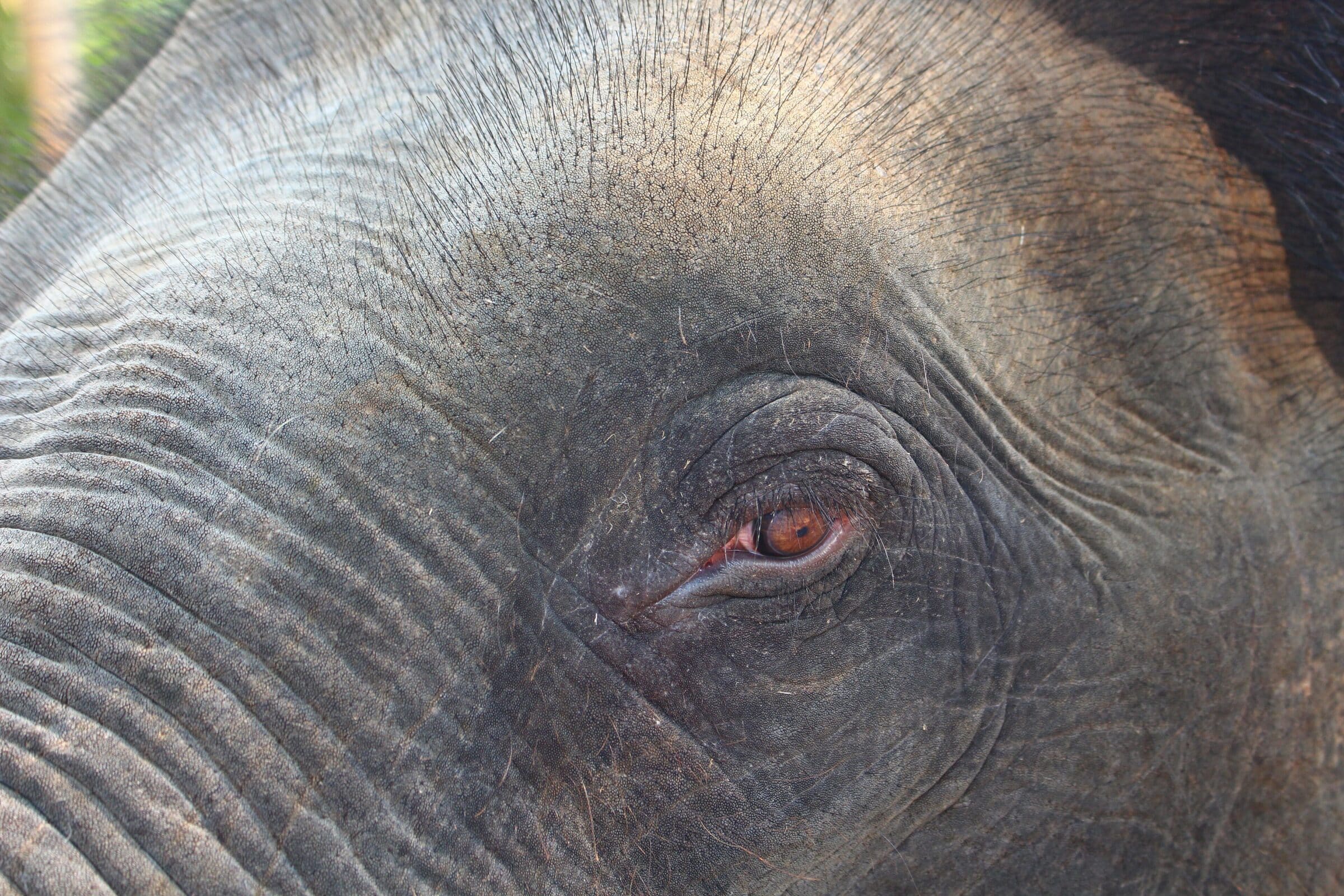
Michael Behe’s Darwin’s Black Box turned 30 years old this past Sunday, August 2. As I reflect on my first impressions of that groundbreaking work, I am struck most by one aspect of it that others might not consider. The concept that has haunted me since I read Behe is not his book’s overarching idea of irreducible complexity per se. What has always stirred me with a deep set of conflicting emotions is his reference to the “elephant in the room.”
Let Me Explain
The fact is that the concept of irreducible complexity originated more than a century before Darwin’s Black Box. Among the idea’s most notable proponents, going back a hundred years, were Alfred North Whitehead and the biologists who followed him in the first half of the 20th century, including Joseph Woodger, C. H. Waddington, Erwin Schrödinger, and more recently Michael Polanyi, Nicolas Rashevsky, and Robert Rosen.
In the first half of the 20th century, neo-Darwinism had not yet become dogma. Speculation about complexity was still considered valid. But then in 1970, the most important biologist in the world, Jacques Monod, declared that all life was reducible and accidental in origin. A legion of acolytes followed to carry on an intellectual purge, including Richard Dawkins, Daniel Dennett, Christopher Hitchens, Michael Ruse, E. O. Wilson, Ernst Mayr, and others. The biochemical revolution was in full swing. Dissent was no longer allowed.
Complexity and Mechanism
I came of age as a scientist just at this time. In the academic milieu in which I spent my formative years, there was no opportunity for doubt. For me, educated and trained at UC Berkeley, UCSF, and UT MD Anderson, there was only one acceptable intellectual framework: scientific materialism, the idea that life’s complexity is reducible to mechanism.
Yet all this time, there was the reality, hiding in plain sight in front of me and my contemporaries. Looking back, my primary emotional response is regret at lost time.
In the ensuing three decades leading up to the turn of the millennium, however, this reality was at least coming dimly into view. The answers that were supposed to be forthcoming, which would explain how to reduce life’s complexity, never materialized. There was then at least some room for doubting the reigning paradigm.
Eugene Wigner once pointed out that Isaac Newton’s greatest achievement was not in deriving the calculus, given that a century of work leading up to it had already been done. Rather, it was that he had the insight to choose the initial conditions necessary to derive his laws of motion.
In the same way, it seems to me that Behe’s greatest achievement was not the discovery of irreducible complexity, because that concept had already been described, as I mentioned. What he did do, with great artistry and insight, was to articulate the concept in the most vivid terms, at a time when there was just enough doubt among at least a few scientists to listen.
Behe illuminated the elephant that was there all the time to for the rest of us to see. But it was something scientists like me were indoctrinated to ignore — until the truth became undeniable.
Behe’s Emancipation Proclamation
In Zen they have a saying, “When the student is ready, the master will appear.”
Behe has played the role of master for many of us who were so confused by the irreconcilable dead ends of materialism that were becoming ever more apparent. Darwin’s Black Box came at just the right time, and restored our vision so that we could finally see the elephant standing there in front of us.
And that explains the other emotion I experience when reflecting on Behe’s book: exhilarating emancipation!