






































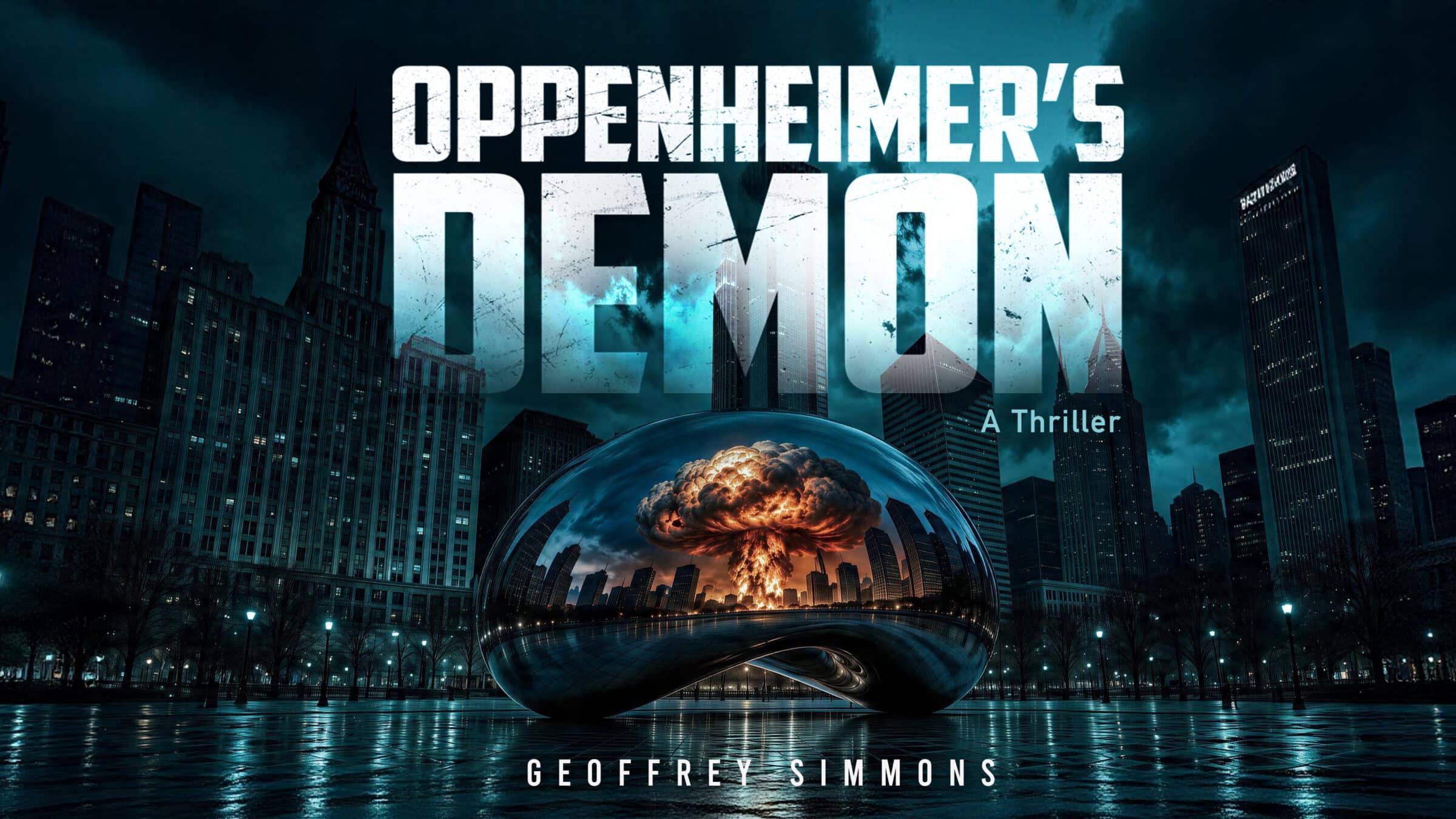
A new novel that’s a thriller with intelligent design as a significant story element: what do you picture? A car chase with Stephen Meyer through the mean streets of the Microsoft campus in Redmond, WA?
An international plot by Richard Dawkins to steal the Rosetta Stone from the British Museum, and by Neil deGrasse Tyson to blow up Mount Rushmore (“They’ll never be able to use these again to illustrate their ID arguments!”)?
Bio-warfare to spoil the workings of the bacterial flagellum (“We’ve got Behe on Line 1!”)?
Don’t worry, Oppenheimer’s Demon by Geoffrey Simmons is none of those. Dr. Simmons is a physician and well-known ID author. He’s also not new to being a successful novelist (thrillers and comic fiction); one of his titles sold 350,000 copies.
His past books have been compared with Michael Crichton’s for “urgency and medical detail.” See some of the earlier praise here. I consider him a friend, but I’m being totally honest when I say this is a tense, compulsive read that, over two weekends when I was reading it, I found difficult to put down.
A Strong Breeze
There was one afternoon when I was reading the book and had also been expecting to hear the Blue Angels, a summer staple in Seattle, roaring overhead. I noticed it was eerily quiet on the street and there was a strong wind through the window. What had happened to the Blue Angels? Had something very serious gone wrong in the world outside? That’s the kind of unsetting question the storyline here prompts you to ask.
(As it happens, the Angels performance had been cancelled due to the wind.)
This is the first thriller to be published by Discovery Institute Press, which was a daring project to undertake for editor Jonathan Witt. It is about trying to avert a catastrophe that would affect Chicago and maybe other places. The justice or injustice of Hiroshima and Nagasaki forms part of the historical background.
The main protagonist is an agnostic, divorced Jewish guy, who is a district attorney and a physician. There is a chaste romance with a Christian gal. However, this is a novel for adults, with a plot that is definitely PG-13.
The Limits of Academic Freedom
The pivotal ID element comes in because a beautiful African-American neurosurgeon is testing the limits of academic freedom, exposing her medical students to evidence of intelligent design, and trying the patience of her Jewish atheist supervisor. If the supervisor gets his way, it will affect her hospital privileges. Because there is currently a very unusual and consequential patient, that could bring disastrous results for a major Midwestern city.
It’s not Proust, but would you really want to read Marcel Proust on intelligent design (“For a long time, I used to go to bed early and think about complex specified information”)? Apart from the comparison with Crichton, Oppenheimer’s Demon reminded me more of a Dan Brown novel. If you like those, as I do, you’ll enjoy this story.
As with Dan Brown, Geoff Simmons takes an area of knowledge that most of us don’t have (in this case, emergency medicine and preparedness), a city he knows well, adds blossoming love, and a spiritual component that will also be unfamiliar and, to some readers (but who?), possibly heretical.
The realism is enhanced by the fact that Dr. Simmons is an expert in the field he’s writing about. He weaves together an amazing number of characters and depicts them individually and memorably, against the backdrop of a ticking timeline that’s registered sometimes minute by minute. It will make your palms perspire.
Science, Culture, and Oppenheimer
Are you wondering why Discovery Institute Press has entered the field of popular adult fiction? As I wrote here, joining science with culture (including literature) is not something that the Center for Science and Culture invented with no precedent. The excellent biography of Robert Oppenheimer, American Prometheus, by Kai Bird and Martin Sherwin, emphasizes that he was a scientist who thought in spiritual and literary terms.
Near the end of his life Oppenheimer was “pondering man’s survival in an age of weapons of mass destruction,” giving “public lectures, most often in university settings, and usually he dwelled on broad themes related to culture and science.”
It makes more sense than it might seem at first that Discovery Institute would branch out to stories like Geoff Simmons’s that probe those themes. Oppenheimer’s Demon is a venture down Oppenheimer’s own path — a gripping and suspenseful one, as I told Geoff when I was less than halfway through.
He texted back, “I was going to tease you and tell you everyone dies at the end of my book.”
Was that a joke, or actually true? I wasn’t sure. You’ll have to get you own copy to find out.