






































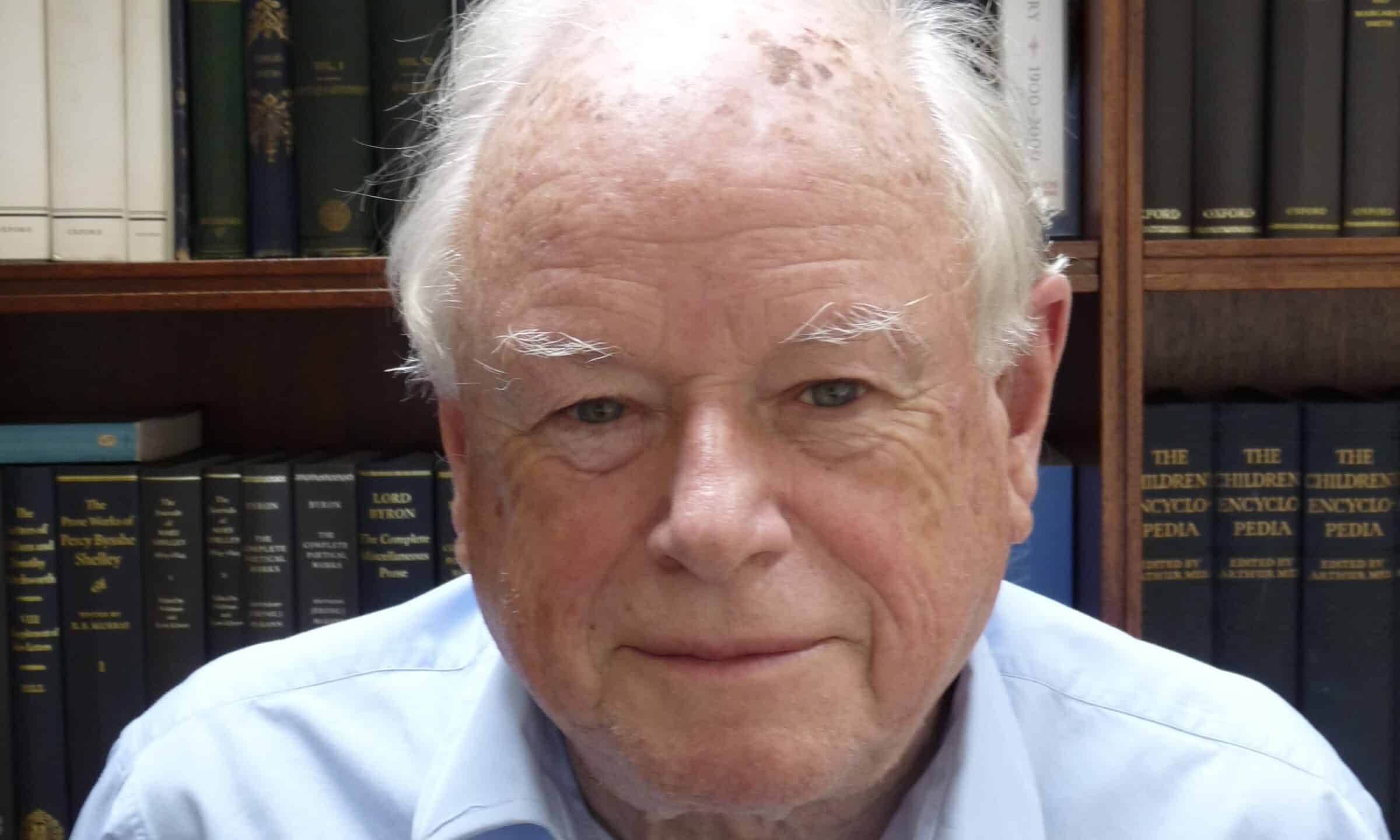
The English philosopher Sir Anthony Kenny has died at age 95. He is lovingly remembered as a prolific scholar, a formidable debater, and a steady administrator who oversaw a variety of academic preservation projects, including the first digitizing of Oxford’s libraries. In a former life, he was a Catholic priest, which he abandoned after a crisis of faith. Many priests would see no reason not to continue dishonestly in their vocation after such a crisis, but dishonesty was never Anthony Kenny’s way, and Christians and atheists alike respected him for it.
An Honest Opponent
Kenny’s academic contributions ranged across philosophy of mind, philosophy of religion, and other areas. His best-known critical work against theism is the book The Five Ways, which takes aim at the classic Thomistic arguments. He considered himself agnostic on theism in general, though not on the immortality of the soul, which he thought he could decisively rule out. Catholic philosopher Edward Feser writes frankly though admiringly that he always thought this was Kenny’s weakest work. Still, right or wrong, for Feser he was always worth reading, and unlike his New Atheist peers he “never resorted to cheap shots or glib dismissals,” which extended to a generous review of Feser’s own work.
Kenny wrote a spiritual autobiography about his deconversion, A Path from Rome. In later life, with characteristic humility, he declined a publisher’s invitation to keep writing about himself but instead published the delightful Brief Encounters, collecting snapshots of other interesting characters he had met throughout his career. Those who follow the intelligent design debate will find his anecdotes about Denis Noble and Richard Dawkins of particular interest.
Noble once chaired a meeting in which Kenny pressed Dawkins on his selfish gene theory. As a convert from the “reductionist” view of biology, Noble occasionally jumped in on Kenny’s side. Kenny, a lifelong anti-reductionist, was gratified by Noble’s evolution (as it were) away from an overconfident materialism, though neither of them ever made the leap to theism. When Noble organized his watershed 2016 conference on new trends in evolutionary biology, Kenny was proud to lend an administrative hand in its early organizing stages.
Kenny’s relationship with Dawkins, however, was on the pricklier side.
A Meddling Chairman
Moderating a popular Sheldonian debate between Dawkins and then-Archbishop of Canterbury Rowan Williams, Kenny sat in the agnostic’s chair between them. But he said he became so irritated by the “feeble” quality of the arguments Dawkins was getting away with that, like Denis Noble, he couldn’t resist jumping in to give the Archbishop a philosopher’s assist. When Dawkins repeated his favorite chestnut about the impossible complexity of God, Kenny noted that Dawkins had never distinguished between complexity of form and complexity of function. A “cut-throat” razor may be much simpler in form than an electric razor, but it’s more complex in function — it can shave you, but it can also cut your throat!
A very ruffled Dawkins complained later about the “meddling chairman” and his training in “obscurantism.” Whether this was aimed at Kenny’s philosophical training or his former theological training is unclear. Either way, once comfortably agnostic, Kenny had no interest in trying to persuade Dawkins of God’s existence. As he put it in conversation with Justin Brierley and Lord Richard Harries on the Unbelievable? show, he merely wanted to point out that Dawkins’s atheist arguments were no better than the theist’s arguments.
In fact, Kenny was a fan of Dawkins’s less popular science writing like The Extended Phenotype, and he recalled in Brief Encounters that the two of them “always got on amicably face to face.” However, this didn’t stop them from sometimes being “rude” to each other. Kenny teased the biologist over dinner after the Sheldonian debate about how with The God Delusion, his work had moved from the equivalent of the Financial Times to the equivalent of The Sun: punchy, but sloppy and unserious. “This did not go down well,” Kenny remembers, “and led to a frosty exchange of emails.”
The Map Home
Kenny still appreciated a good church service and sometimes even did readings from the breviary. But when Justin Brierley asked if he felt himself at all “Christ-haunted,” he said no — more simply “God-haunted.” He was moved by the work of Arthur Hugh Clough, a poet who like Kenny lost his faith and wrote that “We are most hopeless who once had most hope.” While Kenny never felt he could return to what he regarded as a false belief, he related to Clough’s sense of loss and nostalgia.
Unusually, Kenny argued there was no reason why an agnostic shouldn’t pray. After all, “if you’re stranded on the mountainside, you may cry for help, even though you have no idea whether there’s anyone in earshot. And that is how I feel myself when I do pray.”
For Kenny, the mere existence of multiple religions was an argument against theism, as he couldn’t see why God would give only a select few the map home. But when he prayed, he prayed for “enlightenment” about God’s existence. Surely that prayer was heard, like all honest prayers.