






































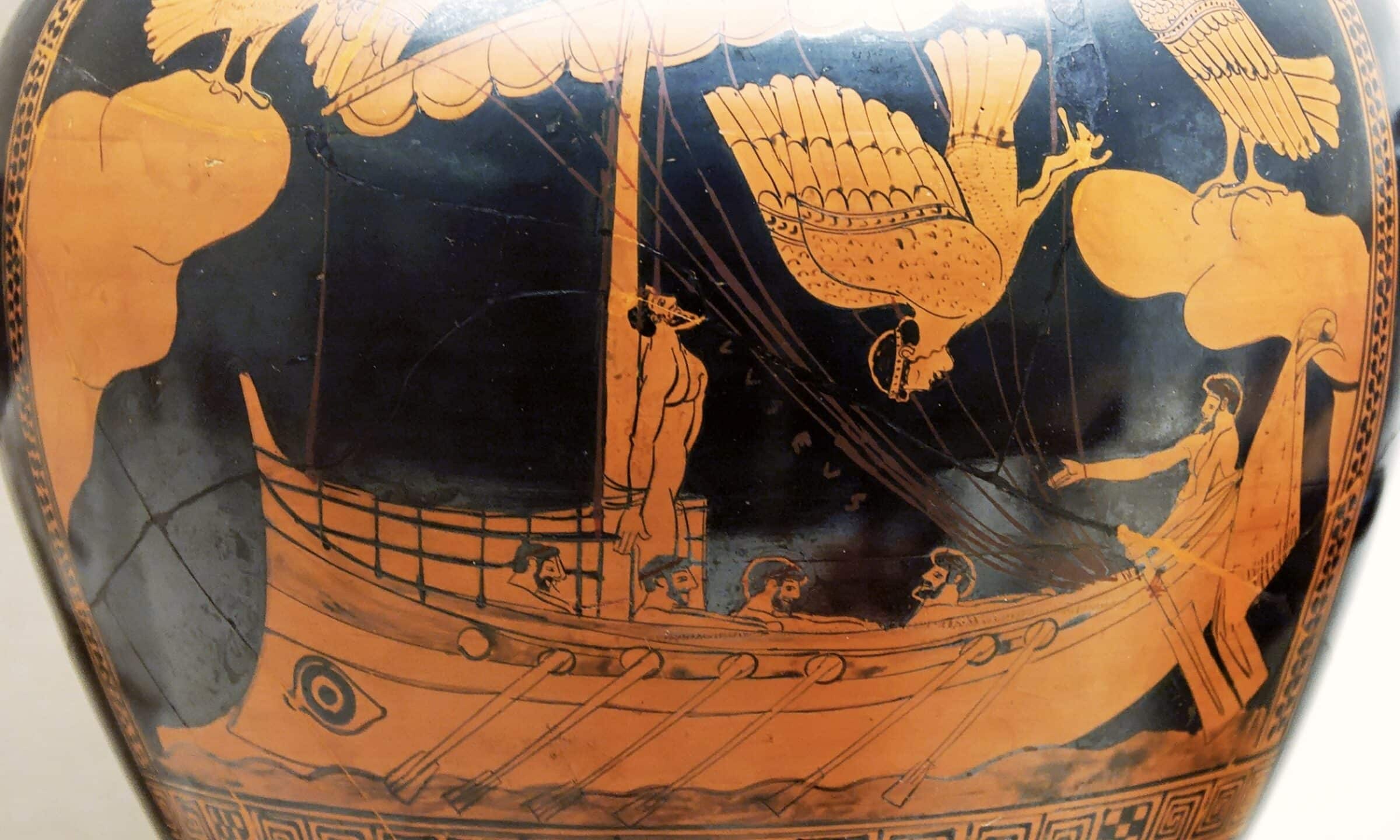
Christopher Nolan’s Odyssey opens with a title card that could be read in two contradictory ways. “In a time of apparent magic” could mean either that the magic of the story only appears to be real, or that the magic is making itself clearly evident. Which one does Christopher Nolan mean? That’s for the viewer to decide.
Nolan likes to play magic tricks on his audience. The Prestige, a dark and twisty tale of two obsessed rival magicians, depends for its payoff on where the jiggery-pokery ends and the real magic appears. One man makes terrible sacrifices to keep up the mere illusion. The other makes sacrifices still more terrible to deliver the genuine article. He acquires his forbidden knowledge on a fateful visit to a reclusive Nikola Tesla, chillingly performed by David Bowie. In Nolan’s supposal, the mad scientist takes on the mystique of a wizard.
Perhaps this is fitting, given that Nolan sees science and wizardry as two words for the same thing.
Is it Zeus or Is It Science?
In a viral interview with young Chinese philosopher Yiyang Zhuge, Nolan talks about how for the ancient Greeks, belief in the gods was more like a matter-of-fact acceptance of reality than an article of faith. It was simply assumed that Zeus must have sent down the lightning bolt, Poseidon must have sent the stormy waves, and so on. In the same way, we now simply accept the scientific structure of the universe as fact. At least this is Nolan’s stock modernist assumption, although scholars like Eric Steinhart would point out that Nolan actually speaks for a minority of the contemporary public. In fact, it might surprise Nolan to hear how pagan some philosophers and scientists sound behind closed doors when they discuss the nature of reality. Steinhart’s Cambridge Elements book Contemporary Pagan Philosophy openly argues for the actuality of the gods and of mythical creatures in general.
Curiously, Nolan says even we “can’t really know” the claims we are handed as absolute fact, like “The earth is round,” or “The earth revolves around the sun.” It’s unclear how he would define “knowledge.” If he means “100 percent certainty,” that would be trivially true, but it’s not very interesting. More interesting (and more provocative) is the challenge long posed for something like the evolutionary paradigm to deliver “knowledge” even at the level of confidence beyond reasonable doubt.
But Nolan seems more than happy to receive whatever the high priests of science deliver to us as absolute fact. In his 2023 acceptance of an award from the Federation of American Scientists, he breathlessly praised scientists as the ultimate truth-seekers, the keepers of a discipline uniquely unspoiled by an “agenda” or “politics.” He channeled Dawkins as he asserted that only science “seeks to disprove itself,” and that no one in the world except the scientist is proud to admit when he’s wrong, because it means he’s learned something. (Anthony Fauci was not available for comment.)
All in Our Heads?
In his review of Interstellar, Brad East observed that given the chance to introduce the concept of the alien or the divine, Nolan instead chose — in typical Nolan style — to twist the plot into a Mobius strip in which the human characters write their own fates. “Nolan bent time and space only to turn humanity in on itself (incurvatus in se), the finger of Adam and the finger of God extending from one and the same outstretched arm.”
For The Odyssey, it was only predictable that Nolan would mostly keep the gods offscreen, not just for Nolan-specific reasons but for reasons of trying to adapt the work without devolving into campy silliness. (Watch the Armand Assante version from the ’90s for the Marvel approach, including a sassy floating Hermes.) However, a much-reimagined Athena periodically shows up to justify the ways of the gods to Odysseus. Or at least, she appears to. In modern fashion, Odysseus complains that the gods feel distant and inscrutable, wondering why they can’t “speak in ways we understand.” The Athena vision shoots back, “Who doesn’t understand thunder? Fire? A child’s smile? A good harvest?” This seems to imply that they do act — just at a distance.
Or do they? The movie’s third-act reveal suggests the possibility that perhaps Athena has been a manifestation of Odysseus’s own guilt this whole time. And yet, there is also an ominous sense throughout that Odysseus and his men are being hunted by some force or forces beyond their control. What does this mean for the theological structure of the film? In his interview with Yiyang Zhuge, Nolan says that “for me, the gods are real, but they are inside the people. They are being projected by the people.” But then it would seem they are not in fact real. Nolan seems now to be channeling Jordan Peterson: “It depends on what you mean by real.”
Are You There, God?
It may be anachronistic for Nolan’s Odysseus to have a crisis of faith, but in the modern era much ink has been spilled about the nature of divine action and why the universe now seems so “disenchanted.” Now that we have a natural explanation for the lightning, the billowing waves, and all the rest, are the gods — is God — out of a job? Does it even make sense to pray for rain or a good harvest and see them as a blessing, or to see a flood or a drought as a curse?
When theistic evolutionists strawman intelligent design and frame it as a “science-stopper,” it seems that they envision something like the original Odyssey — as if we believe God is constantly hovering behind the action, ready to jump in on a divine whim and assist a “teacher’s pet,” avert disaster, cause disaster, or perform some other frivolous “magic” as the mood takes Him.
But within a well-ordered theism, God is not a fickle Greek deity, and we are not His playthings. God has designed a natural order for the world, allowing both for natural blessings and natural disasters. These are all in some sense “from God’s hand,” in that God created the entire mechanism that gives rise to them. But God is uninterested in upsetting science experiments merely because He can. At the same time, this does not bind us to a dogmatic methodological naturalism, where all observable phenomena must be given a natural explanation, however strained and however obvious the limitations of the natural order.
To hear Christopher Nolan talk, you would think we are forced to choose between that dry, disenchanted naturalism and ancient chaotic polytheism. There’s no time like the present to remind people of a better alternative.