






































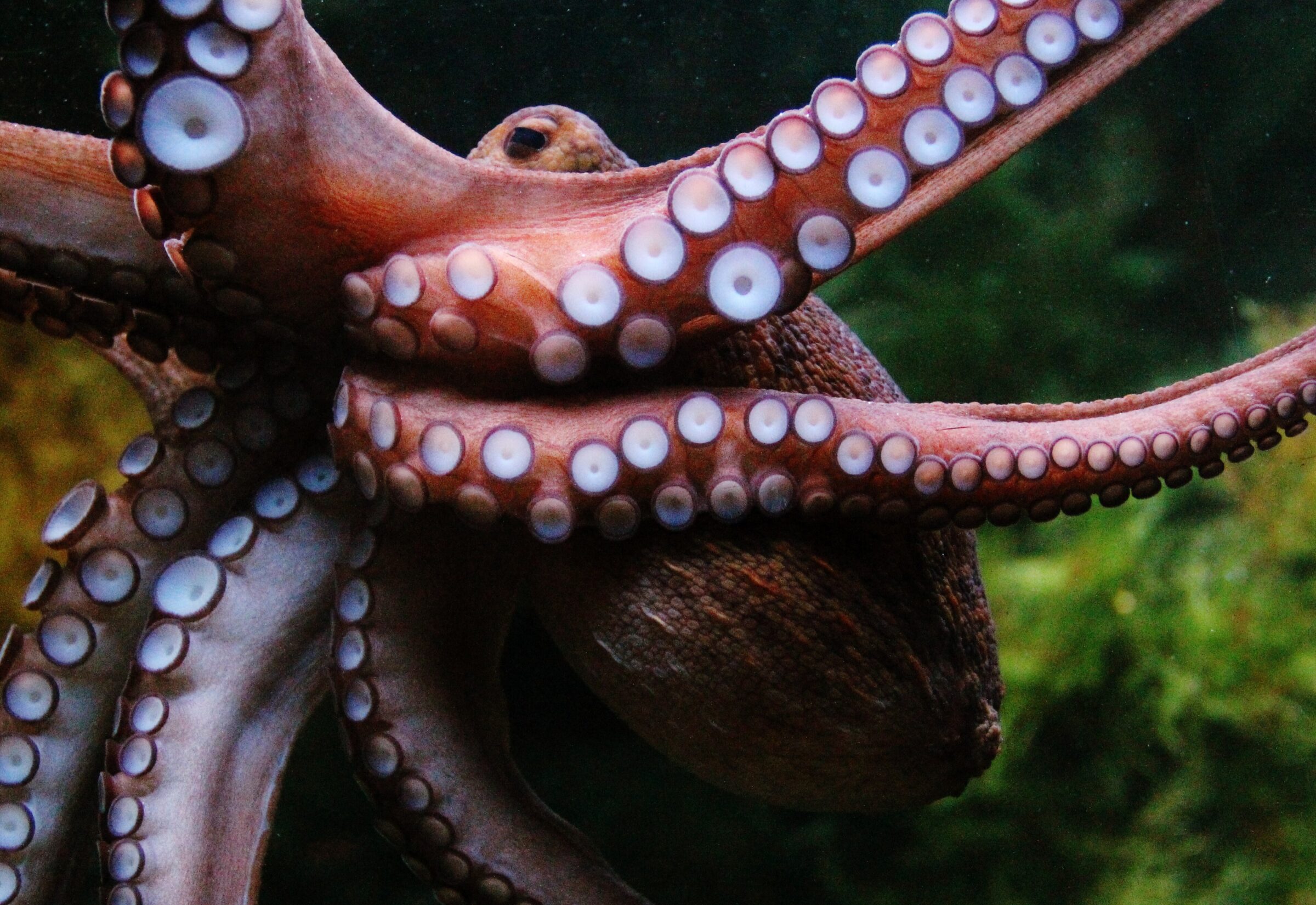
The octopus (also other cephalopods like squid and cuttlefish) is known to be quite intelligent. But in other respects, this group is an extreme outlier compared to other intelligent animals.
A Strange and Fabled Brain
At ScienceAlert, Jess Cockerill points out that its strange and fabled brain is once again in the science spotlight:
Biologists have long believed that having a large brain, relative to your body, might go hand-in-hand with being part of a particularly social species.
This is called the social brain hypothesis, and it holds up pretty well for a particular branch of the animal family tree: ours.
We share this branch with a number of other social animals: hoofed herd animals like sheep and goats; pack carnivores, like wolves and lions; whales; dolphins; bats; primates; and possibly birds too.
All of these animals tend to follow the relationship described in the social brain hypothesis: Bigger social circles correlate with bigger brains, specifically with the mammalian neocortex.
“Octopus Brains Defy a Long-Held Rule About Why Animals Evolve Intelligence,” July 9, 2026
The mammal and bird life forms mentioned here share some additional qualities as well. For example, we are all endotherms (our body temperatures are not governed by the environment). The octopus is an ectotherm (its temperature fluctuates with the environment).
Intelligent mammal species are often related to other intelligent mammal species (whales and dolphins, for example). The cephalopod is related to shellfish. Thus it has sometimes been called a “second genesis” of intelligence and scientists still clash over why it is so smart. They raise an origin of intelligence conundrum.
Asocial Brain vs. Social Brain
Notoriously, as Cockerill reports, the cephalopods are loners that avoid, attack, or eat each other and they die shortly after laying eggs — which means they don’t have or need social or parenting skills. So why the big brains?
She profiles a new open access paper published in iScience that offers a new approach: Their habitat rather than their social needs may be driving the growth of the brain (the asocial brain hypothesis). They found that larger brains in cephalopods were associated with more calorie-rich, shallower ocean environments. Perhaps those environments provide more opportunities for creative problem-solving.
“This should remind us that scientific dogma always needs to be questioned, and that once again it shows that cephalopods don’t follow the predictable evolutionary paths,” octopus psychologist Jennifer Mather from the University of Lethbridge, who co-led the study, says.
Of course, this research still ultimately relies on correlation. But it does suggest there’s more to brain size than a species’ level of sociality.
“Evolve Intelligence”
The research mainly shows that there is more than one route to animal intelligence and shaking up Darwin’s tree can be productive.
Curious Facts About Octopus Brains
The octopus has about the same number of neurons as a dog (500 million) but they are mostly dispersed in the eight arms. Each of the octopus’s arms has its own brain but the ninth, central brain is able to assert control. Lisa Hendry at Britain’s Natural History Museum notes,
This was proven experimentally in 2011 when researchers tested whether an octopus could learn to guide one of its arms through a maze to reach food. The maze was designed so that the arm would have to leave water — and so not be able to use its chemical sensors to find the food. Transparent walls enabled the octopus to see the food. Most of the octopuses were eventually successful at guiding their arm to the food — proving that the central brain, which processed the visual information, could control the arm.
“Octopuses keep surprising us — here are eight examples how”
They can use a mirror to find food out of sight and are well known for tool use and remarkable escapes.
Then there is the octopus who organizes packs of fish to help it hunt …
Could such different, complex, and highly unlikely neurology simply evolve by natural selection acting on random mutation? Let’s hope they’re serious about scientific dogma needing to be questioned.
Cross-posted at Mind Matters.