






































Editor’s note: We are delighted to present this excerpt from Chapter 7 in the new book Epigenetics and the Architect: Evidence of Design at the Frontier of Biology, by Thomas E. Woodward and James P. Gills, MD (Discovery Institute Press).
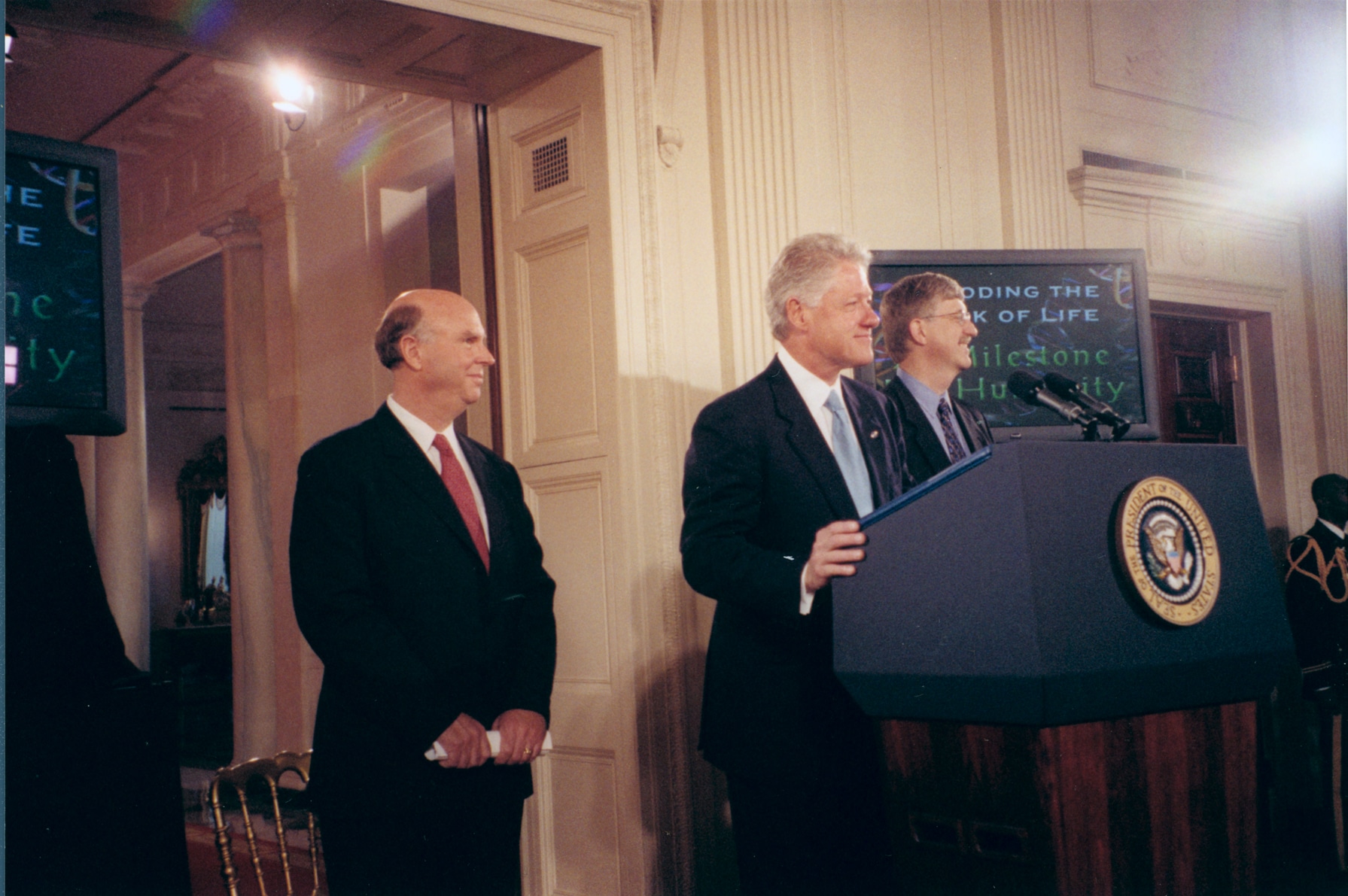
Since the White House announcement in 2000 celebrating the completion of the Human Genome Project (pictured above), work by William Dembski, Michael Behe, and Stephen Meyer has been joined by scores of other books and several hundred peer-reviewed articles adding to the case for intelligent design. These writings have sparked a variety of responses from scientists and scholars. Many of the responses come from evolutionists, some of them outraged that anyone questioning modern evolutionary theory would be taken seriously. Some of these critics characterize ID as a threat to America’s leadership in science.
But in 2012 the eminent philosopher Thomas Nagel published Mind and Cosmos (Oxford University Press), and he placed a once verboten thought squarely in the subtitle: Why the Neo-Darwinian Conception of Nature Is Almost Certainly False. The atheist Nagel was not a figure who could be easily mischaracterized as an uninformed creationist crackpot. Then, in 2016, the oldest and arguably most prestigious scientific society in the world, the Royal Society, met to discuss a possible new path for evolutionary theory. In the course of the meeting, various scientific luminaries frankly admitted that the neo-Darwinian synthesis was in a state of crisis. After this, the rancor against ID subsided somewhat.
“For Bridge-Building”
Even before that, Harvard University geneticist George Church was pushing for more open-mindedness in the evolution/design debate. Of Meyer’s second book he commented, “Darwin’s Doubt represents an opportunity for bridge-building, rather than dismissive polarization — bridges across cultural divides in great need of professional, respectful dialog — and bridges to span evolutionary gaps.” Also notable was the reaction of paleontologist Mark McMenamin of Mt. Holyoke College: “It’s hard for us paleontologists, steeped as we are in a tradition of Darwinian analysis, to admit that neo-Darwinian explanations for the Cambrian explosion have failed miserably. New data acquired in recent years, instead of solving Darwin’s dilemma, have rather made it worse. Meyer describes the dimensions of the problem with clarity and precision. His book is a game changer.”
 Image source: Discovery Institute Press.
So, with all that as background, one may ask, where did the cell’s genetic information come from in the first place? In answering the question, one might choose to foreclose any explanation that is out of step with philosophical materialism. Or one might choose to keep an open mind and consider two competing answers: (1) Nature’s information arose gradually through the interplay of matter, energy, time, and chance alone; (2) Some sort of intelligent agency was crucially involved.
Our Uniform Experience
A key part of intelligent design methodology is to discern the uniform cause-and-effect patterns at work in the present and let these guide us in discerning the causes of various past events in the history of life and the universe. This uniformitarian principle needs to be carefully applied, of course. Here is how ID theorists use the uniformitarian principle in connection with DNA: In our uniform experience, we see coded language and information-packed strings of letters arising only from intelligent causes, never from mindless causes. It follows that coded language and information-packed strings of DNA arose from the same kind of cause — intelligence.
This conclusion follows the uniformitarian principle but also, more broadly, a mode of scientific reasoning common to science, known as inference to the best explanation, elucidated by Peter Lipton at Cambridge University and discussed in an earlier chapter. You may recall the Scrabble illustration in which you come home to the Scrabble sentence TAKE OUT THE TRASH AND WALK THE DOG BEFORE PLAYING SCRABBLE. This is just a string of 49 letters, ten spaces, and a period. Obviously it is an artifact of design, and yet its specified complexity is dwarfed by the highly organized genome of the simplest known bacterium (Nanoarchaeum equitans) with its genomic hard drive of 490,885 DNA letters organized with precision into 552 separate gene files. And to progress from this bacterium (containing a half megabyte of genetic information) to one of the insect-like arthropods among the Cambrian fossils would require a jump to over a hundred megabytes of DNA information and thousands of genes. Are we to believe that all these new genes were produced by random throws of the genetic dice and preserved by natural selection?
One might appeal to the fact that Earth and the universe possess vastly greater probabilistic resources than Scrabble letters in somebody’s home, but venturing there takes one onto thin ice. Douglas Axe’s peer-reviewed work on proteins suggests that blind evolution lacks the probabilistic resources to generate even a single novel, functional protein type, never mind all the novel forms of life on our planet, each requiring scores of novel proteins working in concert. And that work has been confirmed by the work of other researchers.
Codes Upon Codes: Meet the Supercomputer
This challenge to evolutionary theory is compounded by the discovery of the magnificently intricate epigenome. The epigenetics revolution means we now know that much of the biological information essential to cellular function isn’t editable via random genetic mutations in DNA and thus is inaccessible to the Darwinian mechanism.
We find ourselves confronting numerous libraries of epigenetic information that work together to control the expression of DNA — libraries essential for life. This matrix of additional codes, grouped together under the epigenome umbrella, has come into focus only in the past thirty years. The sheer number of distinct biological codes that have been discovered is remarkable. Besides DNA’s code, we see the methyl code, the histone code, the sugar code, the cortical inheritance and zygote codes, the gene body code, the origami code, and the enhancer code. The list of known biological codes, all of which must interact harmoniously for life to persist, has exploded. Two years ago, the German evolutionary biologist Robert Prinz noted this trend and produced a database of thousands of peer-reviewed articles from the past fifty years on biological codes. The online resource lists 237 biological codes.
Is Prinz Serious?
Does he really mean that well over two hundred biological codes have been discovered? We should ask if all the codes he identified deserve to be called codes when fully understood. Prinz used a word-search function in exploring published articles, and certain biological patterns were called codes when the use of that word was meant perhaps only very loosely. Some of these biological codes are code-like in some respects but not true codes. Some function more like cogs in a grandfather clock’s mechanism than like information-bearing letters in a code.
After making these and other adjustments to the list, we estimate that the number of distinct biological codes drops from 237 to about 160. Next, out of an abundance of caution, let’s take that conservative estimate and cut the figure in half, giving us eighty codes. Now, for good measure, let’s divide the figure by two again. That still leaves us with forty codes.
So we are confronted with at least forty interacting biological codes, coordinated symphonically to make life possible. This bespeaks a staggering degree of cellular sophistication. What cause can explain such a molecular universe of ultra-engineering other than a master architect of the system who created these interacting codes?
Berkley Gryder, working in an epigenetics research laboratory at a major university, describes the human cell as a “supercomputer.” He asks if mindless processes in nature have the ability to design and manufacture a supercomputer. To attempt to describe a cell’s complexity, he sets it alongside a smartphone. The technology packed into these devices has progressed rapidly, so that smartphones now possess a functional density that even many science fiction novels set in the high-tech future failed to anticipate. But compare the functional density of this high-end cell phone to that of a human cell. If we represent a new iPhone’s functional density as reaching to the top of a yardstick, the greater functional density of a human cell would reach some five hundred million yards high. The measuring stick would stretch into space — all the way to the moon and beyond. We submit that it is in no way irrational to infer that the best explanation for such technology is not a blind and mindless process but rather an extraordinarily intelligent architect.
DNA Tagging — Epigenetic Nitty-Gritty
Finally, there are several ways epigenetic tagging reveals the signature of a creative intelligence. First, consider the discovery of many different DNA tag maps (including histone tag maps), used to locate epigenetic information in individual types of cells. If the single genetic code arrayed in each human cell is impressive, what about the two hundred or more methylation code maps, a different one for each cell type? Each methylation map in a typical cell in the human body has between one hundred million and two hundred million methyl tags, precisely placed on certain genes. And beyond those maps we have the challenge of mapping the methylation, acetylation, and phosphorylation of a cell’s histones.
Recall the irreducible-complexity challenge posed by biologist Michael Behe, considered now in the light of the cell’s epigenetic tagging systems. Think about the methylation and demethylation processes, which switch genes on and off as needed, working with the millions of methyl tags attached to different sections of DNA in a human cell. If we study in detail the process that handles methylation, we find it brimming with examples of irreducible complexity.
All source notes are contained in the published book.