





































At the New York Times, the science story of the day:
A professor at a prominent university writes in to us to taunt Dr. Tour about this:
So Fellow James Tour and you folk STILL claim the evil materialist scientists are “clueless” about the origin of life?
(Easy fact check: James Tour isn’t a Fellow of the Center for Science and Culture.)
What’s This All About?
It’s a silly comment if the professor has actually listened to Dr. Tour. Tour’s main point is that to get origin-of-life scenarios to work you would need active guidance and control by the scientist… not an unguided process.
The idea is simple. From, “A Chemically Defined Synthetic Cell Capable of Growth and Replication,” at Biotic:
Building ribosomes from genetic instructions. SpudCell currently uses ribosomes from E. coli bacteria. Without the capability to remake ribosomes, SpudCell runs for 5-10 generations before the machinery degrades. Building ribosomes from scratch means synthesising dozens of proteins and RNA molecules, then getting them to assemble in the right order.
Um…so it’s borrowing ribosomes from real cells but can’t make new ones, so it dies. That doesn’t sound like it’s from scratch, doesn’t sound like a minimal cell, and doesn’t sound like a real cell.
Are We Missing Something?
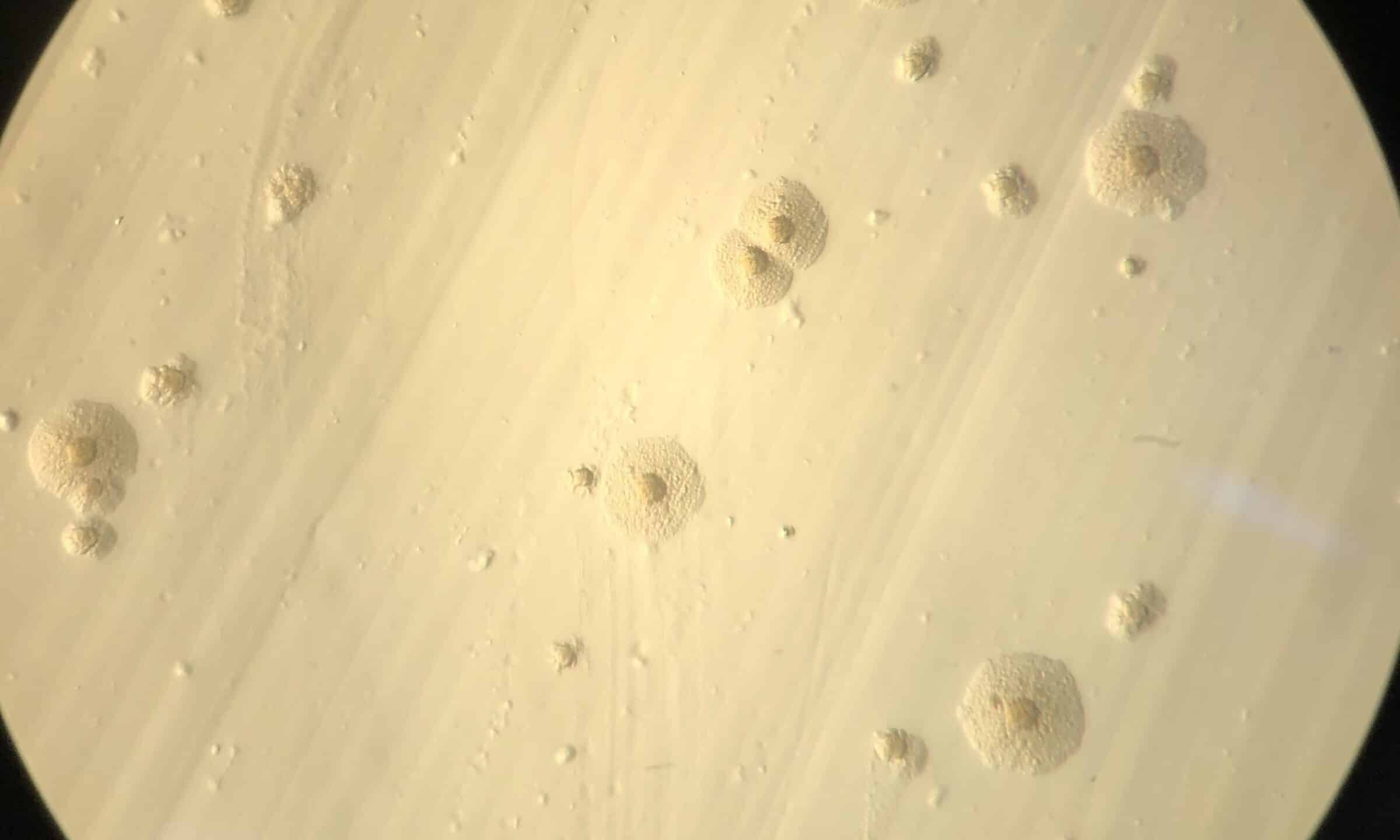
Well, Nature has already found all the ways there are of being a cell. She, if we may personify her, has eliminated hundreds of genes and proteins for obligate parasitic bacteria like Mycoplasma (pictured above), for instance, found workable symbioses for others, collectives, you name it. If a cell loses parts that it can’t do without, that lineage will either go extinct or go viral — meaning, find another group of cells where it can borrow parts (typically, ribosomes). There will be no viruses on Mars, or anywhere else, unless there are also cells on Mars.
So a synthetic cell lineage contrived by humans will (necessarily) need to copy what Nature has already done, or fail. She has already run the experiments, literally countless times on Earth’s surface since life began. Nature long ago located the lower bound of cellular complexity, because anywhere below that will be dead, a virus, or a failed human experiment. If cells could be simpler, they would already exist.
Synthetic biology will end up, to the degree that it actually succeeds, in being Sophisticated Plagiarism Biology.
We genuinely admire what the Adamala lab at the University of Minnesota is able to do, but we are pretty sure we know where they’re going. Their inevitable destination looks a lot like cells as we know them.