






































Editor’s note: We are delighted to present this excerpt from Chapter 4 in the new book Epigenetics and the Architect: Evidence of Design at the Frontier of Biology, by Thomas E. Woodward and James P. Gills, MD (Discovery Institute Press).
Ever since scientists first spotted the new molecular continent of the epigenome and began landing on its shores, strolling its sunny beaches, and penetrating its dark and mysterious forests, there has been no end of surprises. This voyage of discovery has been intimately connected with the question of how a stem cell — in our case, a fertilized human egg cell with its vast store of information encoded along the DNA molecule — can differentiate into all the types of tissue in a body.
For example, the human shoulder contains hundreds of billions of cells and various types of tissues, including muscle fibers, nerve networks, and bone structures. Every component is brilliantly aligned and interconnected to achieve exquisite functionality, with each tissue having its role to support and aid the joint’s movement. The shoulder’s formation begins modestly, at the molecular level. During development, each cell must perform flawlessly to ensure that the shoulder properly matures, even though the very first cell of a human being — the zygote that comes from the merging of egg and sperm — has a host of tasks radically different from building the bone, nerve, muscle, and skin cells of a shoulder. What enables the necessary cell differentiation and placement? What builds the complicated structural network? What sets up the unique life of each specialized cell within that system? As it turns out, the epigenome is key to this process.
Key to the Process
As development progresses, each cell is directed to unique use of its DNA files by the epigenetic system, which sits above the DNA while maintaining intimate contact with its genetic riches. This by itself represents a revolutionary discovery. But as scientists have made progress in pinning down the functions of the epigenome, another revelation has emerged. Each of us carries within his or her body more than two hundred versions of the epigenome. It has to do with the myriad of cell types in our bodies. Even on very conservative estimates, the human body contains hundreds of cell types (e.g., blood cells, skin cells, bone cells, nerve cells). And while they all have the same basic genome, each cell type has a unique set of epigenetic software, tailored precisely for that cell type. This fact may be the biggest shock to emerge from epigenetic studies.
Epigenetics researcher Berkley Gryder notes that if we include all the developmental stages of the cells in a human fetus, the number of separate epigenomes would be astronomical — in the many thousands. So, while the Human Genome Project had only one genomic informational system to map, a Human Epigenome Project would have a far more daunting task. If one includes in the count the differing epigenomes for the different transitional cell states, such a project would have to survey and map several thousand systems.
 Image source: Discovery Institute Press.
A daunting prospect, but scientists have responded to the challenge. As a start, the National Institutes of Health has overseen a project called the Epigenome Roadmap, whose opening phase mapped 111 cell types, while ENCODE scientists mapped another sixteen, giving investigators a total of 127 epigenetic maps. ENCODE released its breakthrough findings in 2012 with the publication of about thirty papers in various scientific journals, including Nature, reporting that about 80 percent of the genome is biochemically functional. Researchers investigated other cell types in the subsequent decade, cracking still other epigenetic codes.
Recent studies confirm that the control processes are directed from an information network outside DNA, directed in order to maintain health in the entire organism. The paradigm-shifting realization has now sunk in: DNA alone does not play the role of the cell’s director. It is, itself, directed by a system higher in authority.
Revisiting the Construction Engineer
Though the terms epigenome and epigenetics were largely unknown to those outside the field of genetics at the start of the new millennium, by 2009 the epigenetics frontier merited an article in the New York Times. In “From One Genome, Many Types of Cells, But How?” science writer Nicholas Wade noted, “One of the enduring mysteries of biology is that a variety of specialized cells collaborate in building a body, yet all have an identical genome.”
As he went on to explain, scientists have concluded that in order to develop the brain, liver, bones, heart, and many other structures, there must be a different set of hereditary instructions above and beyond the DNA, acting to “open up” key lines of script in each cell, while making other lines functionally invisible. Wade compared the varied tasks of human cells to a situation in which different actors read from the same master script while additional instructions, outside the script, block the actors from seeing the parts that do not pertain to them. Within a collection of living cells, the individual cells, analogous to the actors, do not see the entire DNA script — that is, the entire set of genes. The portions of the DNA script irrelevant to a particular cell are closed off by epigenetic markers.
As the geneticists quoted in Wade’s article explain, the epigenome controls access to the genes, blocking many genes while allowing each cell type to activate its own special genes. Researchers have further concluded that the epigenome is involved not just in defining what genes are accessible to each type of cell, but also in directing the process of activating the accessible genes.
Thus, the epigenome directs DNA to create many different types of tissues in the body from one stem cell. If each person has more than two hundred distinct versions of the epigenome and thus as many distinct orchestral conductors deployed in different kinds of cells, each with a distinct musical score, this raises crucial questions. How are the many different versions of the epigenome established in the first place? And how are they rewritten after the initial epigenome begins its directing activities in the zygote? What system directs the rewriting of the epigenomic system itself? To put it simply, how do so many epigenetic directors unfurl from a single, fertilized egg cell?
The Zygote Code
This is a complex process that must happen dozens of times, as cells are differentiated from their starting point. Based on responses from the geneticists Wade interviewed, he says the DNA rewrites the epigenome when needed, and the epigenome redirects the DNA usage in new ways as new cell types emerge.
Without completely rejecting this circular cause-and-effect pathway (we’ll assume there’s some truth to it), it seems an odd description of causality. What Wade does not mention is the foundational role of the zygote’s interior architecture in producing the unique body plan of any higher species — whether a lily, a beetle, a kangaroo, or any of a million other life forms. The zygote’s three-dimensional structure appears to be supremely important. Every molecule, every structural detail, every atomic nook and cranny of the zygote potentially contributes to the zygote’s destiny. Some embryologists have now proposed that the precise molecular patterning of the interior of the zygote (in our case, the fertilized single-cell human embryo) is the locus of the supreme epigenetic code — the master code. Let’s give it a name: the zygote code.
In exploring the informational mystery of the zygote for the present book, we have been guided in part by cell biologist Jonathan Wells, the late scientist who did pioneering work in this area. He earned a doctorate (his second) in cell and developmental biology at the University of California-Berkeley, specializing in embryology.
After publishing peer-reviewed embryology research while at Berkeley, he went on to write several articles and multiple books on evolutionary theory. But what interests us here is his 2014 article in the journal BIO-Complexity challenging the widespread assumption that an animal’s unique three-dimensional body plan could be specified from nothing more than a one-dimensional, letter-by-letter DNA code.
When the zygote is poised on the threshold of cell division and embryological development, there is within that cell a structural goal — e.g., an elm tree, a lion, a hummingbird. Yet, where in the cell are the architectural plans for that goal embedded? Wells reviewed the sparse evidence other scientists had marshalled in arguing that DNA alone carries the plans for the spatial patterning of cells, plans said to lead to the construction of a new member of a particular species. He then described several fascinating embryo experiments that point in another direction, to certain structural patterns in the zygote carrying what he called “ontogenetic information.”
Inside the Egg Cell
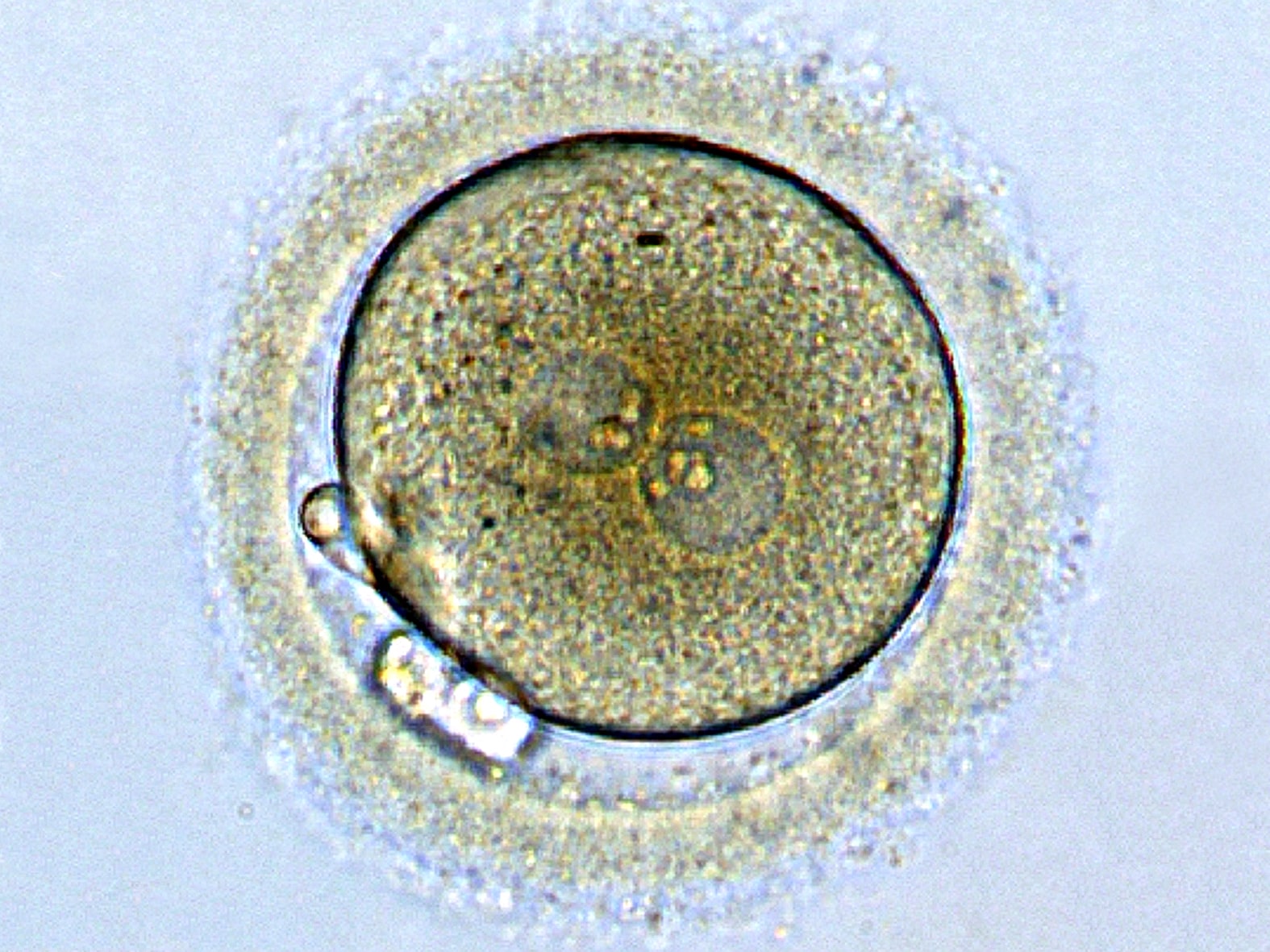
To gain a vivid sense of some of these epigenetic discoveries, let’s return to our fictional submarine for another miniaturizing descent, this time into an egg cell.
As the submarine descends, the only sound is the quiet hum of its propulsion system, but as the vessel gathers speed, a swishing sound mingles with the hum. Soon the egg cell looms ahead, looking like a small planet. This living planet looms larger and larger until it fills the entire view out the front of the submarine. “We’re heading for the famed zona pellucida surrounding the egg,” explains your tour guide as he pilots the ship forward.
All source notes are contained in the published book.