






































My favorite atheist is Sean Carroll. Seriously. Although, to be fair, I should use his preferred term for his own view, “poetic naturalist.”
Over the years that I’ve been a follower of Carroll’s Mindscape podcast, I’ve learned a great deal from his commentaries and interview guests. I regret that I finished up at the University of Chicago in 1998, before he arrived there in 1999. He must be a great teacher (currently at Johns Hopkins): honest, patient, curious, and above all, a good listener. I say all this because I found myself unhappily surprised by the author who provides the opening quote, and no small part of the metaphysical framework, of Carroll’s new cosmology paper: Friedrich Nietzsche.
Here Is the Backstory
During my time at Chicago, as a condition of my fellowship, I had to teach undergraduates in the College what could be called the Greatest Hits of Western Philosophy. Most of these students took intro philosophy to satisfy a humanities distribution requirement, on their way to medical, law, or business school. A few of them found that they loved the subject.
I always felt uneasy when the course arrived at Nietzsche, given the enormous attraction of his nihilism and pessimism to the well-fed, bourgeois student mind. So I regularly broke with academic objectivity and told the kids, you have to learn this, I have to teach it, but please don’t live this way. You will make yourself and everyone around you absolutely miserable. I had seen this pattern even in high school, among a group of my friends who took to studying Ayn Rand and her “objectivism,” aka her glorified selfishness. Misery.
Nietzsche’s doctrine of eternal recurrence, which has ancient roots in both Western and Eastern philosophy and religion, struck me as especially bleak. If it were true, I would fail eternally, again and again at the age of 16, to make the Western Pennsylvania all-star ice hockey team as a defenseman. The same superb skater (I can’t remember his name, but I can see his confident face) would defeat me in the one-on-one tryout drill. His same tricky moves, my same failure to stop him. Eternally. And my name would be removed again from the roster of candidates.
“Speck of Dust!”
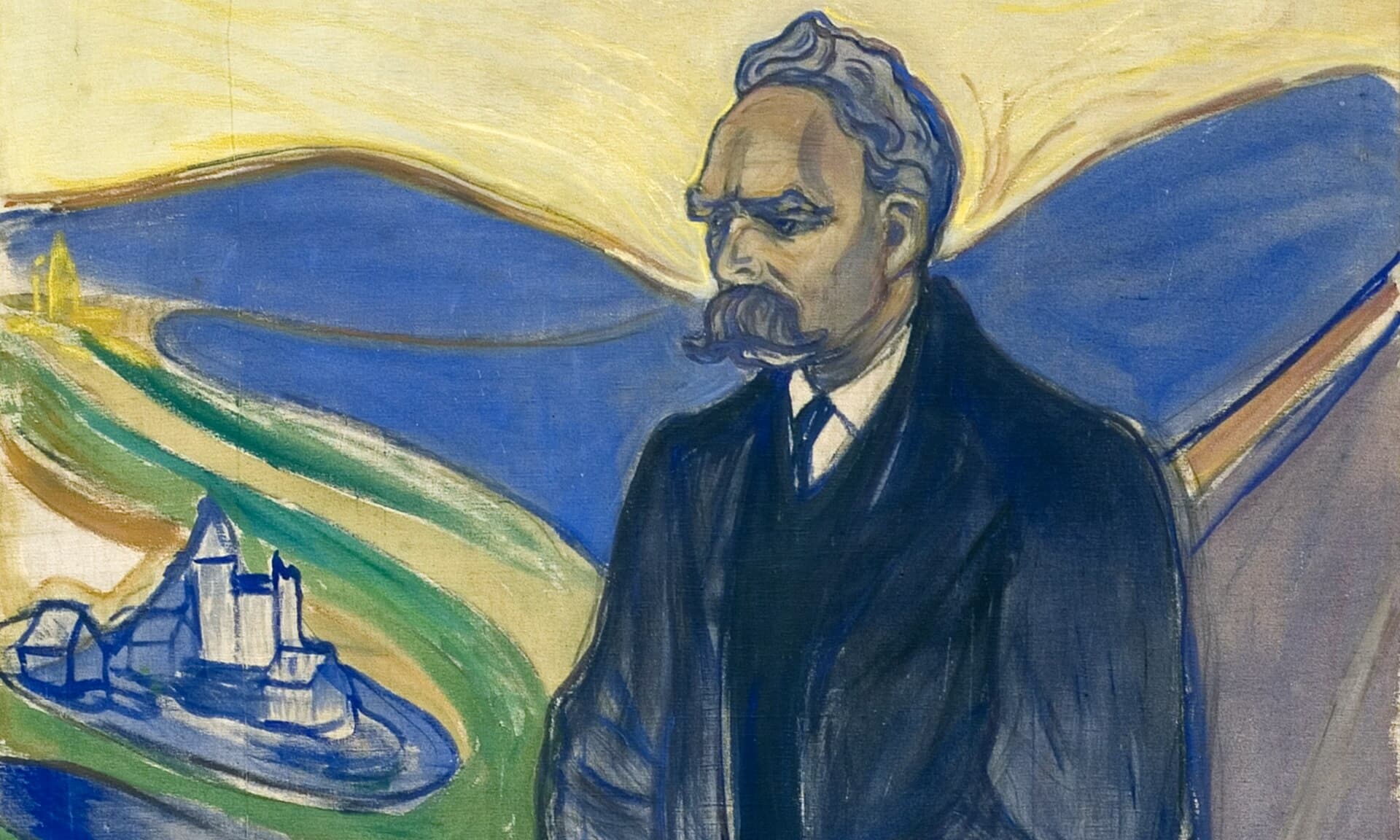
In this new cosmology preprint, at the start of their argument, Carroll and two colleagues put a quote about eternal recurrence from Nietzsche’s The Gay Science: “The eternal hourglass of existence is turned over again and again, and you with it, speck of dust!” And yet, says Genesis 3:19, “Dust you are, and to dust you shall return.” So why am I picking on Carroll? Why, as a theist and Christian, Paul, do you hypocritically point your finger at Nietzsche, or him?
We are dust. Nietzsche and Carroll are right about that. My own dusty end becomes increasingly real to me as I have become a grandfather — but I am not ONLY dust. The realest dimension of me exists eternally; dust does not.
But there is another reason I find Carroll’s outlook unspeakably bleak, which he spells out in the conclusions of his paper:
As Nietzsche envisioned, everything you do has already been done infinitely many times in the past, and will be done infinitely many times in the future. We leave the moral implications of this view for readers to contemplate.
Indeed. Who cares about my astronomically petty and meaningless regret that I didn’t make the all-star hockey team? But the Khmer Rouge’s slaughter (1975-79) of the Cambodian educated middle class, the Holocaust (1939-1945), Stalin’s murderous purges in the 1930s, the Black Death (1346-53), the Rwandan genocide (1994), the Sandy Hook massacre (2012) — on and on the list of moral and natural disasters runs throughout Earth’s history. Once is enough for these events. Once is more than enough.
Your Deepest Commitments
There is a point in the dialectic of philosophy (and science, for that matter) where one finds the discussion going deep: well below the elegant mathematics and clever logic, down to what Carroll elsewhere has called one’s deepest commitments. I think Carroll would acknowledge that he is not committed to a universe which begins in an act of divine creation.
That created cosmology, however, is one possible implication of the arrow of time. Richard Feynman, himself an atheist, described in his book The Character of Physical Law (1965) the need for a hypothesis, taken from beyond physics, to account for the asymmetries we universally experience between past, present, and future:
…the success of all those [historical] sciences indicates that the world did not come from a fluctuation, but came from a condition which was more separated, more organized, in the past than at the present time. Therefore I think it necessary to add to the physical laws the hypothesis that in the past the universe was more ordered, in the technical sense, than it is today — I think this is the additional statement that is needed to make sense, and to make an understanding of the irreversibility.
But eternal recurrence? I wish Feynman were still around, to give us his take.
When asked by his biographer Boswell about the impossibility of refuting Bishop Berkeley’s subjective idealism, according to which only human perception is real, Samuel Johnson gave a fierce kick to a nearby stone. “I refute it thus,” he said. The point arrives when a philosophy is so unreasonable, so utterly broken, that one can only give it a good strong kick. Argument fails; one must act.
If the children in the Sandy Hook school are going to be killed again, and again, and again — I must act to say No. That picture cannot be true, no matter how elegant the math.