






































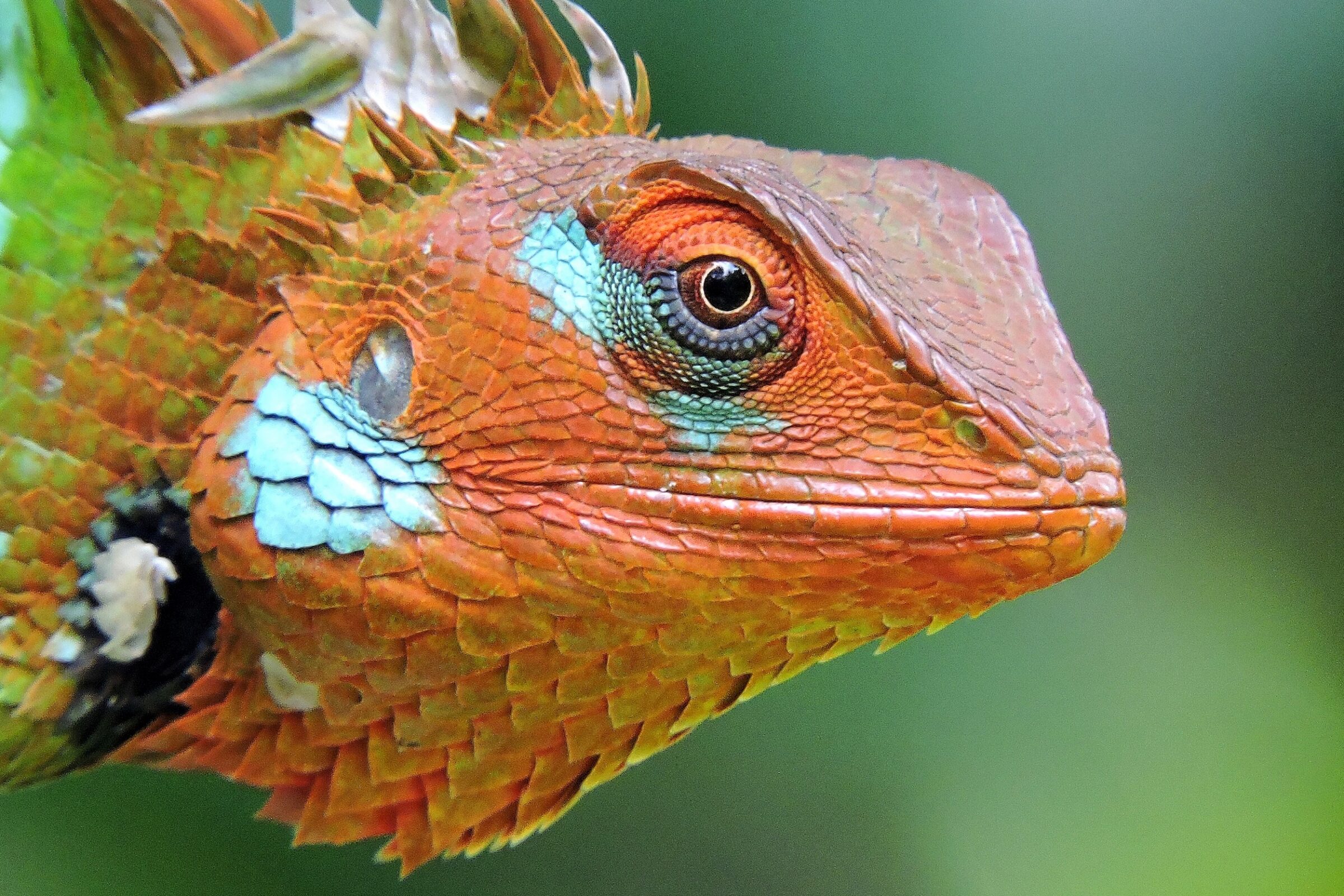
How many of us sat through a college-level psychology or evolution course and heard the professor claim that we have a “lizard brain”? It’s just like ontogeny recapitulates phylogeny: an evolutionary model that many of us were taught in school, but it’s totally false. According to the now-defunct hypothesis about ontogeny recapitulating phylogeny, evolution tacks new stages of development onto older ones to make new types of organisms. This view would therefore claim that your ancestors originally went through a “fish” stage of development, followed by a “reptile” stage, and then finally became a mammal, etc.
News from McGill University
Many evo-psych theorists would maintain that something similar happened with brain evolution — new neural components just got tacked onto old ones to create more complex brains with more and more advanced capabilities. A new article from McGill University’s Office for Science and Society, “You Do Not Have a Lizard Brain,” explains the “lizard brain” theory — and why it is wrong:
We have all heard that we have a lizard brain. In fact, popular wandering hero Jack Reacher is said to have a highly reliable lizard brain, a sort of primitive instinct that alerts him to what is really going on. On top of this ancestral brain, we are said to have evolved a second brain, full of emotions, shared with mammals like mice and horses. Lizards are detached, but mammals? We experience fear, anger, joy, defiance, and longing. And crowning this limbic system is what makes us uniquely human: a third brain capable of speech, of contemplation, and of complex thoughts.
Widely Believed, but False
Unlike ontogeny recapitulates phylogeny, the idea that we have a “lizard brain” is still widely believed. The McGill article cites a 2020 study, “Your Brain Is Not an Onion With a Tiny Reptile Inside,” which evaluated 20 introductory psychology textbooks and found among those that covered brain evolution “almost all … made the mistake of teaching students about the lizard brain.” That 2020 study stated, “We urge psychologists to abandon this mistaken view of human brains.” Nonetheless, the new McGill article explains that we’ve known for decades that humans don’t have a “lizard brain.” The false belief traces back to the fact that Carl Sagan was one of its strongest proponents:
Carl Sagan is partly to blame for the widespread belief that we all have a lizard brain inside of us. … Its origin goes back to 1959 — although it draws from Western cultures’ obsession with trinities — and it got a boost from a well-respected science communicator: none other than Carl Sagan himself.
The article explains why this long-held belief is mistaken:
It will come as a shock, then, that neurobiologists have known since the 1990s that this simple and enticing idea is just not true…. There were alternative explanations … and, more importantly, our evolving knowledge of the brain just did not add up to his layering hypothesis.
That limbic system mammals have? Reptiles, an informal category which includes lizards and snakes, have one too.
And that neomammalian brain unique to humans? It’s not. Every mammal has one. It’s not even brand new; it’s a modified version of what reptiles have.
Evolution does not create new organs on top of older versions like it’s trying to control a radio with a flatscreen television. As one paper put it, the trunk of an elephant has not been superimposed over a snout; it’s like a snout but longer. And lest we get sucked into MacLean’s mid-century ideas about the exceptionality of Man, we know that octopuses, crows, and parrots are not mere sacs of emotions. They are clever.
Three Layered Pancakes?
Our “current understanding of the brain” has moved beyond the “lizard brain” model:
Our current understanding of the brain, I am sad to report, is just not as easy to understand as three pancakes stacked on top of each other, with the lizard pancake dictating our survival, the mammalian pancake damning us with emotions, and the human pancake making us peculiarly smart and rational. Emotions are not restricted to what [Paul D.] MacLean called the limbic system, and our so-called limbic system (a phrase that has fallen out of use) is not merely concerned with processing feelings. In fact, our entire brain communicates with different regions of itself to a profoundly intricate degree. Our brain has regions, sure: we have a visual centre at the back of our head, and we have areas that process language, for example. But evolution did not pile up brains like layers of rocks and sediments showing us the age of the Earth.
The moral of the story, according to the McGill University article, is: “Some scientific hypotheses get canonized despite what we now know because of how simple and satisfying they feel. The world, unfortunately, is full of complexity, and our brain does not escape that.”
Those are very wise words, and we should all take heed of them.