






































As we celebrated 250 years of American independence this past weekend, I was reminded of those famous words of the Declaration of Independence:
We hold these truths to be self-evident, that all men are created equal, that they are endowed by their Creator with certain unalienable Rights, that among these are Life, Liberty and the pursuit of Happiness.
The founders chose their words wisely. They acknowledged that our rights to life and liberty are just a few of the things we have received as gifts. We’ve also been endowed with free will, creativity, the ability to reason, and an engineered body. On top of that, we bear the likeness of our designer and share in a divine, eternal nature.
In the Modern Age
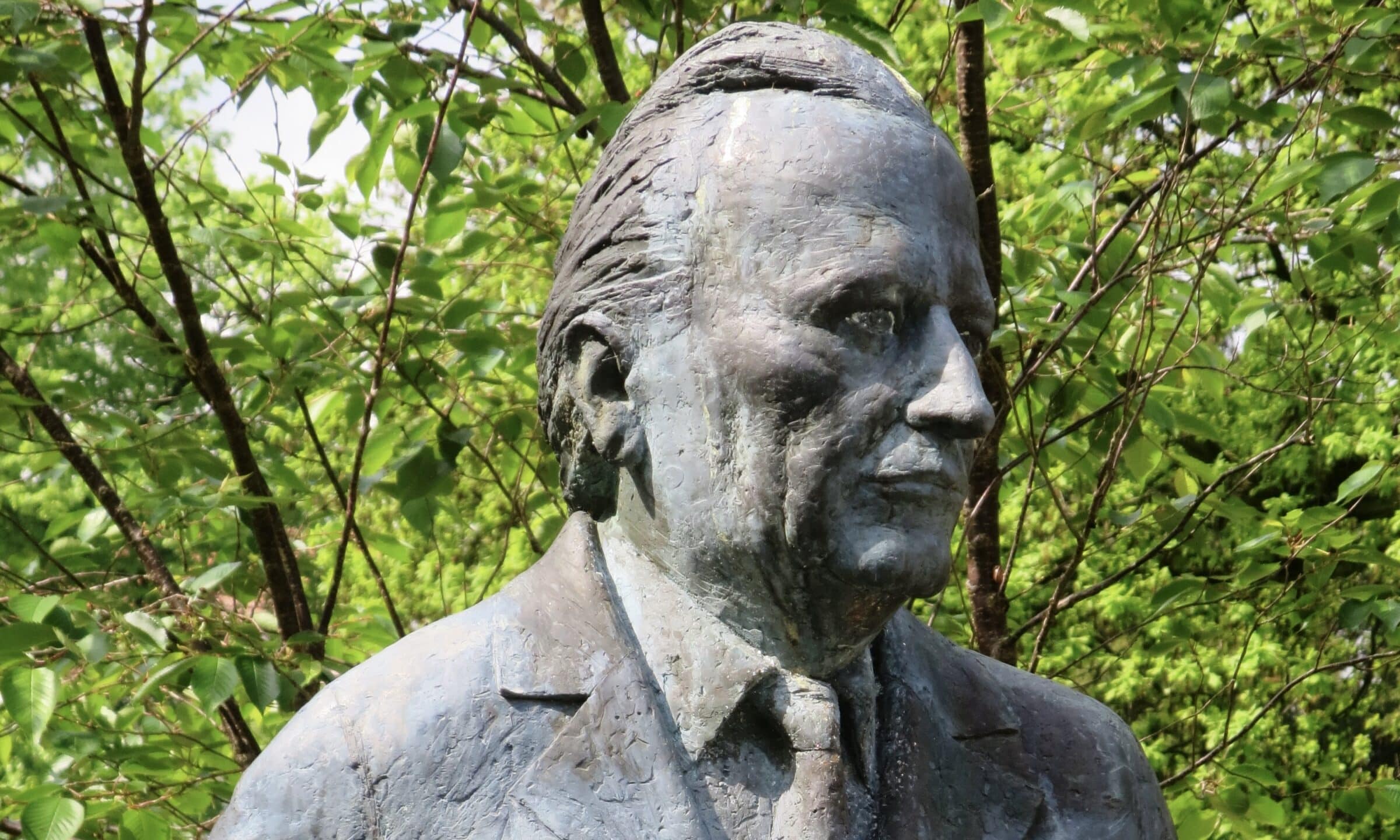
I recently read a book, Man in the Modern Age (1930), by German philosopher Karl Jaspers (his bust is pictured at the top). Although his writing can get a little heavy and hard to fully understand at times, I enjoyed his review of some of the problems faced by humankind in the modern age. Jaspers promotes existence-philosophy as a uniquely effective approach to promoting all that makes man genuinely human.
Toward the end of the book, he discusses the limitations of disciplines that seek to understand human beings:
Sociology, psychology, and anthropology teach that man is to be regarded as an object concerning which something can be learnt that will make it possible to modify this object by deliberate organization. In this way, one comes to know something about man, without coming to know man himself.
Neither Organic nor Inorganic
I recently wrote about Russian philosopher Nicolai Berdyaev’s assertion that technology is neither organic nor inorganic. Instead, it is organized. Technology produces organized bodies and systems that rationalize organic life by its own law. Jaspers makes a similar assertion here. The sciences, of which technology is a part, seek to understand and modify human beings through “deliberate organization.” But to what extent can you organize humans? I argue right along with Berdyaev that, as organic beings, we are not designed to be comprehensively organized, and that the attempt to fully organize human beings and human life ends in the dehumanization of man.
Jaspers goes on to invoke the unshakable freedom that characterizes human beings:
Yet man, as a possibility of a creature endowed with spontaneity, rises in revolt against being regarded as a mere result. What the individual can be transformed into sociologically or psychologically or anthropologically, is not accepted by him as cogent without qualification. By comprehending cognizable reality as something particular and relative, he emancipates himself from that which the sciences would like definitively to make of him.
“Endowed with spontaneity”: That’s the phrase I want to linger with today.
Jaspers brings it home here:
The best laws, the most admirable institutions, the most trustworthy acquirements of knowledge, the most effective technique, can be used in conflicting ways. They are of no avail unless individual human beings fulfil them with an effective and valuable reality.
That’s 1930s-German-philosopher-speak for the power and freedom human beings have to know themselves, be known to others, and be active agents in the world. And let me come back to that beautiful word “spontaneity.” Its Latin root goes right to free will: “of one’s own accord, of one’s own free will, willingly.” The modern idea of being “spontaneous” means unpredictable or acting with little or no thought. But that doesn’t capture the fullness of the word. More accurately, it describes actions “occurring without external stimulus, proceeding from an internal impulse” (etymonline.com).
The Human Paths
Spontaneity is just one of the characteristics of humans that are not computable, non-algorithmic, not rational, not determined. Here are some others: contemplation, friction, presence, relationship, creativity, meaning, virtuousness, individuality, intuition, faith, hope, love, courage, resistance, transcendence, and surprise. There are still other aspects of humanness that resist total organization. No doubt you could think of a handful more with a little thought.
Today, we live in an age characterized by awe-inspiring technology that impacts much of human life. But that technology dances to the beat of its own drum. It’s a “new reality” we must learn to master. And as we do that, we should become keenly aware of the parts of human life that will be naturally resistant to the rationalizing, organizing effects of technology. We must guard those human qualities closely as we seek to walk the human paths.
Originally published on The Human Adventure Substack.