






































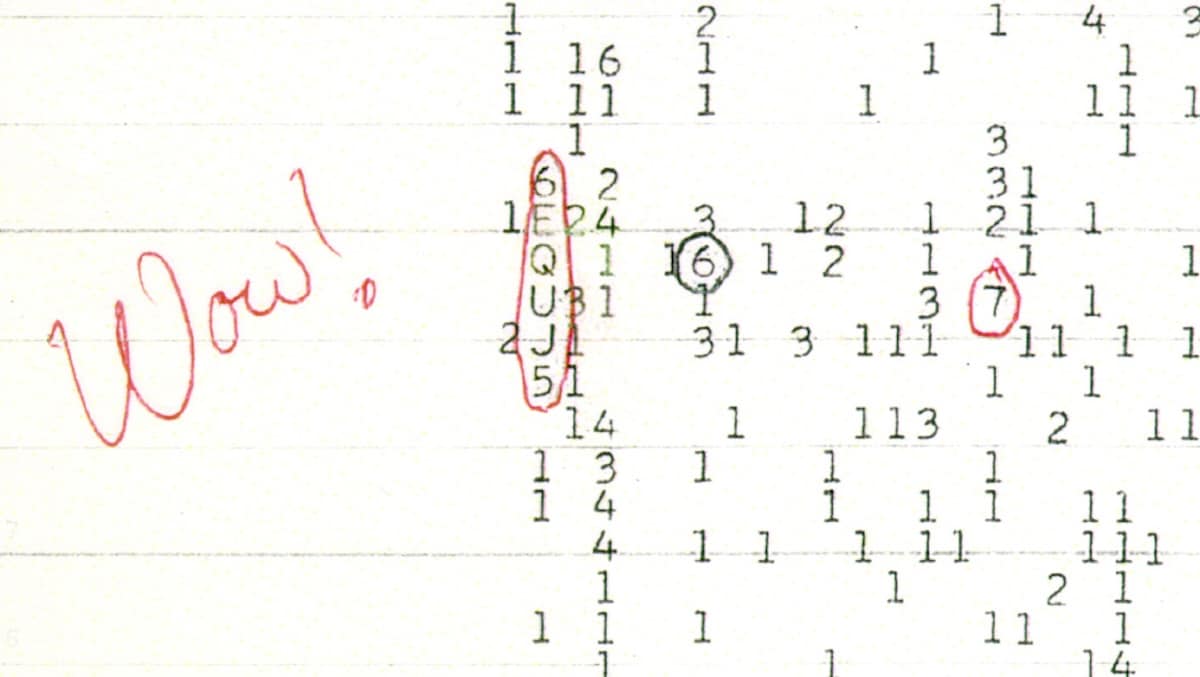
In 1973, Ohio State University assigned a defunct radio telescope to the project of searching for signals from outer space that might come from an intelligence source. On August 15, 1977, a surprising signal was detected. When one of the researchers, Jerry Ehman, discovered the signal while inspecting a printout of the data, he circled the letter representing the signal and wrote “Wow!” in the margin.
The search for extraterrestrial intelligence is a project in design detection. The project searches through evidence coming from outer space in the hopes of finding something that indicates intelligent extraterrestrial life.
A Very Small Probability
But what was so “Wow!” about this signal? The signal was thirty standard deviations above the background noise. We can estimate the probability of such a strong deviation at approximately 1 in 10198. That is a very small probability and easily provokes the Wow! response.
However, simple improbability is not enough. As emphasized by William Dembski’s work in specified complexity, we have to take into account whether or not the event is specified. The second edition of The Design Inference emphasizes an approach based on measuring the length of a description. The length of the description must be small.
A simple practical approach to incorporating this is to count the number of words in an English description of the observed pattern. There are on the order of 105 words in typical English. This means, for example, that there are 1020 four word phrases. This means that if a pattern takes four words to describe there are approximately 1020 other such patterns. We thus multiply the probability by this number to adjust for those.
The “Wow!” signal can be described as a “strong narrowband radio signal.” This is a four word phrase. We can thus multiply the small probability by this number and obtain 1 in 10178. This is still a very small number and thus still worthy of the “Wow!” response.
When May We Infer Design?
Does this mean that we have detected intelligent aliens? No. It means that we can firmly reject the idea that this was simply a random fluctuation. To infer design, we need to reject all relevant chance hypotheses. Only once we have eliminated all chance and necessity explanations are we entitled to infer design.
This event has never been accepted as strong evidence for intelligent aliens precisely because other explanations seem plausible. In particular, a rare but natural event could explain a surprisingly large burst of signal. Some researchers have proposed particular mechanisms that could have explained the signal. However, because the signal has never been seen again it is difficult to confirm.
But the lesson here is that SETI research is using the design inference methodology laid out by Dembski. They effectively used the concept of specified complexity to determine that a signal was “Wow!” But they also realized that they need to address all relevant chance hypotheses before concluding design.
It is not, of course, that SETI is deliberately following his techniques. But rather that Dembski was able to articulate the intuitive process we use in inferring design. In so doing, he laid out the methods that SETI and others were already using.