







































In my last two articles, I describe the futility of origin-of-life research based on chemical catalysts and on self-organizational processes. Here I will broaden the argument, explaining why the entire enterprise of exploring an undirected pathway to life is doomed to failure. It also shows how origin-of-life experiments, rather than demonstrating the creative power of unguided chemistry, repeatedly reveal the indispensable role of design in producing anything even remotely relevant to biology.
Origin-of-Life Experiments
Research into life’s origin typically falls into two broad categories. The first consists of experiments designed to approximate plausible environments and chemical conditions on the early Earth. Examples include the Miller-Urey experiment and related studies that begin with relatively realistic mixtures of simple gases and other compounds thought to have been present in early-Earth settings. Such experiments generate complex mixtures dominated by low-free-energy products: chemical dead ends bearing little resemblance to the highly organized, energy-rich systems characteristic of life (here, here).
The second category consists of experiments carefully engineered to generate products with some biological relevance (see Figure 1). Investigators achieve the desired outcome by selecting the appropriate starting chemicals, constructing the ideal experimental environment, and implementing a precisely specified sequence of procedures. The resulting products arise not from processes resembling those in nature, but from information embedded in the experimental design specifications (here, here, here).
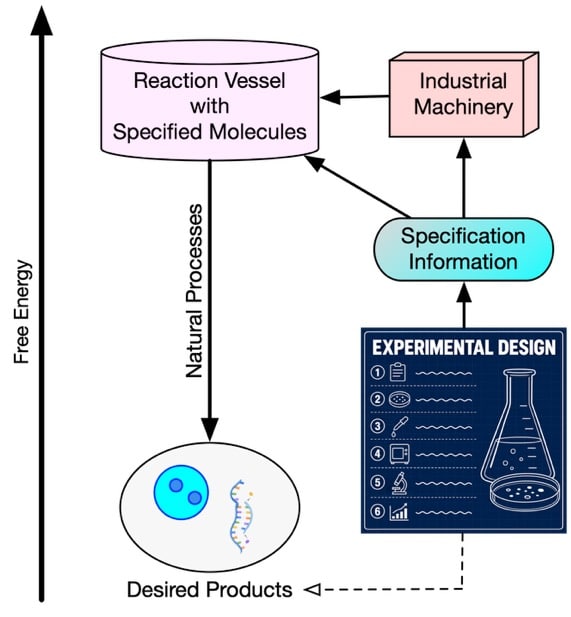
The starting molecular combination differs sharply from anything possible in the environment. The mixture contains a small set of specified molecules supplied at unnatural concentrations, corresponding to very high free energy. During the experiment, the chemical mixture transitions to a lower-free-energy state that exhibits the desired properties.
Moreover, the reagents composing the initial feedstock are never produced by processes that resemble plausible conditions on the early Earth. Their production instead requires substantial energy inputs and tightly controlled industrial procedures, including high-temperature furnaces, high-pressure catalytic reactors, exposure to strong acids, drying under oxygen-free conditions, crystallization, filtration, and purification (here, here). The entire pathway — from raw natural materials to purified feedstocks, to the final products — depends on large inputs of processed energy directed by complex machinery operating according to detailed manufacturing specifications (i.e., information).
Comparison with Biology
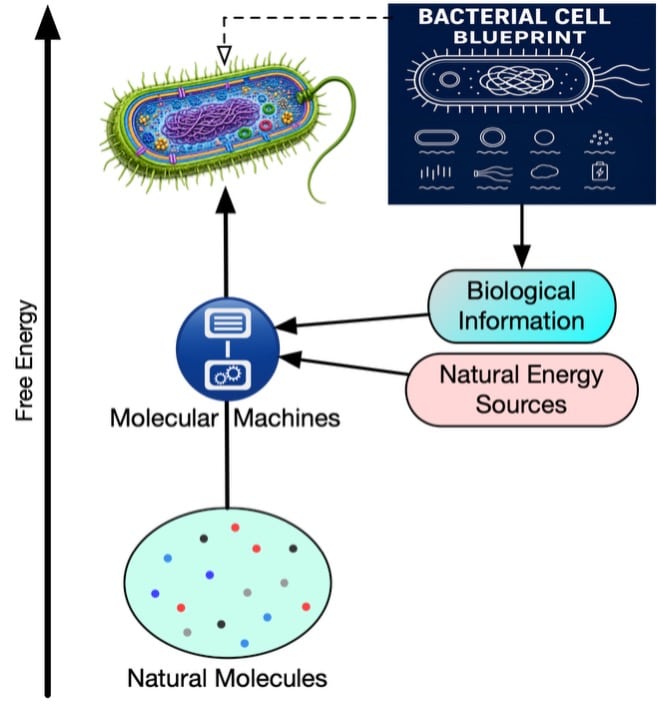
Like the experiments that produce specified outcomes, biology is dependent on pre-existent information (see Figure 2). A cell’s organization and operations conform to an architectural plan — a blueprint tailored to the central goals of autonomy, adaptation, and reproduction. This blueprint is instantiated in biological information embodied in DNA, proteins, and other cellular structures. The information directs molecular machinery to construct cellular components, coordinate operations, and preserve the cell’s architecture. The machinery is powered by high-energy molecules generated through energy-conversion systems. A continual supply of channeled energy is required to drive energetically unfavorable processes, such as transporting resources against concentration gradients, to maintain the cell’s far-from-equilibrium state (here, here, here).
The underlying logic of biology closely parallels that of origin-of-life experiments. Comparing Figures 1 and 2 reveals a striking correspondence between the elements required to construct and maintain a cell and those required to yield the desired experimental outcomes (see Table 1).
| Function | Cell | Origin-of-life experiment |
| Goal | Autonomy, adaptation, and reproduction | Desired experimental products or outcomes |
| Architectural plan | Cellular blueprint | Experimental design |
| Information | Biological information embodied in DNA, proteins, and other cellular structures | Information embodied in experimental specifications, protocols, and choice of chemicals |
| Machinery | Molecular machinery and supporting structures | Industrial machinery used to manufacture reagents and laboratory apparatus used to generate the output products |
| Energy supply | Chemical energy generated by cellular energy-conversion systems | Externally supplied energy used to manufacture reagents and operate experimental equipment |
| Coordination | Tightly coordinated metabolic pathways integrated with cellular structures and regulatory systems | Highly orchestrated industrial and experimental operations implementing diverse processes, including reagent synthesis, purification, mixing, heating, pressurization, separation, and controlled reaction pathways |
Design Implications
The parallel is revealing. In origin-of-life experiments, the desired outcomes do not emerge from unguided chemistry alone. Talented synthetic chemists must carefully specify the materials, conditions, energy inputs, and experimental protocols required to achieve the desired results. Yet even the most accomplished investigators design systems and produce outcomes that pale in comparison with the complexity, sophistication, and ingenuity of even the simplest biological structures and processes.
How much more strongly, then, does a living cell — whose molecular machinery must construct its components, regulate and coordinate its operations, harvest and direct energy, maintain its organization, repair damage, and reproduce itself — point to the necessity of a designer? And must not that designer possess knowledge and understanding that far surpasses our own?