






































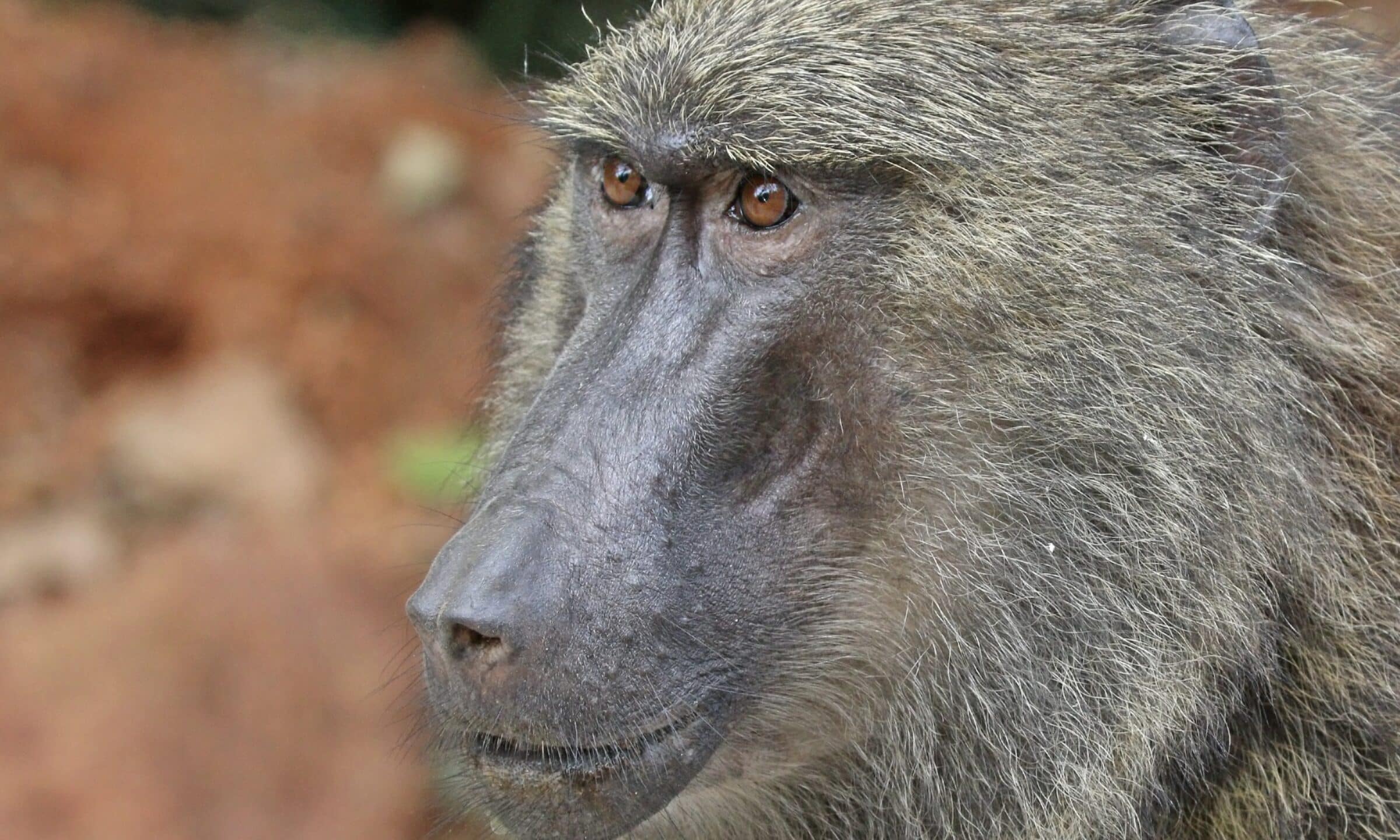
I recently returned from a two-week wildlife safari through Zimbabwe and South Africa. I visited Victoria Falls, which dwarfs Niagara, the extraordinary Table Mountain, and several wildlife reserves including Kruger National Park. The jeep rides through the brush yielded close encounters with female lions shepherding their cubs, male lions sleeping off meals, a leopard in a tree crunching the skull of an impala, herds of piously maternal elephants — only one of which came close to charging us — and a dozen other species of predator or prey. The high point, I’ll confess, was one wildlife encounter in particular: when a troop of baboons charged the outdoor diners at The Black Marlin in Cape Town, driving them to flee, so the apes could stuff their faces with pilfered pasta. Sadly, I was sitting inside, so all I could do was cheer the hairy creatures on from through the window.
The Book of Nature
I hope that I’m sufficiently grateful for this encounter with the baroque, sublime abundance of biology that our planet is privileged to host — alone, so far as we know, among the billions of planets. Gratitude should be aimed at a giver, and it was reading the works of Discovery Institute authors that made this easier for me. I could wonder at the tiny penguins that somehow survive in the Mediterranean climate near the Cape of Good Hope, or the birds that live symbiotically with wildebeests by feeding on bloodsucking insects, without the deflating idea lurking in the back of my mind, “This all the result of blind chance and iron necessity, with no crafting intelligence behind it.” Instead, I saw works of art, and found myself thanking the Artist. I was reading the Book of Nature, and seeing in it glimmers of divine action, intention, and generosity — as “natural philosophers” did from Kepler and Newton to Pasteur and Mendel.
Back when I unreflectively adhered to the theistic (really deistic) evolution that’s preached in most Christian pulpits, I accepted the notion that God was somehow behind every aspect of the cosmos. If pressed, I would have said that God had “guided” or “instigated” the emergence of extraordinary creatures like the zebras that stared at our jeep, the elegant kudus that capered past us through the veldt, the wild dogs that seemed at once so alien and so familiar that it was tempting to hop out and try petting them. (“Do not attempt this,” I was informed by our solemn African guide.) But all of life was at best a convoluted Rube Goldberg contraption, which Someone had set in motion then stepped away to observe.
God even had humans in mind — deciding, for some reason, to slowly evolve His earthly image through a long chain of predecessor species, until at some point He chose to implant both rationality and immortal souls in creatures who’d mutated in and then emerged from the womb of an animal.
I used to speculate about how that allegedly worked, and how I could reconcile it in some fashion with the Genesis account of God making man directly from the dust of the earth, and woman from his side. I remember thinking, lamely, “Maybe they were identical twins … and He switched Eve’s sex before the ape gave birth to them?” Then I stopped bothering, encouraged by modern priests who treat not just Genesis but most of the Old Testament as mostly wholesome mythology, akin to that found in Bulfinch or Edith Hamilton.
Christianizing Darwinists
Obeying the dictum of 19th-century “Higher Criticism,” Christianizing Darwinists aim to explain away every claim of miraculous action — from the direct creation of man to the parting of the Red Sea, from Jesus’ virgin birth to even his Resurrection. I was taught in high school that the last, most crucial Christian miracle, amounted merely to the “ongoing presence” of Jesus in his apostles’ hearts and minds. Big whoop. In that sense, Adolf Hitler is still sadly with us. (If you want an account of how and why biblical critics crafted such blinders, read Scott Hahn and Benjamin Wiker’s magisterial Politicizing the Bible, which I edited for publication.)
Priests, theologians, bishops and even (recently) popes have responded to the popular triumph of Darwinism by dismissing most of the events recounted in Genesis as purely allegorical and moral. Keen to avoid being tarred as “fundamentalists,” and encouraged by some cautious leeway granted to evolutionary thinking by popes such as Pius XII and John Paul II, most Catholics have eagerly accepted that Darwin’s theories fully explain the emergence of every living species, even man. Otherwise-orthodox believers have made this intellectual concession, convinced that “the science” is irrefutable, so the theology must make room for it. But what if, in fact, the science is very shaky, and the implications for a Christian worldview profoundly toxic?
Those are the questions asked and convincingly answered in a new book, Creation or Evolution? A Catholic Dilemma. It’s written in an extremely engaging format — a series of questions posed by science journalist Steve Greene and answered by theologian Rev. Michael Chabarek, O.P. It was Chaberek’s previous book, Aquinas and Evolution, that convinced me to take intelligent design seriously, and embark on the journey through the works of Stephen Meyer, Michael Behe, Douglas Axe, and many others — to my profound intellectual and spiritual enrichment.
This new book is every bit the equal of Chaberek’s earlier work. He lays out the serious evidential weaknesses in the Darwinist claim to have explained the appearance of human beings by incremental mutations from previous apelike species. (For much more detail than this book offers, see Science and Human Origins, from Discovery Institute Press, which Chaberek cites.) He explains how circular logic and wishful thinking pervade the claims of paleontologists to have discovered non-human ancestors for our species, with periodic claims to have found a “missing link” based on tiny bone fragments of indeterminate origin.
False First Principles
But Chaberek’s main focus is not on empirical flaws or gaps in the Darwinist account. Instead, he focuses on the false first principles that motivate, even compel Darwinists to invent their “just so” stories in the first place. Here’s a sample of the straightforward, plain-speaking way that the authors convey key philosophical issues:
If man did not come from the ape, then how did he come into existence?
First, let us consider whether sciences such as paleontology and genetics are actually capable of providing an answer to this question. If man came into existence naturally, then, yes, because science explains the workings of nature. But if man came into existence supernaturally, that is, by the action of divine power exceeding the power of nature, then science cannot explain the beginning of man. Therefore, whether science can provide an answer to this question does not depend on scientific research, but on the previously adopted religious or philosophical assumptions.
Chabarek argues convincingly that secularist and materialist assumptions precede and determine the scientific work of Darwinists, essentially forcing them to deny evidence of design, and to make impossible claims for the creative power of mutations — despite the overwhelming odds against blind chance happening upon even a single useful new protein in the entire history of life on earth (as Douglas Axe showed in exhaustive experimental detail in his book, Undeniable).
When such bias-inducing reductionist assumptions migrate from the research papers of laboratory scientists into the works of Christian leaders, the consequences are even more baleful, Chabarek warns. If such a central question as the origin of the only rational species, the “image of God,” is to be surgically excised from the domain of religious authority and turned over to materialist scientists, what is to stop that same debunking impulse from undermining every mystery of faith? Should we leave Sarah’s miraculous conception of Isaac to the gynecologists, the parting of the Red Sea to the oceanographers, and the resurrection of Jesus to the biologists? That’s the inexorable logic of Christians who cling to Darwinist explanations of the “descent of man” from ancestral apes.
Far better, Chabarek advises, for Christians who accept a long series of miracles and mysteries as entailed in the redemption of humanity to also make room for the Bible’s literal account of the miracle of his creation — from the dust of the earth, by the hand of God.