






































We have been looking at Christoph Adami’s book, The Evolution of Biological Information. Up to now, we have been criticizing his theoretical use of information theory. Now we turn to his Chapter 4, “Experiments in Evolution,” where he draws conclusions from various evolution experiments.
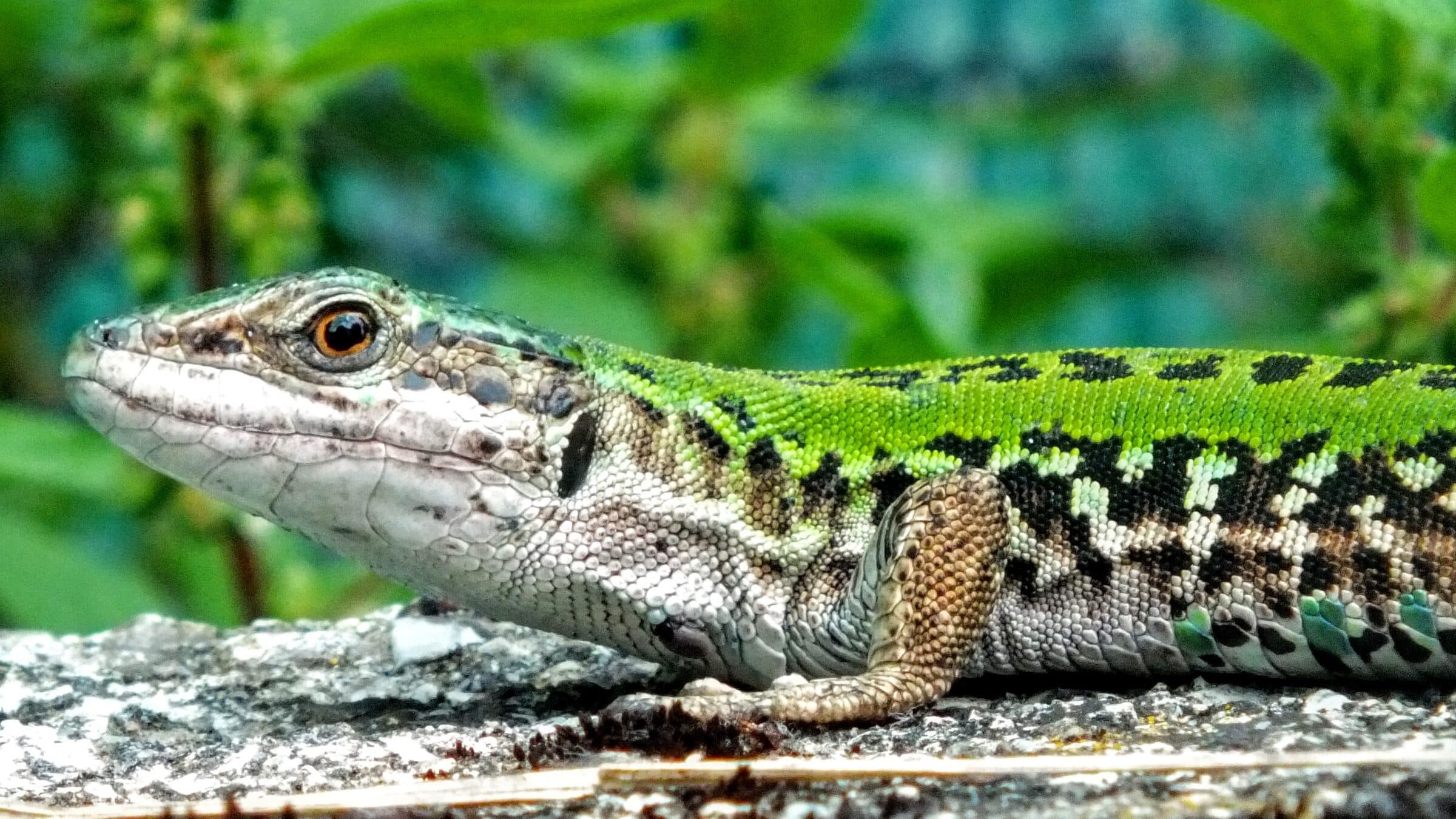
The first experiment that he discusses is one where scientists transported lizards from one island to another. The island in question was home to the lizard Podarcis melisellensis. They introduced five breeding pairs of another species, Podarcis siculus (pictured at the top). The scientists returned thirty years later. To their surprise, they found the island filled with what appeared to be a new species of lizard. They had larger heads and stronger jaws than the introduced species. However, when the genomes of these lizards were sequenced, they found them to be a match for Podarcis siculus. The new species was descended from the pairs introduced to the island, but 33 years later they looked very different.
The Most Striking Difference
But the most striking difference was anatomical. The lizards on the island had a cecal valve. The cecal valve is a muscle that separates the intestine into compartments. This can help the digestive process. This feature was absent in the ancestral population and in the population already present on the island, but it was found in this new species of lizard. Adami characterizes this as the evolution of a new organ.
Part of the story is clear. These lizards ate insects on their home island. The new island had few insects and they had to adapt to a new plant diet. The larger heads, stronger jaws, and valve all helped them adapt to this new environment.
Something Immediately Odd
There is something immediately odd about this story. If we have a documented case of a new organ evolving, why have we not heard about it? Darwinists frequently trumpet far less impressive cases of adaptation as proving Darwin right. Where is the clamor about this one?
The cecal value is not unique to this lizard. Rather, many other herbivorous lizards have a structure that is “similar in overall appearance and structure.” Indeed, many other members of the same family have this structure. Did Darwinian processes re-evolve a structure that was present in related organisms? It seems unlikely. Furthermore, the time frame is very short, a few decades. Evolution is claimed to be a slow gradual process. It is not one that builds new organs in such a small number of generations.
There is a more plausible explanation. The invading species already had the information necessary to produce the valve. However, it was turned off as unnecessary in an insect-eating population. As the population switched to a plant diet, it was turned on. This might be due to a genetic mutation, an epigenetic marker, or environmental triggers. It is a demonstration of how powerfully living things can adapt to new environments by using the information they already have.
But Adami’s book is called The Evolution of Biological Information. For this example, he has not demonstrated information evolving. Indeed, the best explanation of his example is that the information was already present when the experiment began.