






































Lehigh University professor Michael Behe is one of the most influential biologists of our age. But you might never know it. His critical views on evolution and his embrace of intelligent design have made him a target of establishment scientists and popularizers since the late 1990s. He’s been dismissed, ridiculed, and critiqued. Yet he’s undoubtedly been heard.
Behe is a meek fellow. I’ve met him on several occasions and he’s always thoughtful and respectful. He’s also astoundingly insightful. He introduced the concept of irreducible complexity, mapped the speed limits of Darwinian processes, and explained the direction of evolutionary change. When he’s challenged, he reflects and responds. Contrary to Wikipedian belief, Behe has spent a good part of three decades publicly rebutting critiques to his work.
Three Decades Later
And after three decades, his work stands. In a more just world, Michael Behe would be one of the most cited scientists on the planet. Almost every biologist I’ve encountered knows his name and is aware of his ideas. If they know only one name among those who challenge neo-Darwinism, it is Behe.
The sheer amount of research that has gone into trying to find alternative explanations to what he has proposed is mind-boggling. He has moved fields. Yet those critiquing him are reluctant to openly cite his work. His ideas affect the far reaches of biology and live rent-free in the minds of many scientists.
I was introduced to Behe’s thought in high school, by a friend who loaned me his copy of Darwin’s Black Box, which as of August 2 has reached its 30th birthday. I was hooked. I soon discovered the work of William Dembski (who later became a mentor of mine and fellow research collaborator) and Stephen Meyer. I was drawn to their pursuit of the information question in evolution. Behe’s work was my gateway into the broader world of intelligent design.
The Future of Biology
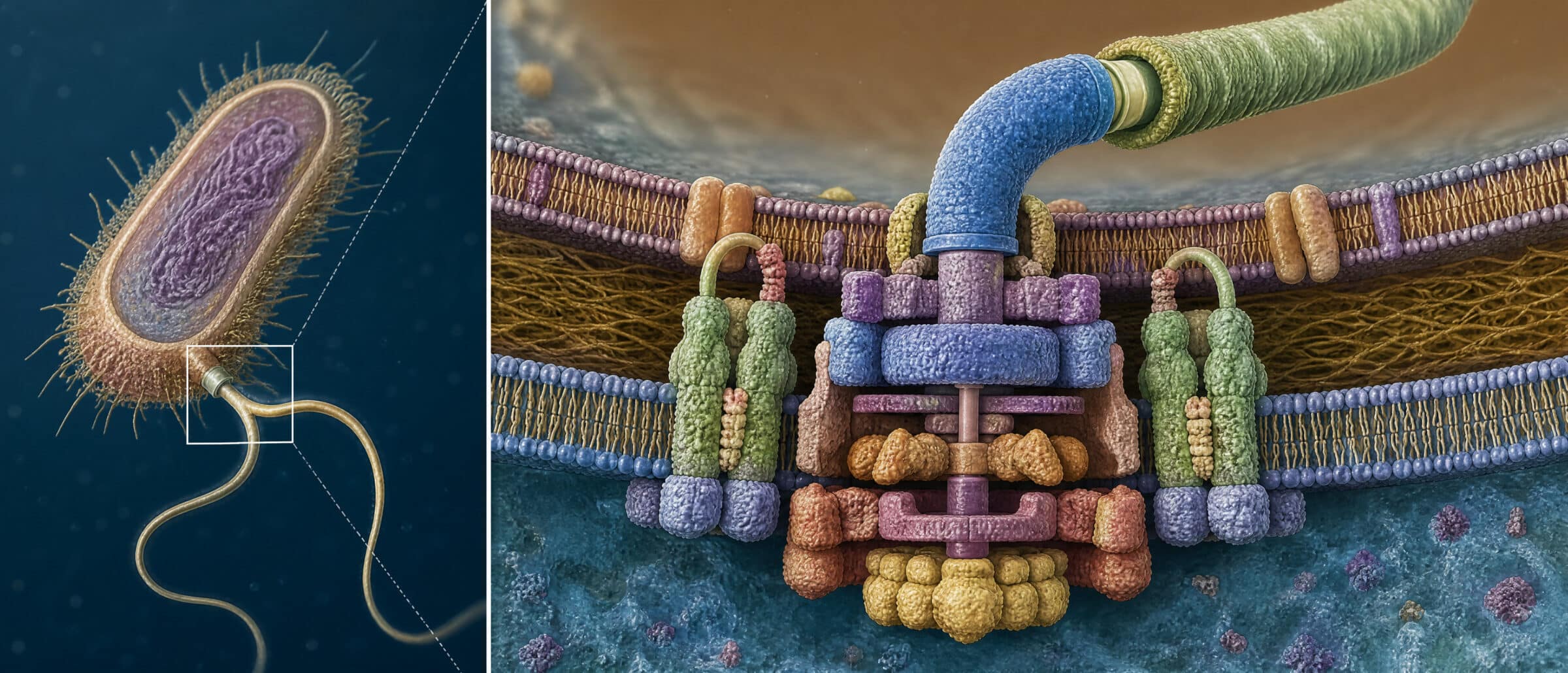
I didn’t realize it at the time, but it was also a glimpse into the future of biology. Behe’s prescience is admirable. Over time, biologists seem to catch up with his insights. Think of his work on waiting times, or the first rule of adaptive evolution. Case in point: a group of researchers recently uploaded a paper to BioRxiv on the bacterial flagellum1, one of the molecular systems he made famous in his 1996 Darwin’s Black Box. The paper seems to vindicate Behe.
It posits that the Last Bacterial Common Ancestor (LBCA) already contained a fully working flagellum. Thus, the bacterial flagellum did not evolve gradually from a less-complex Type III Secretion System (T3SS), as was argued by Kenneth Miller and others. Furthermore, the LBCA flagellum was more complex than flagella today, purportedly containing 52 genes compared to today’s 40.
As the authors of the paper write:
This reconstruction supports a “complexity-first” model of flagellar evolution from the LBCA onward. Instead of emerging as a minimal scaffold that was progressively elaborated within Bacteria, the bacterial flagellum appears to have already existed in the LBCA as a complex system whose descendants were later modified by differential retention, loss, and lineage-specific innovation. This view is consistent with the “big bang” model, in which major evolutionary transitions are marked by the early emergence of comparatively complex biological systems, followed by a slower subsequent period of refinement.
This sounds like it could have been written by Stephen Meyer, who penned a best-selling book on the explosive “big bangs” present in the fossil record. Complexity first, sudden appearance, gradual loss, and modest modification. These are intelligent design perspectives offered by those who are likely antagonistic to intelligent design as a paradigm. The ideas continue to work their way through biology, like a bit of yeast in dough.
Icing on the Cake
Adding icing to Behe’s 30-year-old cake, the authors suggest that today’s flagella are the products of gene loss in individual bacterial lineages. They write,
Subsequent flagellar evolution appears to have been dominated primarily by secondary loss and lineage-specific innovation.
Evolution by devolution, with a dash of lineage-specific modification. These findings agree with existing research from 2021 which suggested the bacterial flagellum predated the T3SS. As Casey Luskin wrote then,
Because of these kinds of phylogenetic arguments for the widespread, ancient nature of flagella, a 2017 article in Nature Reviews Microbiology concluded that if anything, the flagellum is ancestral to the T3SS, not the other way around.
Rather than being refuted by new research findings, Behe’s far-sighted hypotheses continue to find support in them. His work stands.
Notes
- BioRxiv is a preprint server, which means papers loaded there are often not yet peer reviewed. (Not that peer review is a guarantor of truth, but it is arguably better than nothing.) The findings in the paper may be challenged and overturned during a review process. I am also not a computational biologist, so I cannot vouch for the soundness of their methods, though they seem to reflect the sort of standard phylogenetic reconstructions I often see in evolutionary research.