






































Editor’s note: We are delighted to welcome the new book by award-winning British engineer and designer Stuart Burgess, Ultimate Engineering: An Engineer Investigates the Biomechanics of the Human Body (Discovery Institute Press), with an excerpt from Chapter 5.
Of all the miracles of embryological development, formation of the vertebral column and spinal cord may be the most impressive. The nervous system is among the earliest systems to begin forming and the last to be completed. The long period is required because the neural systems are the most complex and most integrated in the body.
When a human embryo is three weeks old and just a quarter of an inch long, a tiny spine begins forming. At this stage, the ribs also can be seen emerging. The early central nervous system begins as a simple neural plate that folds to form a groove. This then turns into a tube, initially open at each end.
The hundreds of intricate mechanical parts of the vertebral column then gradually self-assemble as the embryo grows a perfect spinal column. The millions of nerve pathways also self-assemble in the spinal cord. When we consider that the spinal cord must develop in perfect synchronization with the vertebrae, it becomes evident that we are witnessing a master class in engineering.
One reason engineers are in awe of the vertebral column is that the system is integrated without any fasteners like nuts, bolts, and screws. When you look at an electrical wiring system, it is full of connecting parts that make the system bulky and inefficient. The human nervous system, in contrast, is seamlessly integrated.
Irreducible Complexity, Inexplicable Variety
The vertebral column is a striking example of irreducible complexity (IC). In particular, the integration of the spinal cord and nerve roots with the vertebral discs represents a major IC challenge for evolutionary theory. For example, which evolved first, the holes for the nerve roots or the nerve roots? Neither is useful without the other. And if the column evolved one disc at a time, how did the nerve routes get integrated?
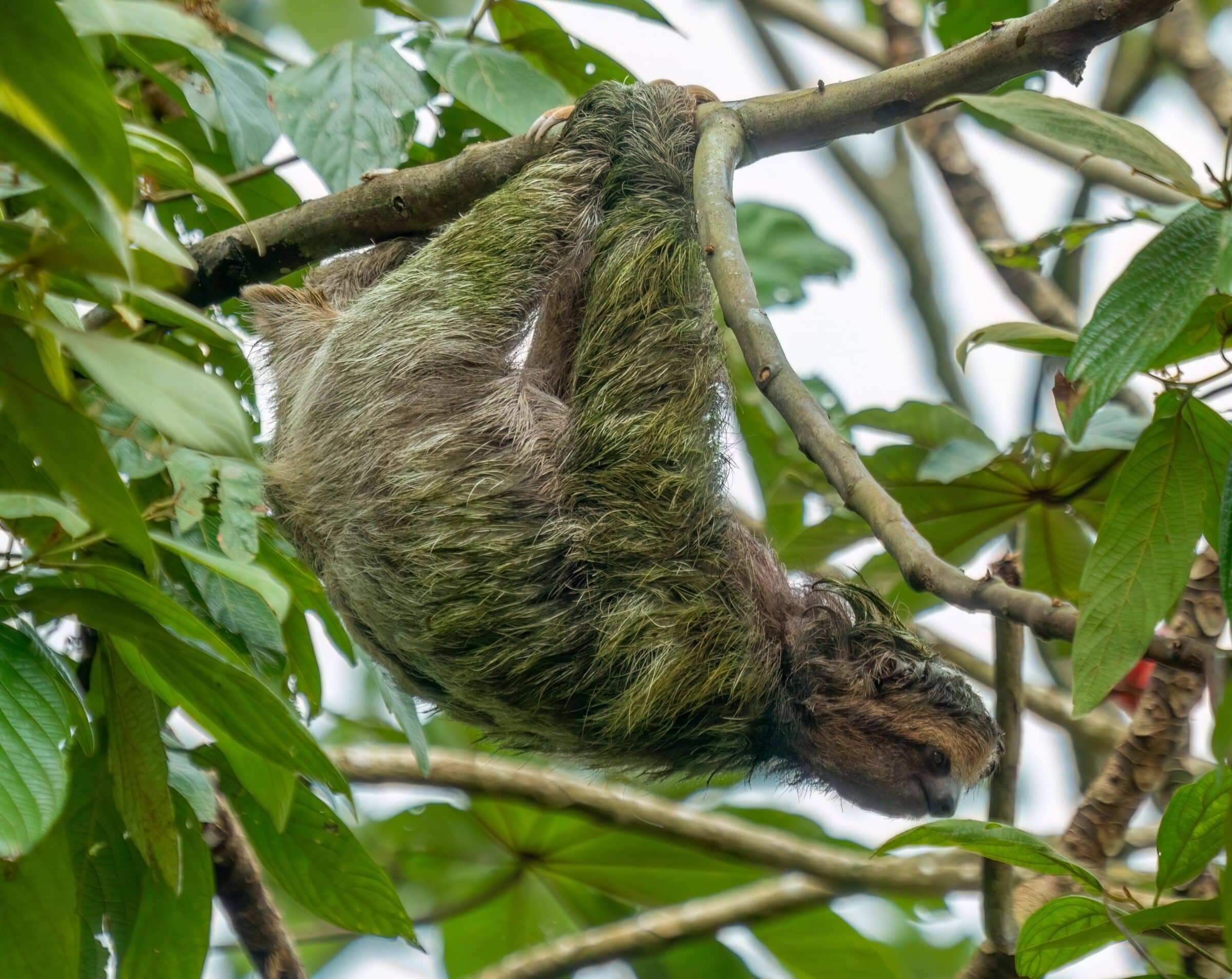
The differences among the spinal columns of different animals also present a problem for evolutionary theory. For example, the sloth has ten neck vertebrae whereas almost all other mammals have seven. The sloth’s extra vertebrae allow it to swivel its neck almost all the way around, which means it does not have to move its body so much when looking around — extremely useful for an extremely slow-moving creature that depends for its survival on blending in and being overlooked by predators. But how such a feature could have gradually evolved by mindless evolutionary forces remains a topic of speculation.
Giraffe spines are also unique. The design of their long spines allows the giraffes to reach down to the ground while keeping their heads up. It’s not just the length. The cervical vertebrae in the giraffe’s neck contain ball-and-socket joints for extra movement. The first and second thoracic vertebrae also contain ball-and-socket joints. Additionally, the joint between the neck and skull permits the giraffe to extend its head almost completely perpendicular to the ground. These unique features are quite different from those of other vertebral columns.
Easily Explained by Evolutionary Adaptation?
Ironically, the giraffe’s long neck is celebrated as something easily explained by evolutionary adaptation, as if the neck merely needed to get a bit longer every few generations, with natural selection rewarding the ability to reach higher and higher tree leaves until nature had evolved the giraffe’s long neck. In reality, the giraffe’s neck isn’t just a lot longer than that of other hoofed mammals; it also involves multiple, complex engineering innovations, which together serve as a particularly dramatic example of irreducible complexity.
Another unique spinal column belongs to the hero shrew, native to the Congo Basin of Africa. This shrew has a super-strong, corrugated, interlocking vertebral column, markedly different from that of other creatures. It has eleven lumbar vertebrae, in contrast to a typical mammal’s five. Also, the shrew’s ribs are much thicker than those of similarly sized mammals. The spinal muscles are also significantly different. These unique features mean the animal’s back can withstand powerful forces, which researchers theorize may serve the purpose of allowing it to pry its way to food sources that it otherwise couldn’t reach. The hero shrew is quite an enigma for evolutionary theory but is readily explained from within an ID paradigm.
Someone might ask whether the human spinal column would benefit from the design features found in the shrew, which produce high strength. The answer is that such features would prevent the human back from having the required flexibility. The human spinal column has just the right balance of flexibility and strength for human living.
All notes may be found in the published book.