






































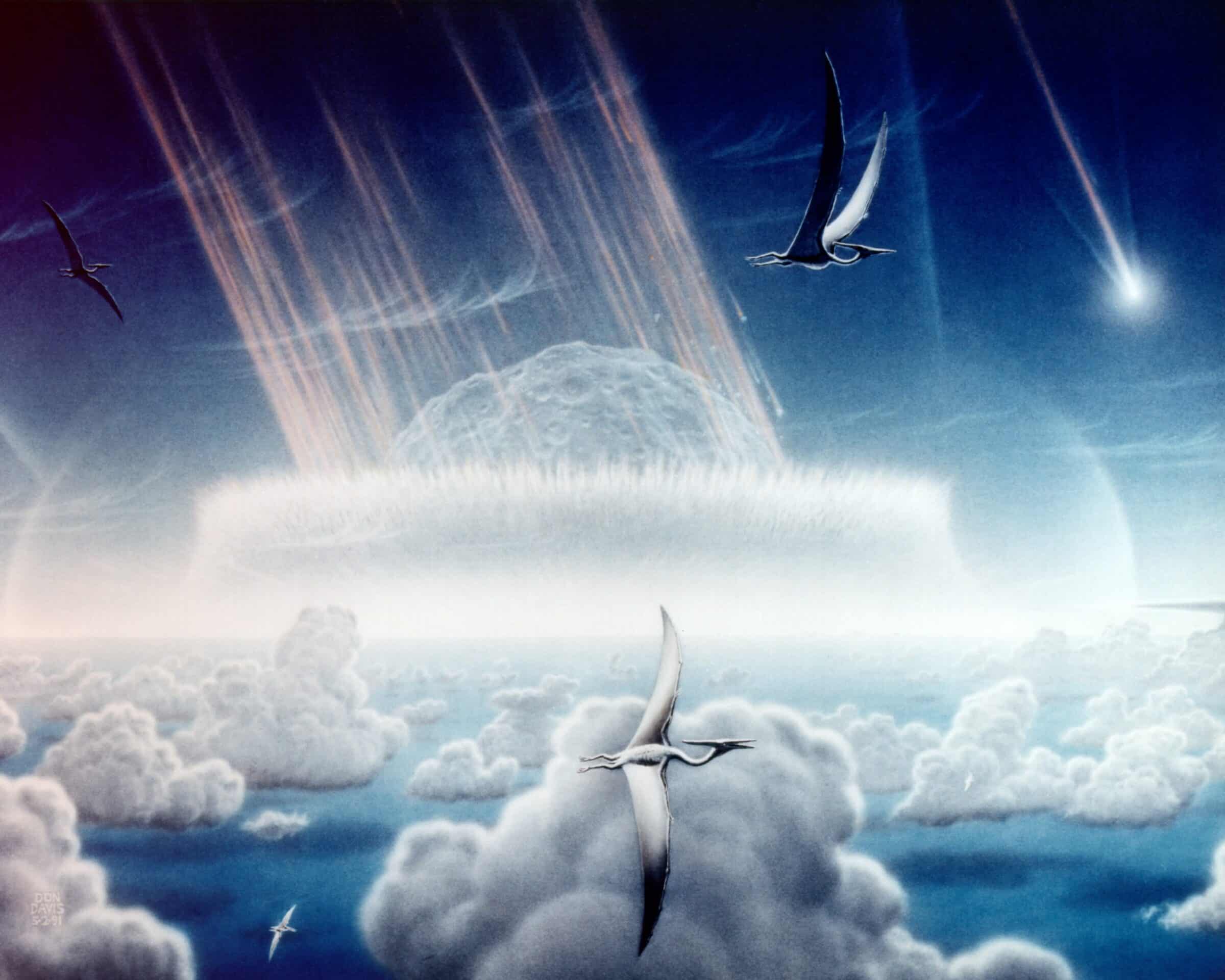
Research at University of Texas at Austin reveals surprising developments in the origin of new plankton species after the K-T extinction event. This event, one of five major extinctions throughout Earth’s history, is widely associated with a massive impact that caused a global winter through ejected debris that enshrouded Earth in darkness for several months.
K–T extinction [was] a global mass extinction event responsible for eliminating approximately 80 percent of all species of animals at or very close to the boundary between the Cretaceous and Paleogene periods, about 66 million years ago.
Not only dinosaurs and other large fauna, but also oceanic plankton suffered from the event.
Of the planktonic marine flora and fauna, only about 13 percent of the coccolithophore and planktonic foraminiferal genera remained alive.
For the Love of Plankton
Although the welfare of plankton may not be at the very top of most people’s minds, these tiny organisms fill an important ecological niche upon which many other forms of life are dependent.
Plankton is the productive base of both marine and freshwater ecosystems, providing food for larger animals and indirectly for humans, whose fisheries depend upon plankton.
Recent research, however, reported by Science Daily this month, shows an unexpected outcome in the immediate wake of this global catastrophe. As the article’s title puts it, “Life rebounded shockingly fast after the asteroid that killed the dinosaurs.” The wheels come off the science wagon, however, when the evidence of rapid formation of new life after this is, without evidentiary support, attributed to evolution.
New research shows that microscopic plankton began evolving into new species within just a few thousand years — and possibly in under 2,000 years — after the disaster.
“It’s Ridiculously Fast”
A geophysics professor at UT Austin commented on the findings:
…this pace of evolution is extraordinarily fast compared with what scientists usually see in the fossil record. Normally, the formation of new species takes place over millions of years. “It’s ridiculously fast.”
Astoundingly, rather than concluding that this unheard-of rapid appearance of new life points to processes beyond Darwinism, researchers double down on evolution, heralding its unexpected abilities.
This research helps us understand just how quickly new species can evolve after extreme events.
One could reasonably ask what evidence the researchers had that the new species arose by naturalistic evolution. The answer is none. They merely detected new species and dated their appearance using a more accurate time proxy, involving the isotope helium-3. This much is science. Then, they blithely assumed evolution was the cause, even though the central fact of the species’ sudden appearance contradicted their own expectations of how evolutionary processes work.
The study suggests that between 10 and 20 new species of foraminifera appeared within roughly 6,000 years of the impact…. Overall, the revised timeline shows that under the right conditions evolution can move remarkably quickly….with new species emerging far sooner than scientists once thought.
The authors of the research article, published in the journal Geology, emphasize just how quickly new species of plankton appeared.
Based on our new calibration, the first of these new species appeared less than 2,000 years after the Chicxulub impact.
What Would Be Expected Naturally
In a previous article at Science and Culture, I commented on how biological researchers have unfortunately used terms such as “evolved” to “fill in oceanic gaps in their knowledge of how natural processes could have resulted in such conditions lying far from configurational equilibrium.” The researchers reporting on the rapid origin of new species after the major impact attest to how divergent their findings are from what would be expected naturally. Their report is replete with descriptions such as “extraordinary,” “ridiculous,” “quickly,” “within a geologic heartbeat,” and “shocking.”
Just how unusual are the timelines for the appearance of these new planktonic species, according to evolutionary expectations? The authors of the source article for this study state,
Development of new species in a lineage takes, on average, ~2 million years, but during times of rapid climate change or environmental stress, species can develop more quickly.
Christopher M. Lowery; Timothy J. Bralower; Kenneth Farley; R. Mark Leckie, “New species evolved within a few thousand years of the Chicxulub Impact,” Geology (2026) 54 (3): 285–288.
The new species found in the sediment layer just after the impact layer could be clearly identified by “significant innovations,” such as spines.
Speciation opened the Cenozoic at a break-neck pace, with numerous new species, some with novel traits, appearing just a few thousand years after the K/Pg mass extinction.
Lowery et al., Geology, ibid.
By the scientists’ own admission, the results showing new species within 2,000 years of the extinction event occurred up to a thousand times faster than expected under the assumption of evolution. Such a departure from expectations could hardly be counted as support for a theory. However, these findings are fully consistent within the framework of intelligent design.
Attributing new species of life to an intelligent agent, able to produce outcomes beyond the known boundaries of unguided naturalism, is an inference supported by the evidence. Moreover, from the ID perspective, one could appreciate why an intelligent designer would create multiple new species of plankton in order to reestablish the foundation of the food chain. Rapid creation of multiple species of plankton ultimately benefited the animals and birds that would populate the Earth in the age of mammals, after the impact event that ended the dinosaur era.