






































Editor’s note: We are delighted to present this excerpt from Chapter 8 in the new book Epigenetics and the Architect: Evidence of Design at the Frontier of Biology, by Thomas E. Woodward and James P. Gills, MD (Discovery Institute Press).
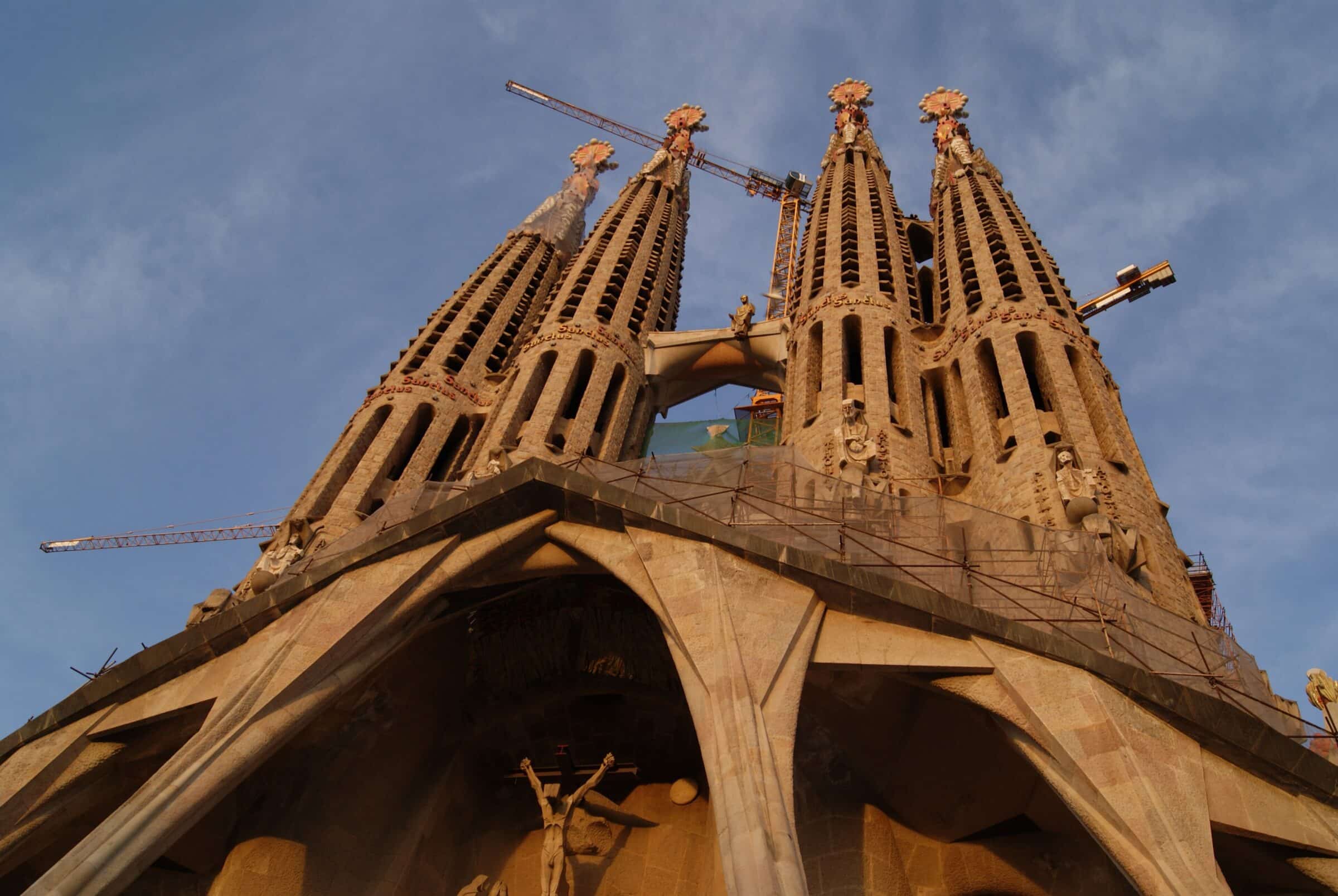
If you ever tour the city of Barcelona in Spain, one stop will be unforgettable, one of the world’s astounding architectural masterpieces. We refer to the Sagrada Família church. Its construction began in 1882, and after 144 years of meticulous crafting, its completion was recently celebrated with a papal mass that drew international coverage and more than 100,000 celebrants to the basilica and its surrounding streets.
Its mammoth four-armed cross was erected atop the main tower earlier this year, making it, at 566 feet, the tallest church in the world. But its height is a mere footnote compared to the unusual design itself.
In some ways it seems high-tech, as if equipped with a phalanx of huge rockets ready for launch; yet overall the design is earthy and organic, as if blending elements from the ceilings of Carlsbad Caverns with sculpted shapes resembling a dense grove in the Amazon jungle.
A Master Designer
Every masterpiece can be traced to its master designer — the architect. Sagrada Família is no exception. It owes its elements of genius to one of the world’s most talked-about architects of the modern era, Antoni Gaudí. His quirky, whimsical Park Güell and his undulating facades adorning his apartment buildings (like his La Pedrera) are legendary. Whenever you see one of Gaudí’s creations, his exceeding genius and creativity radiate not only in the overall structure, but in the fine details that fill every nook and cranny.
In the realm of biology we also find dazzling architectural masterpieces, equipped with multi-level design details that exceed anything Gaudí attempted. These masterpieces also point to a master architect.
This inference to design is rooted firmly in scientific evidence and proven modes of scientific reasoning. At the same time, the inference, once made, invites questions that extend beyond science: If the universe was purposefully made, what was the point? If we are the product of purposeful design, what is the purpose of human life? Why are we equipped to ponder and pursue such questions?
Recalling humanity to such questions may prove to be science’s ultimate gift.
The fact that human intelligence, through scientific advances, can observe and decipher such intricate workings, and ask such profound questions, raises another question: Whence did that capacity for such intellectual pursuits originate? One explanation is that the human mind and its reasoning abilities constitute a glorious gift, granted so that we might know a greater mind from which ours is derived.
Many will regard all this as dangerous, a line of thought that threatens to drag our culture back into a benighted age of superstition. But we do well to recall that it was Judeo-Christian theism that served as the unique ground for the birth of science, as noted by Steve Fuller, a sociologist of science at the University of Warwick in England.
Common Knowledge Among Historians
Although Fuller does not identify as a Christian or a practitioner of any religion, he emphasizes what is common knowledge among historians of science: The conviction that nature is the work of a divine artificer, and that humans are made in the image of this being, fueled the birth of science by motivating its founders to go searching for an underlying order they had reason to believe they could successfully uncover.
Isaac Newton, Johannes Kepler, and other scientific pioneers built their quest for knowledge on the conviction that the universe was created, and thus the study of the cosmos provides the wondrous prospect of probing and beholding the Creator’s mind. Theistic belief, in other words, has proven good for science.
“Man or Rabbit?”
At the same time, we ought to recall C. S. Lewis’s cautionary note regarding religion, namely that “what good it will do you” is not how one should settle the debate between, for example, atheism and monotheism. Lewis sounded this warning in his impish essay “Man or Rabbit?,” though there he set before the reader the scenario of someone attempting to resist theistic faith on the view that surely it was inessential from a practical perspective.
In the essay, Lewis pictures a person who takes a purely pragmatic approach to the question of religious faith:
Can’t you lead a good life without embracing a God-centered picture of reality?… I’m not interested in finding out whether the real universe is more what like the Christians say than what the Materialists say. All I’m interested in is leading a good life. I’m going to choose beliefs not because I think them true but because I find them helpful.
To this Lewis responds,
Now frankly, I find it hard to sympathize with this state of mind. One of the things that distinguishes man from the other animals is that he wants to know things, wants to find out what reality is like, simply for the sake of knowing. When that desire is completely quenched in anyone, I think he has become something less than human. As a matter of fact, I don’t believe any of you have really lost that desire.
An Open-Minded Hearing
So, yes, although we are convinced that theistic faith is good for science (and good for you in other ways, as we discuss in Epigenetics and the Architect), we note the evidence for this not because we consider it dispositive but only to encourage agnostic readers to give the design hypothesis an open-minded hearing, for many of us have been told all manner of off-putting nonsense about the supposedly stultifying and warping effects of theistic belief.
But our hope is that ultimately neither any ostensible convenience nor inconvenience of such theistic belief will play the primary role in your investigations of these matters. The admonition that rings out from Lewis’s “Man or Rabbit?” is this: In considering the evidence for a designer of life, seek the truth, come what may. Any lesser counsel is surely unworthy of that most curious of animals, Homo sapiens.