






































As a physicist, I’ve often thought that one of the most remarkable aspects of our universe is the discovery that just four fundamental forces of nature govern natural interactions among all particles of matter. Most people have learned that these forces include gravity, electric and magnetic forces (combined into the electromagnetic force), and nuclear forces (separated into the so-called strong and weak forces).
In a series of articles, I’ll highlight each of these forces and their unique roles in shaping the universe and in making life possible. A close look at these forces — individually and in relation to each other — illuminates a level of design that is nothing short of amazing. And it’s certainly not necessary to know about the physics of forces to appreciate their effects!
The Plot Thickens
We enjoy the warmth of sunshine on a beautiful fall day, or the red, orange, and yellow leaves adorning the trees, or the silver light of the moon in its various phases. These, and almost every manifestation of physical nature and life, form a tapestry that sustains and nurtures our souls. The plot thickens, however, when we examine the underlying forces between particles that cumulatively shape all that we see and experience.
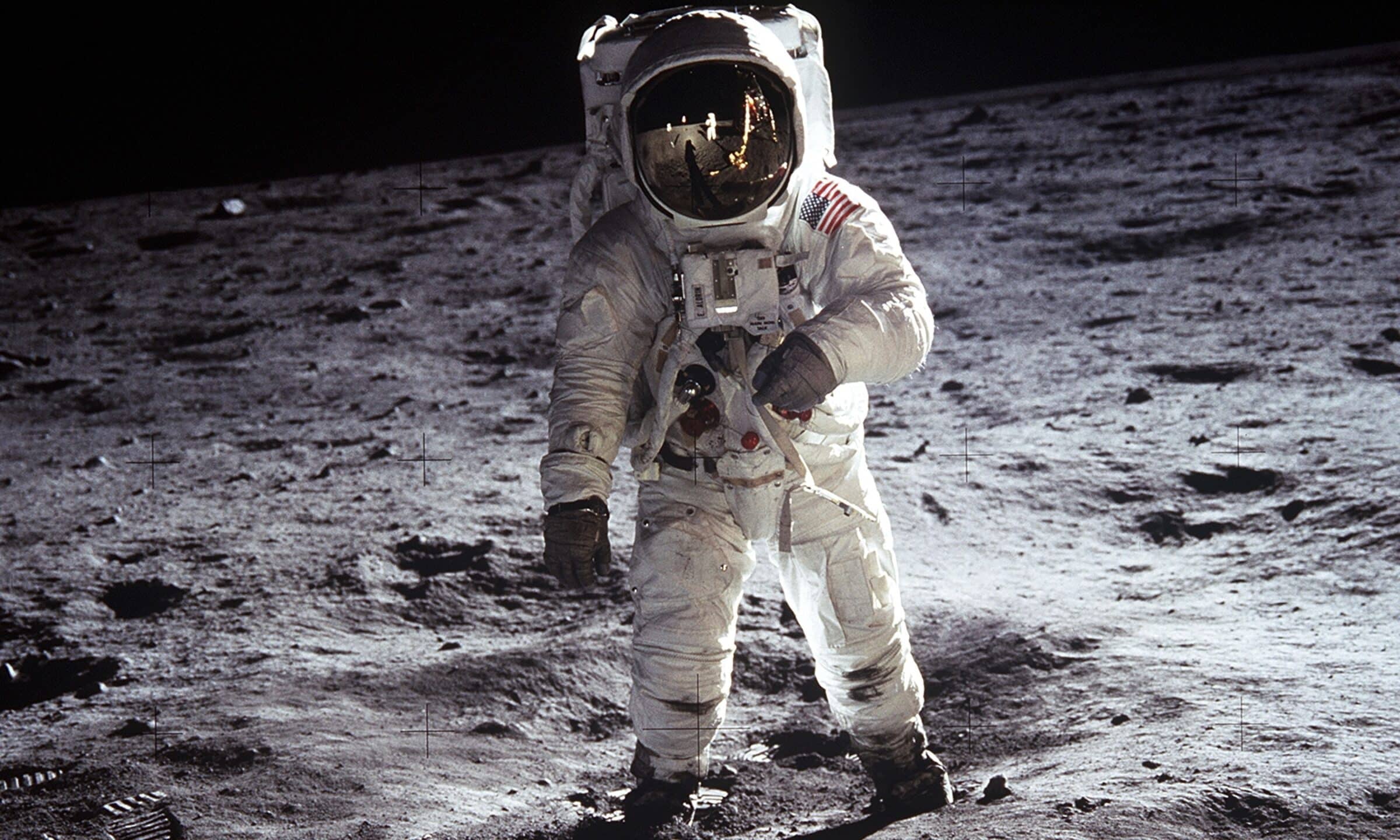
If we think of gravity, we often relate it to the weight of something — more gravity, more weight. Maybe we’ve seen videos of astronauts on the moon, as if they’re walking in slow motion or under water. These effects come from the moon’s surface gravity being about six times less than Earth’s. What causes this? Apparently not just the mass of the moon, since its mass is about 81 times less than the mass of the Earth.
Sir Isaac Newton discerned the correct relationship for the force of gravity — not only is it proportional to the masses of the attracting objects, but it’s inversely proportional to the square of the distance between them. The moon is only about 27 percent of the size (radius) of the Earth, so an astronaut standing on the surface of the moon is nearly four times closer to its center than if the astronaut was standing on Earth. Put it all together, and according to Newton’s law of gravity, the weight of the astronaut on the moon is (1/81)/(0.27)2=1/5.9 (or about one sixth) of their weight on Earth.
Beyond Newton
Einstein’s theory of general relativity extends our understanding of gravity beyond Newton’s classical theory and introduces us to some of the most bizarre physical effects in the universe. General relativity shows that mass (and even the mass-equivalent of energy) bends space itself, so that light rays following the curvature of space can deviate from a straight line and can even undergo “gravitational lensing.”
Perhaps even more unbelievable is the effect of gravity on time. Einstein’s theory shows that time slows down in a stronger gravitational field — an effect that manifests in our GPS systems and must be compensated for to allow the positioning satellites to accurately track your position when driving.
Now, let’s expand our thinking to consider how the force of gravity shapes stars and planets and the entire universe. Going all the way back to the beginning of space, time, matter and energy — the moment astronomers call the Big Bang — evidence shows that space and all the matter and energy within it began to rapidly expand out of essentially a mathematical point, referred to as a singularity.1
The Cause of the Universe
Leaving aside the magnificent question of what could cause the universe to begin, we can imagine that the force of gravity would strongly affect the expansion rate of the universe after the Big Bang. Every bit of matter gravitationally attracts every other bit of matter, so stronger gravity would more vigorously resist the expansion, and a weaker force of gravity would be less effective at slowing the expansion. By the way, gravity doesn’t exist apart from the presence of matter, energy, and spacetime, so gravity can’t be invoked as the cause of the universe, since these things only came into existence with the universe.
If the strength of the force of gravity determines the expansion rate of the universe from its inception, how does that play out in our lives? Here’s the downstream effect of the force of gravity. All the stars and galaxies in the universe eventually came together through the gravitational coalescence of primeval matter that formed in the first few minutes after the beginning (a later article will explore more about how other forces contributed to this process). A slightly weaker gravitational force would have allowed all the primeval matter from the first minutes after the Big Bang to spread out too diffusely for gravity to coalesce it into galaxies and stars. A slightly stronger force of gravity would clump matter together so much that the universe would end up as a “mess of black holes.”
In either case, the universe would be unfit for life of any kind. Careful analysis shows that for the universe to have formed stars and galaxies and to support life as we know it, the strength of gravity needed to be exceptionally balanced2 to one part in 1060.
To appreciate the degree of fine-tuning in this figure, imagine that someone calculated that the universe couldn’t support any life if it was just one second older or younger than it presently is. This would give a fine-tuning in age of one part in 1017. The fine-tuning of gravity is ten million times a trillion, trillion, trillion times more delicately tuned than that!
The Electromagnetic Force
Another point of the fine-tuning of gravity is seen in comparing it to the strength of the electromagnetic force. Every star maintains its existence in a balance between two forces — gravity trying to collapse it and gas pressure resisting that collapse.
As a force of nature, gravity is the ultimate weakling. Astrophysicists have calculated that the extreme weakness of gravity compared to the electromagnetic force (to the tune of about a trillion times a trillion times a trillion (1036) times weaker) is necessary for the gravity-pressure balancing act to make a star like our sun shine and support life on a planet like Earth. To get a stable stellar balance at all requires fine tuning the ratio of the strengths of these forces to one part in 1035.3
Turning Our Focus to Planets
We undoubtedly know that all planets are formed and held together by the force of gravity, and, of course, the weight of everything on Earth is proportional to the strength of the gravitational force. Perhaps less well appreciated is that our atmosphere is also held in place by the force of gravity, and that the strength of this force even affects the long-term composition of our atmosphere. Molecules of gas in the atmosphere of a planet can escape into space if their velocity exceeds the planet’s so-called escape velocity. Weaker gravity leads to a lower escape velocity, allowing a higher rate of atmospheric loss.
However, in determining the livability of an atmosphere, a balance must exist between the loss rates of gases that are favorable for life and those that are not. For example, consider methane, ammonia, and water vapor, with nominal molecular weights of 16, 17, and 18, respectively. The average velocity of an atmospheric molecule is inversely proportional to the square root of its molecular weight, and so it’s more likely that methane and ammonia would escape into space over time than would water vapor. If gravity were slightly different, our atmosphere could either see a build-up of these unhealthy gases over time, or a higher loss rate of essential water vapor.
An interesting consideration of a planet’s surface gravity on technological development was investigated by astronomer Guillermo Gonzalez. He finds that a small increase in the force of gravity would render space flight exponentially more difficult, as summarized in an earlier Science and Culture article.
…as the surface gravity of a planet increases, the amount of fuel needed for a rocket to be blasted into space increases at an exponential rate until so much fuel would be needed that it would be impossible for the rocket to escape a planet’s gravity.
Although the focus of this result was on the difficulty of launching space travel from “super-Earth” exoplanets, the conclusion also holds relevance for a given planet, if the strength of the fundamental force of gravity increased over its current value.
Adjusting Multiple “Dials”
One could possibly argue that a change in the strength of gravity could be compensated for by concomitant changes in other factors or forces. However, as astrophysicists Geraint Lewis and Luke Barnes describe in their book, A Fortunate Universe: Life in a Finely Tuned Cosmos, trying to compensate for the effect of changing one physical parameter by changing others (adjusting multiple “dials” at once) is problematic.4
Life requires a number of different constants to be related to each other in unusual and precise ways….Sure, there are many dials. But there are also many requirements for life. Adding more dials opens up more space, but most of this space is dead.
Without gravity, life would be nonexistent in our universe, and the more in-depth we study the effects of gravity, the more evidence we find for its remarkably finely tuned properties to support life.
Notes
- Eric R. Hedin, “The Cosmological Singularity,” Dictionary of Christianity and Science: The Definitive Reference for the Intersection of Christian Faith and Contemporary Science, P. Copan, T. Longman III, C. L. Reese, and M. G. Strauss, eds., (Grand Rapids, MI: Zondervan, 2017), p. 115.
- Geraint F. Lewis and Luke A. Barnes, A Fortunate Universe: Life in a Finely-Tuned Cosmos (Cambridge: Cambridge University Press, 2016), p. 165.
- Eric Hedin, Canceled Science: What Some Atheists Don’t Want You to See, (Seattle: Discovery Institute Press, 2021), p. 95.
- Geraint F. Lewis and Luke A. Barnes, A Fortunate Universe: Life in a Finely Tuned Cosmos (Cambridge, UK: Cambridge University Press, 2016), pp. 255, 261.