






































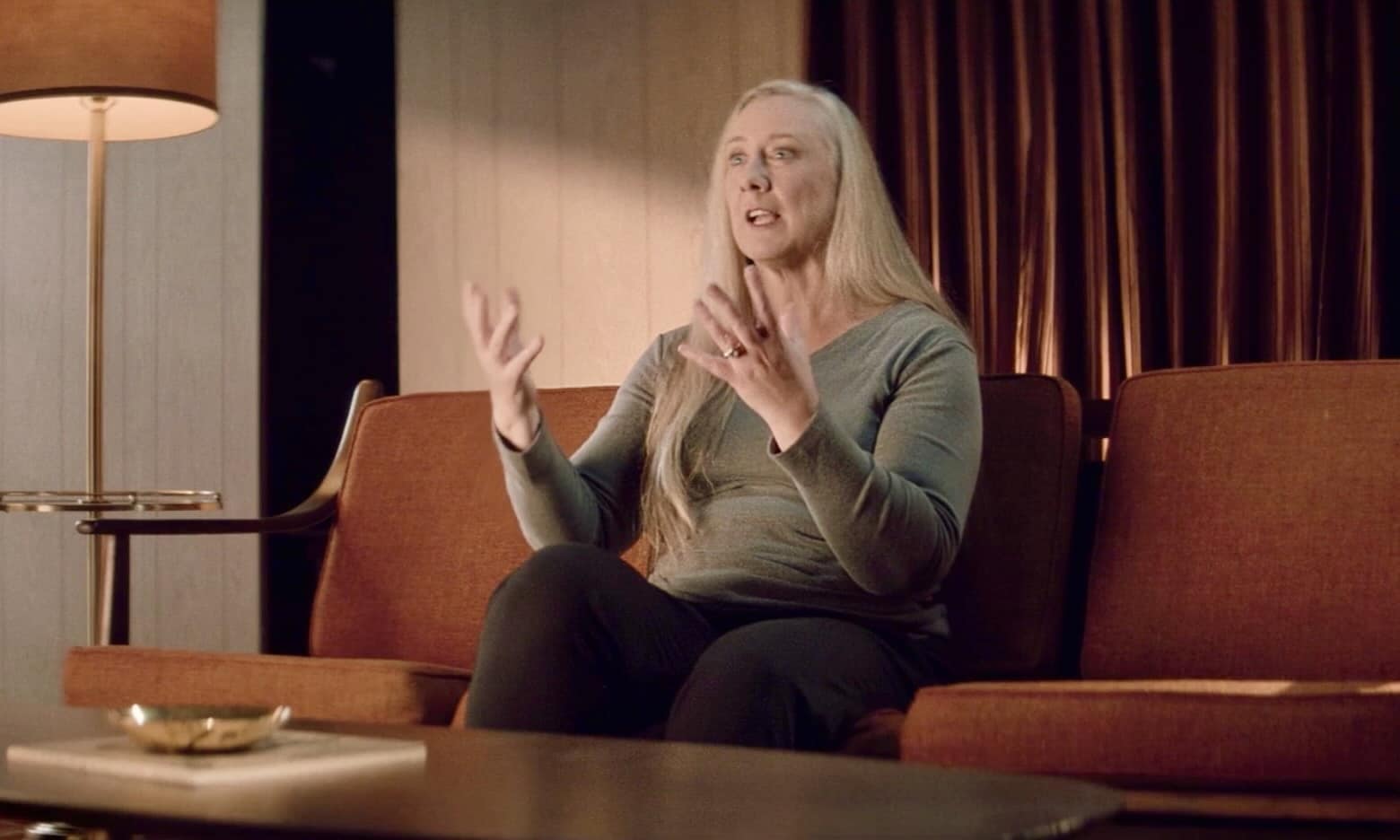
Sarah Salviander is an astrophysicist who appears as one of the diverse range of scientific experts in the upcoming theatrical documentary The Story of Everything, out on April 30. The film presents the case that of two possible “stories” we can tell about reality, either including or denying a source of immaterial, intelligent purpose behind nature, the scientific evidence is overall far stronger for purpose.
Writing on X, Dr. Salviander (pictured above) poses an interesting question:
As an astrophysicist, I was convinced of a Creator by the ingenuity of the observable universe; but I have to admit that biology is even more convincing. The incredible machinery of a living cell is far more complex than the structure of an entire galaxy of stars.
The Premise of the Question
So which is it — what’s the best evidence of intelligent design — cosmology (the study of the origin and structure of the universe) or biology? I know, you’ll say the very best evidence is the conjunction of the two. Fine, but that’s not what I’m asking. The premise of the question is that you have to choose just one.
Based on Stephen Meyer’s Return of the God Hypothesis, The Story of Everything beautifully covers evidence (not all the evidence!) from both cosmology and biology, also including the very hard problem of how to explain, without design, the “gratuitous beauty” of nature. That is, the beauty that need not have been there at all — and almost certainly wouldn’t be, if the materialist story were true.
The whole picture “seems to be reaching out to us,” as biologist Richard Sternberg says in the film. The suite of scientific evidence in all its forms wants somehow to catch our attention, to hint to us about itself.
Hitchens’s Answer
Atheist Christopher Hitchens had an answer to Dr. Salviander’s question, different from hers. Caught on video in the back of a car, in which he was riding with pastor Doug Wilson, Hitchens said about himself and his fellow atheists:
I think every one of us [champions of atheism] picks the “fine-tuning” one as the most intriguing [of arguments for intelligent design]…. You have to spend time thinking about it, working on it. It’s not trivial. We all say that.
That’s a striking statement, especially the seeming unity of top atheists on it. But I agree with Salviander (biology over cosmology as evidence for a design, if you had to pick one), not Hitchens. That’s for a few reasons.
First, it’s only because there is biology that biological beings like ourselves can wonder about this question in the first place. Imagine that material nature existed, as initiated at the Big Bang with its fine-tuned physical constants and its other properties exquisitely tuned from the very beginning for life like ours. But then imagine that, despite it all, we didn’t exist.
Apparent fine-tuning, so you’d have all the stars and galaxies, but no life. Well, that would seal the case against design. That’s almost too obvious to mention.
Second, there is the intimacy of biology. The most intimate aspects of our humanity are tied up most directly with biology, not physics or chemistry. At the end of The Story of Everything, philosopher Timothy McGrew uses a lovely image of your finding a seemingly abandoned cabin in the woods, but with, you discover, a hot cup of tea sitting on a table waiting for you.
It’s only the biological creature who will enjoy that gesture. Cosmic fine-tuning has little of the warmth, the caring, embodied in that cup of tea, in this world of life “bearing everywhere the fingerprints of its Creator.”
Design in Real Time
Finally, as Dr. Richard Sternberg has been foremost in arguing, biology gives evidence of intelligent design in real time. That is unlike the design that was set at the beginning of creation, the fine-tuning for physical existence and ultimately for life.
As detailed in my book about Sternberg’s thought, Plato’s Revenge: The New Science of the Immaterial Genome, an immaterial realm, which some think of as the mind of God, interacts with life on a continuous, moment-to-moment basis.
The information in DNA is not sufficient, far from it, to account for the operations of life. An immaterial genome must be participating, always.
Though we can take in the wonder of the starry sky on any clear night, cosmic design is in the past. The stars themselves, as we know them from their light, are in the past. Biological design is in the present as well as in the past, ongoing in your every cell. That’s the main reason why, if I had to choose one, I would choose biology.