






































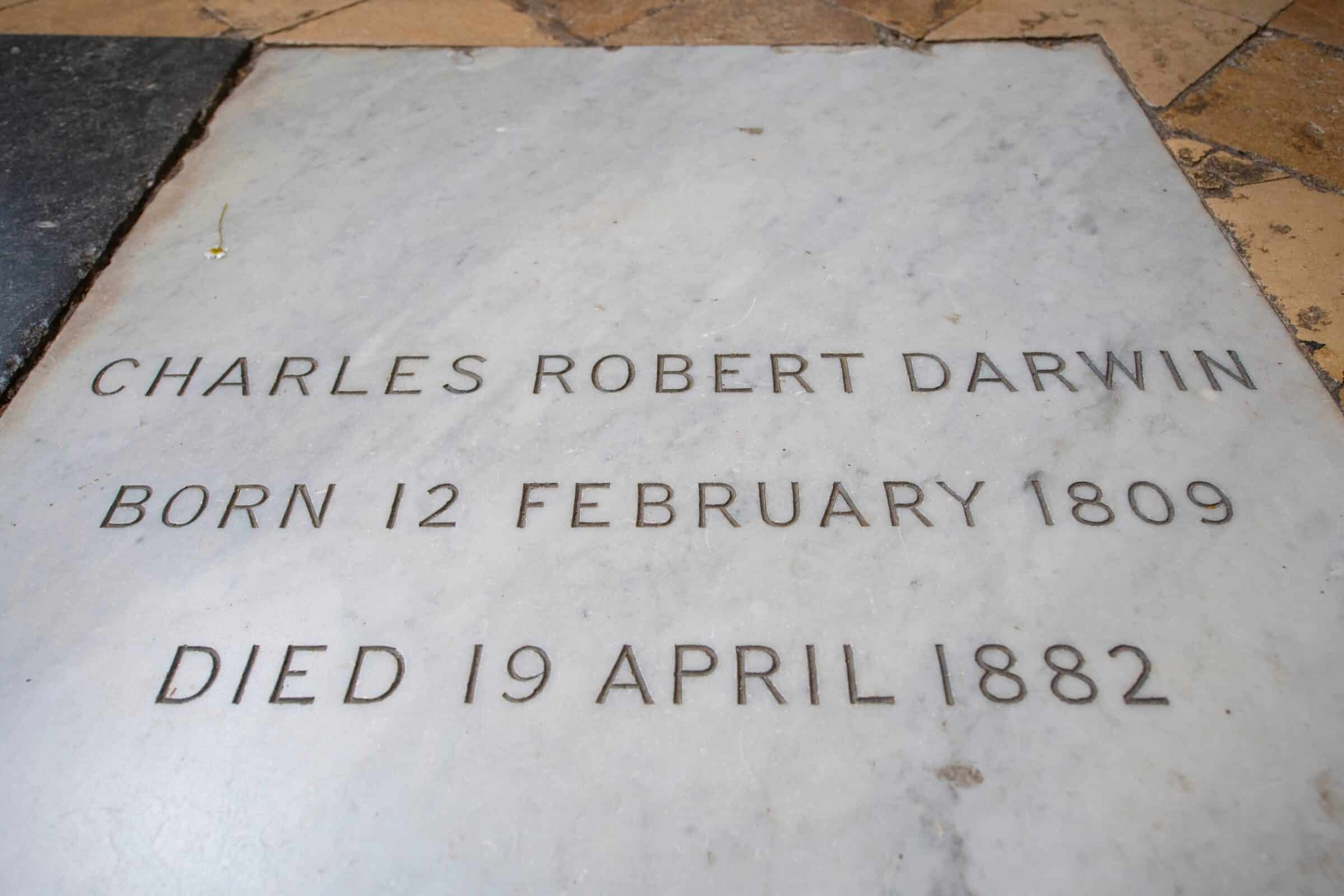
Over the years, there has been a continuing debate over a significant issue, namely, Charles Darwin’s purported atheism. Many, such as Karl Giberson, describe Darwin as a “reluctant” agnostic (p. 38). Kenneth Miller admits that Darwin often equivocated on the subject, sometimes identifying as an agnostic and at other times feeling compelled “to look to a First Cause having an intelligent mind . . . [in which case] I [Darwin] deserve to be called a theist” (p. 287). Whatever Darwin’s beliefs at any given time, Miller argues that Darwin’s God — the God that Miller believes in — stands behind a system of nature where chance rules, in some senses, independent of God, in a law-based world of chemistry and physics.
Alister McGrath, pointing to those “laws impressed on matter by the Creator” affirmed in Darwin’s Origin, claims “there is not even a whiff of a personal atheism here…. It is difficult to believe that his references to a Creator in the Origin of Species were simply contrived to mollify his audience, representing crude deceptions aimed at masking a private atheism that Darwin feared might discredit his theory in the eyes of the religious public” (pp. 159-160). Despite all this, science historian and philosopher Maurice Mandelbaum long ago referred to Darwin’s agnosticism “as an undogmatic form of atheism” (p. 376). I am convinced, after years of study, that Mandelbaum got it spot on.
Three Pieces of Evidence
To get at why this is so, I offer three bits of solid historical evidence as follows:
First, though Darwin dismissed its effect upon him in his Autobiography years later, there can be little doubt that his involvement with the Plinian Society (he was only 17 when he joined) at the University of Edinburgh exposed him to the most radical “freethinking” ideas of his generation. There he met Robert Edmond Grant who became an older role model for him: “Nothing was sacred for Grant,” write Desmond and Moore. “As a freethinker [like the other Plinians], he saw no spiritual power behind nature’s throne” (p. 34). Darwin was impressed by this expert on aquatic invertebrates, and although the exposure wasn’t long, “What he learned from Grant in those months was to shape his own approach to evolution ten years later” (Desmond and Moore 1991, p. 36). While Darwin was aboard the Beagle, Grant provided the philosophical template through which he would view nature.That’s near the beginning of his life. What about at the end?
Second, months before his death, Darwin agreed to meet with Edward Aveling and Ludwig Büchner, two of the era’s leading atheists. On September 28, 1881, they met the sage of Down House along with his son Francis. According to Aveling, the subject of religion was broached not by either Büchner or himself but by Darwin. He wanted to know why his guests called themselves atheists. Aveling and Büchner insisted that they were not god “deniers” — but, instead, only not god affirmers. Aveling indicated that Darwin agreed with their line of reasoning but preferred the term agnostic, to which both replied: “‘Agnostic’ was but ‘Atheist’ writ respectable, and ‘Atheist’ was only ‘Agnostic’ writ aggressive” (Aveling 1883). But Darwin’s gentler spirit thought atheism was too strong a term for the public and suggested that agnostic was a more acceptable, seemingly more on strategic than philosophical grounds. Aveling reported that Darwin was in essential agreement with both his and Büchner’s views, and they left overjoyed “that our Master had cast off the old bonds, and was walking in the large freedom that he has given [through his writings on evolution] to so many of his brothers and sisters.” Francis Darwin admitted later that Aveling’s account of the events was largely accurate but that a mere reading might leave the false impression that his father was in more agreement with the reporter than was actually the case. But Francis noted no real disagreement between his father and the two atheists, only some quibbles over terminology. Taken altogether, Francis’s explanation of his father’s meeting with the atheists amounts to public relations damage control.
Too Radical for the Unitarians
Third, sandwiched between these two interesting events at the beginning and end of the evolutionist’s life is his curious but revealing relationship with Francis Ellingwood Abbot. Abbot, an American, was a nominal theologian — too radical even for the Unitarians — and a prominent secular humanist before the term was popular. According to Abbot, the Christian religion based upon the exclusive divinity of Christ was outdated. He advocated for a “scientific theism” that cast aside the old religious superstitions of the past in favor of fifty radical propositions calling for (among other things) “the extinction of faith in the Christian Confession” in favor of a so-called “Free Religion” as “the only hope of the spiritual perfection of the individual.” Abbot edited The Index, which served as the weekly manifesto for his “post-Christian” creed. Not only did Darwin and his son William subscribe to The Index, but they offered financial support to the publication “in your [Abbot’s] noble & determined struggle” for his brand of secularized religion (Desmond and Moore 1991, p. 591). In response to Abbot’s propositions he wrote, “I admire them from my inmost heart, & I agree with almost every word.” However, when the issue of atheism became a political issue in England with the election of Charles Bradlaugh, founder of the National Secular Society, as a Liberal MP in 1880, the Darwins became nervous that their support of Abbot might get back across the Atlantic to their English audience. Charles Darwin’s public endorsement of Abbot’s Truths for the Times (1872) was quietly but promptly withdrawn. Writing back to the author, William complained to Abbot that his father “had no intention that his words would be used for that purpose.” Of course, this was nonsense; Abbot knew Darwin’s endorsement was to be used for advertising copy, but he complied rather than make an embarrassing fuss (Desmond and Moore 1991, p. 643). In other words, Darwin was willing to give his money and his mouth in support of a clearly secular cause covered in a weak veneer of “spirituality,” but at the risk of exposure all support was withdrawn. This gives credence to precisely what McGrath wants to deny — that Darwin’s God-talk was indeed strategic and meant to mollify his audience. In short, Darwin was afraid to commit in public to an essentially atheistic position that he personally supported and endorsed. This is perfectly consistent with his private conversation with Aveling and Büchner.
A Consistent Position
Darwin claimed in his Autobiography that his move away from religion was so slow and gradual that he hardly noticed it. Whether that is true or not, what is true is that these three historical facts demonstrate a consistent position away from religiosity, a position certainly held by his grandfather Erasmus and his father Robert.
What all this tells us is that the arguments of Giberson, Miller, and McAlister that seek to minimize Darwin’s secular materialism lack historical credibility. Darwin was, in fact, exposed early on to materialist reductionism and his quiet alliance with Abbot is perfectly consistent with what he would have learned at Grant’s side as a youth. Moreover, his reluctance to announce in favor of atheism was not born of philosophical resistance to the idea, but simply a matter of strategic preference for a subtler approach, precisely what one would expect of a master rhetorician who favored a flanking action over a frontal assault. Therefore, Mandelbaum’s formulation, “undogmatic atheism,” seems a perfect fit.
A True Theistic Evolutionist
This is why getting our terms straight is so important. Calling Gibberson, Miller, McGrath, and others like them theistic evolutionists is inaccurate because it fails to distinguish them from genuinely theistic evolutionists. What they really should be called are Darwinian theists. That Darwinian theism is at best awkward and at worst just incoherent seems obvious. But Darwinian theists are not theistic evolutionists because they carry metaphysical baggage that does not encumber those who believe in a God-inspired or God-directed evolution.
An example of a true theistic evolutionist is the very co-discoverer of natural selection, Alfred Russel Wallace. For more on Wallace’s thought, William Dembski and I have just released a new edition my Intelligent Evolution. Read that and the difference becomes clear.
Sources
- Aveling, Edward B. 1883. The Religious Views of Charles Darwin. London: Freethought Publishing. Available at The Complete Works of Charles Darwin Online.
- Desmond, Adrian and James Moore. 1991. Darwin: The Life of a Tormented Evolutionist. New York: W. W. Norton.
- Giberson, Karl. 2008. Saving Darwin: How to Be a Christian and Believe in Evolution. New York: HarperOne.
- Mandelbaum, Maurice. “Darwin’s Religious Views.” Journal of the History of Ideas. 19, no. 3 (June 1958): 363-378.
- McGrath, Alister E. 2011. Darwinism and the Divine: Evolutionary Thought and Natural Theology. Malden, MA: Wiley-Blackwell.
- Miller, Kenneth R. 1999. Finding Darwin’s God: A Scientist’s Search for Common Ground Between God and Evolution. New York: Haper Perennial.