






































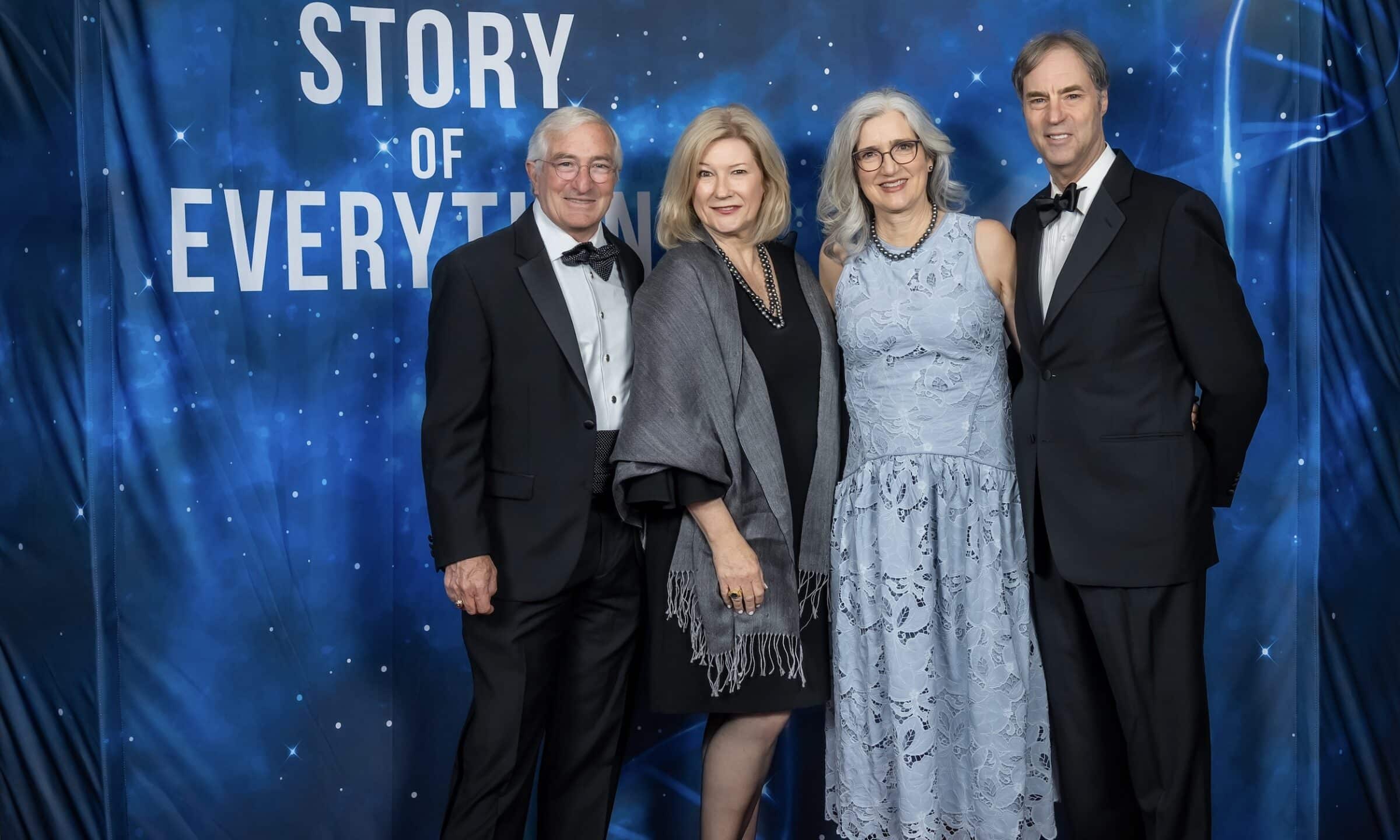
I attended the premiere last night of the theatrical documentary The Story of Everything over at the local arthouse theater, The Angelika, not far from the campus of Southern Methodist University here in Dallas. I’d watched the film (which runs nationally through May 6) on the small screen so I could write an advance review (go read that here). But I was eager to experience the film in its full, widescreen glory. I wasn’t disappointed.
I’m not familiar with video tech, so I don’t know how the film team produced the vast array of haunting, beautiful images of deep space and cosmic time which enlivened this information-packed film. If they used AI they did so with taste and tact — no “shrimp Jesus” cringebait here. The music was subtle, haunting, and exquisitely suited to the action, a journey of the mind through the vast sweep of … literally everything that has ever happened at all, at least within the natural universe, and through two competing theories of why and how any of it was ever possible: reductionist materialism, and intelligent design.
I also was impressed by the film’s judicious use of very well-informed talking heads, eminent scientists and philosophers who unpacked the potentially overwhelming subjects of cosmology, physics, planetary geology, biology, and information science. Nobody spoke too long, and none of these experts veered either into incomprehensible jargon or chintzy pop-science clichés, as too often happens in other science documentaries. Instead, these profoundly well-informed experts acted like very good teachers in the best science class you might remember taking.
Impact on a Large Screen
The visual style of the film is also worth noting, since I’m speaking of its impact on the large screen. While the documentary covers literally the entire history of time, most of the action in it consists of scientists wrestling with the angels of newly emerging data, between the 1920s and our day. The film makes excellent use of historical footage, from jumpy black and white frames of men like Albert Einstein and Georges Lemaître, to slightly grainy VHS footage of Carl Sagan in the 1970s — which fittingly is shown on a classic console TV of the kind we Boomers grew up with. An audio of Fred Hoyle admitting his doubts about his long-fought-for atheism gets played on an old-timey cassette. The interview spaces the filmmakers use for the experts who tell its story are warm, 1950s living rooms, which nicely situates the story of 20th-century materialism gradually collapsing in the face of emerging, 21st-century evidence.
No one voice dominates the narration, with different specialists who’d been interviewed and identified stepping in to recount the parts of the story with which they’re most familiar. But the person we hear from the most is Stephen Meyer, which is fitting since the film is a rich adaptation of his most sophisticated synthesis so far of the case for intelligent design, Return of the God Hypothesis. As those who have read him would expect, Meyer is scrupulously fair and even charitable to figures whose views he’s compelled to critique, from the bristling Richard Dawkins to the much more sympathetic but sadly misguided Stephen Hawking.
A Theory in Crisis
As to the film’s content, beyond its style, I’ll reiterate what I wrote over at Chronicles:
At every point along the grand narrative of creation, the film reveals that the old Victorian story that Charles Darwin told — which inspired the mechanistic political theories of Karl Marx and Adolf Hitler — fails to explain the latest evidence emerging in laboratories, to the point that prominent evolutionary biologists now admit that theirs is a theory in crisis. The evidence of some vast design, and hence a Designer, keeps piling up and embarrassing scientific materialists. The great debunking machine that has shredded the faith of millions over the decades and empowered materialistic reductionists is sputtering to a stop. …
If I had high school or college-aged children, I’d be dragging them to see this film.
I was surprised at first to learn that we in Dallas would be treated to the world premiere of The Story of Everything, instead of some media hub like Los Angeles or Manhattan. My first thought was that it might not even be prudent to try such an event in a blue city and blue state, given the increasing willingness of activists to disrupt or even attack those whose views offend them. (It did have a Seattle-area premiere event, though, as Emily Sandico reported here earlier.)
A More Personal Reason
In fact there’s a more personal reason why Stephen Meyer chose Dallas as the site where he’d appear in black tie and present the video distillation of his three decades of work: It was right here in Dallas, back in the 1980s, that he attended a debate among biologists about the origins of life which planted the seeds of his quest for answers. Here he watched a famous scientific materialist, Dean Kenyon, publicly renounce his widely accepted theory that dead chemicals automatically assemble themselves into information-packed DNA molecules — and humbly admit instead that intelligent design was a much more likely answer. So Meyer was in some sense completing a pilgrimage. It’s well worth retracing his steps by enjoying this marvelous film.