






































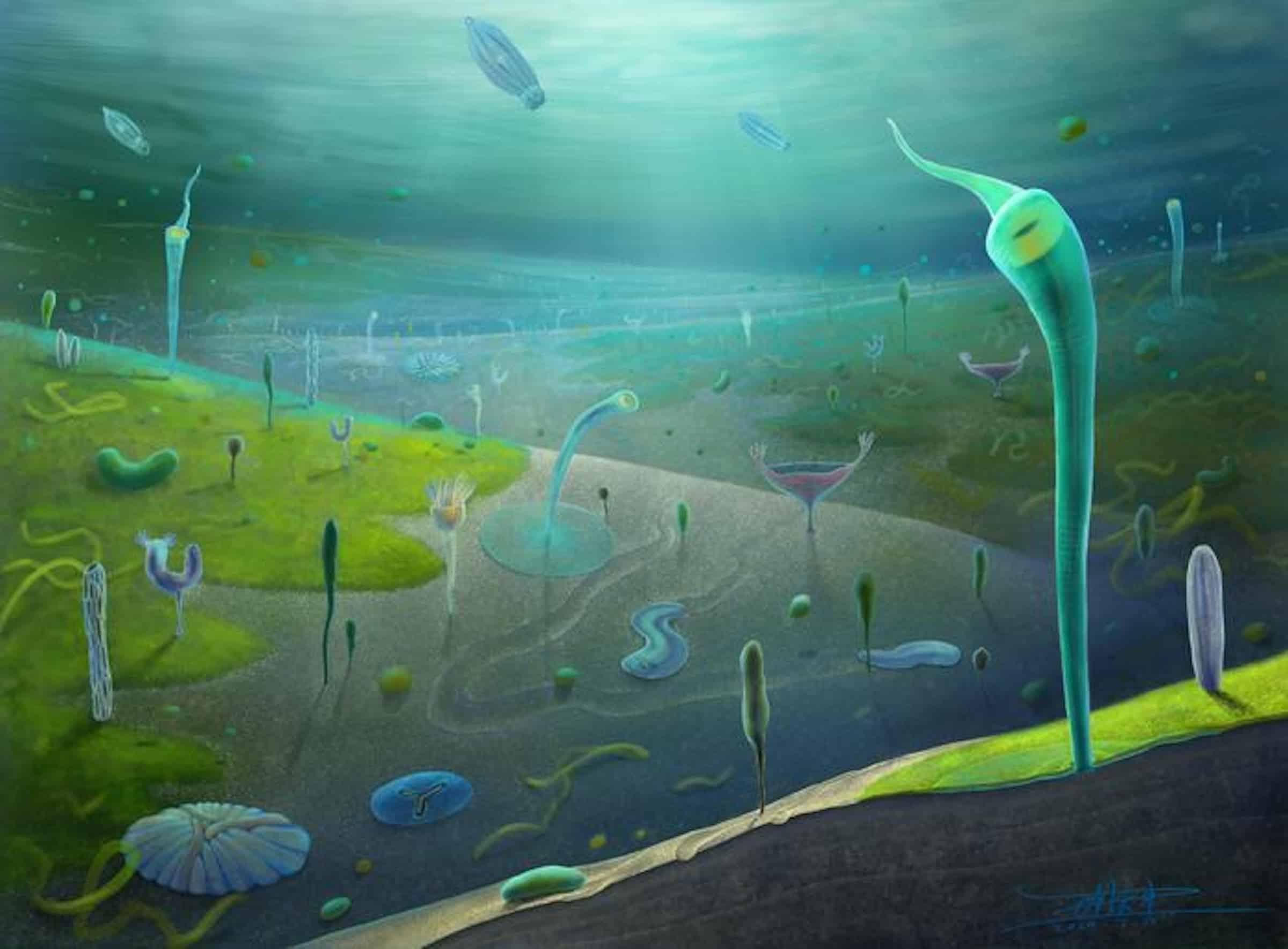
There’s a lot of buzz about a new paper in Science reporting ~550 million year old animal fossils from Ediacaran strata in China. Some are said to be clear examples of Precambrian bilaterians (i.e., animals with right/left bilateral symmetry). This Ediacaran fossil site is about 30 km from where the famous Chengjiang Cambrian explosion fossils were found in the Yunnan Province of China. An accompanying article over at The Conversation by some of the paper’s co-authors explains the great difficulties that scientists have faced when trying to interpret and classify Ediacaran organisms:
The preceding Ediacaran period (635–538 mya) was much more enigmatic than the Cambrian. Many organisms from that period have defied efforts to classify them. Their strange bodies — often resembling shapeless sacs or thin, quilted pillows — have no obvious counterparts among living species, let alone modern animals.
As a result, interpretations of Ediacaran creatures have encompassed almost all multicellular forms of life — from fungi and lichens to an extinct kingdom unrelated to anything multicellular alive today. These Ediacaran organisms lived in close association with mats of microbes that smothered the seafloor — a type of ecosystem that did not survive the advent of grazing bilaterians.
Luskin’s First Law
What you just read is an amusing example of what some of my friends affectionally call “Luskin’s First Law.” It goes like this:
Evolutionists are loathe to admit a problem with their theory until after they think they have found a solution to it. Thus, we routinely see retroactive confessions of ignorance, where a problem is acknowledged only once a solution has purportedly been found.
I’ve discussed these retroactive confessions of ignorance multiple times previously (for example, see here, here, here, here, here, here, and here), describing them thus: “Evolutionists acknowledge a severe gap in their model only after thinking they have found evidence to plug that gap,” and “they concede the lack of knowledge on a certain point only after some new allegedly ‘transitional’ fossil is found.” This is exactly what is happening here.
Consider The Conversation’s article’s confession about the “enigmatic” nature of the Ediacaran fauna and how “their strange bodies … have no obvious counterparts among living species, let alone modern animals.” The article even provides a nice review of how this strangeness has led to major debates about how to interpret and classify the Ediacaran fauna, stating that “interpretations of Ediacaran creatures have encompassed almost all multicellular forms of life — from fungi and lichens to an extinct kingdom unrelated to anything multicellular alive today.”
Why the Sudden Openness?
Yet how many times — prior to the publication of this paper — had we been told that the Ediacaran fauna were ancestors of the Cambrian animals and that solved the mystery of the Cambrian explosion? I don’t know because we heard that so many times.
Now this was never a very strong argument against what’s so revolutionary about the Cambrian explosion. In fact, we’ve been rebutting it for years. Steve Meyer wrote about it in Chapter 4 of Darwin’s Doubt (reviewed here and here, for example), and Günter Bechly and I debunked some of these supposed previous Ediacaran bilaterian animal fossils many times as well. Yet now it is being plainly admitted by leading Precambrian paleobiologists that the Ediacaran fauna “have no obvious counterparts among living species, let alone modern animals”!
We’re witnessing a classic retroactive confession of ignorance. These evolutionary scientists believe the new paper in Science reveals clear Precambrian bilaterian animal fossils from the Ediacaran which were ancestral to the Cambrian animals (more on that in a moment), so only now are they willing to candidly acknowledge all the prior problems.
“Diverse and Flourishing” in the Ediacaran?
Covering this story, Scientific American has another nice example of a retroactive confession. It states:
Before, scientists thought bilaterians primarily arose during the Cambrian period and were rare — certainly not diverse and flourishing — in the Ediacaran.
The technical paper offers a similar retroactive admission: “Body fossil evidence for Ediacaran bilaterians is meager, with only four controversial genera, Kimberella, Ikaria, Uncus, and Yilingia.”
What curiously candid statements! But how many times before this new Science paper did we hear it claimed that there were very good examples of Ediacaran bilaterian fossils? To adapt a famous Disney song, it was always “Kimberella, Kimberella / Night and day it’s Kimberella”!
OK, maybe not quite that bad, but the purported mollusk was cited as a Precambrian bilaterian by keyboard warriors and even some more-qualified experts more times than I can remember. Apparently those claims weren’t quite correct after all because its evidence for bilaterian symmetry is now apparently “meager” and “controversial”!
One danger for evolutionists in making these retroactive confessions is that the evidence which supposedly plugs the old gap that’s now finally being acknowledged may not turn out to be so strong after all. We’ve seen this happen before (e.g., here and here). To their credit, the authors of the new paper in Science appear to recognize this danger and are more measured in their claims than is the Scientific American article. Instead of trying to claim that there is now clear evidence that animals were “diverse and flourishing” in the Ediacaran just before the Cambrian explosion, the Science paper frankly concedes:
Animal fossils typical of late Ediacaran assemblages are scarce in both diversity and abundance.
It seems that Scientific American’s retroactive confession of a problem actually isn’t as retroactive they’d hoped.
But what about the other admission that Ediacaran fossils “have no obvious counterparts among living species, let alone modern animals”? Is it rectified by these newly discovered Ediacaran fossils? Do the new fossils match up with well-established animal phyla known from the Cambrian explosion? Does this paper finally solve the mystery of the origin of Cambrian animal fossils? The answer, in my opinion, on all counts is … no. We’ll discuss why in my next post.