






































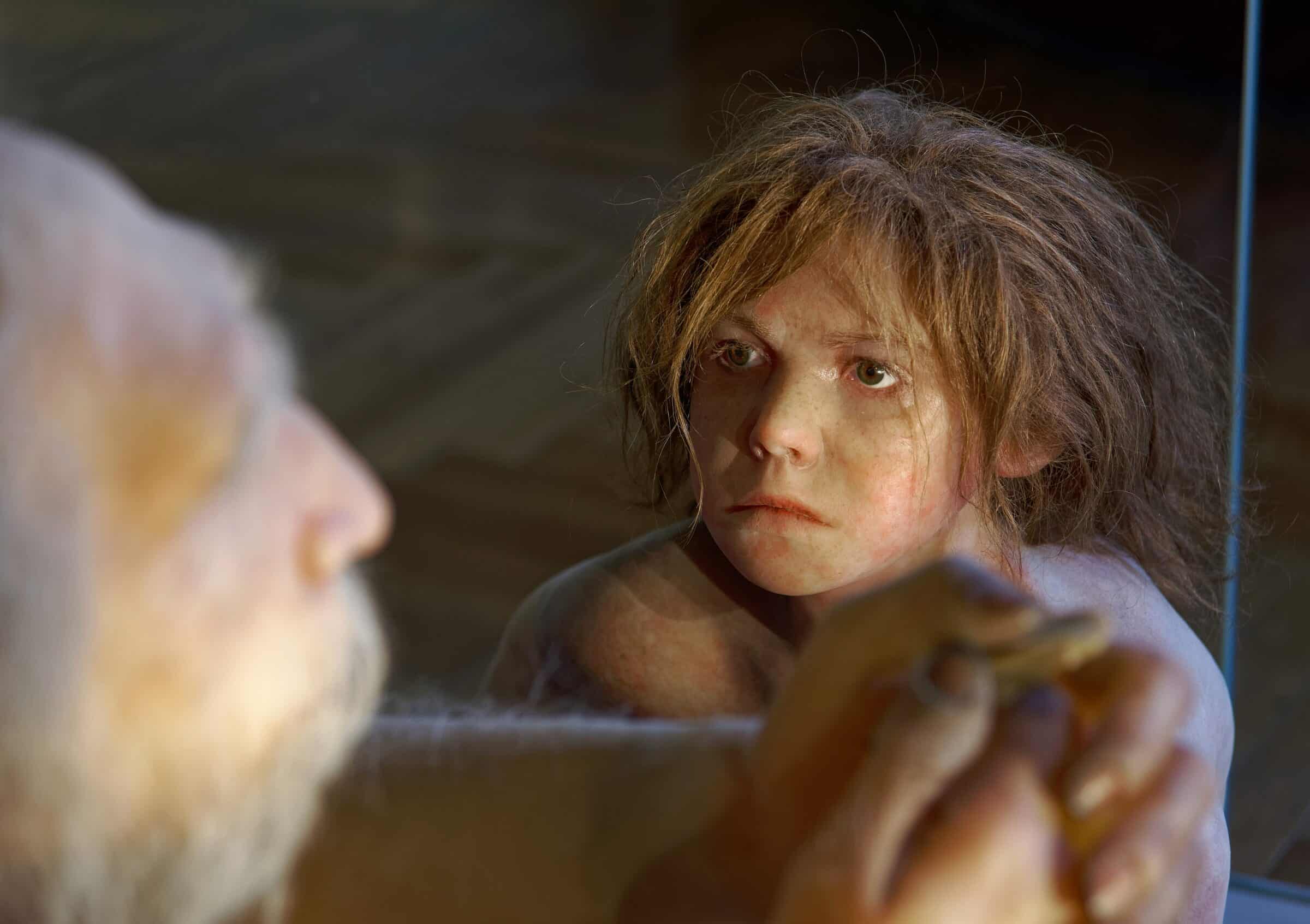
We’ve discussed many times the fact that humans and Neanderthals are so similar that Neanderthals provide no evidence we are closely related to some type of primitive non-human hominid. Now, a new pre-publication paper reviewed by New Scientist provides more evidence for this, proposing the radical hypothesis that Neanderthals are not only closely related to humans — they are descended from us!
Michael Marshall asks, “Are Neanderthals descendants of modern humans?” He writes:
Among the many other human species that once inhabited Earth, the Neanderthals are the most famous. They lived until relatively recently and in many ways, they were like us.
Just in the past few months, we’ve seen tentative evidence of them treating wounds using tar with antibiotic properties made from birch bark. An ancient yellow crayon, made of ochre, gave us a hint of their artistic practices. A well-preserved skull suggested that their noses weren’t adapted for cold climates, as many had thought. Elephant bones from Germany show signs of having been butchered by Neanderthals. There is even suggestive evidence of Neanderthals crossing wide expanses of water.
Reviewing the “Candidate Ancestors”
Marshall then goes through various potential “candidate ancestors” of Neanderthals and explains in each case why they don’t work:
- Homo erectus may seem like a good option on temporal grounds, but Neanderthals are mainly found in Europe and “despite decades of searching, nobody has found H. erectus in Europe.”
- Another option is “Homo antecessor” but he says too little is known about this species: “The trouble is that H. antecessor are known from only one site: the cave of Gran Dolina in Spain. While the site held remains from at least six individuals, we don’t know how widespread or long-lived the species was. Mark it as promising but unproven.”
- Or there’s Homo heidelbergensis, but again we run into problems: “Most of the fossils originally thought to be H. heidelbergensis have been reassigned to other species upon further analysis, so nowadays there are only a few left, all from Europe. This means our knowledge of the species is patchy. And crucially, the fossils left in the group seem to be too recent to be Ancestor X.”
But that leaves out one potential option — our species, Homo sapiens. The idea has been proposed by a highly credible scientist — David Reich, a geneticist at Harvard (including both the Howard Hughes Medical Institute and the Broad Institute). He argues for this in a new paper at bioRxiv that has not yet been peer-reviewed, “Hypothesis: A modern human range expansion ~300,000 years ago explains Neandertal origins.” At New Scientist, Marshall explains Reich’s basic argument:
Reich suggests that the origin of Neanderthals lies in an early migration out of Africa by modern humans. The oldest examples of our species are about 300,000 years old, from Morocco. Reich proposes that some of them wandered into Europe and interbred with the as yet unidentified local hominins, sometime between 400,000 and 250,000 years ago.
The resulting hybrids lost most of their modern human DNA, but they did keep their modern human Y chromosomes and mitochondrial DNA. These hybrids were the Neanderthals. This is a wholesale reinterpretation of the genetic evidence, which would mean those earlier episodes of interbreeding that messed with the Neanderthal Y chromosome and mitochondrial DNA weren’t a minor detail: they were the origin of Neanderthals.
This scenario neatly explains a curious archaeological finding. There are distinctive stone artefacts called Levallois tools, which were used in Africa from at least 400,000 years ago (presumably by modern humans), but also in Europe and the Middle East (presumably by Neanderthals) between 480,000 and 300,000 years ago. We might imagine that modern humans and Neanderthals independently invented Levallois tools, but it’s a little neater to suggest that some modern humans took them with them when they left Africa.
Anticipating Complaints
Again, Reich’s paper has not yet been peer-reviewed, but it does advance a fascinating hypothesis. Here’s the abstract, which lays out of the evidence that Reich believes supports the thesis:
This paper demonstrates the feasibility of the hypothesis that Neandertals formed when a population using recently developed Levallois stone tool technology expanded between 400-250 thousand years ago (ka). In Europe, their range expansion into an area with Sima de los Huesos-like people led to massive introgression of local archaic genes producing a population with around 95% archaic ancestry (Neandertals); if this range expansion was sex-biased it would provide a simple explanation for why Neandertals retain modern human lineage Y chromosomes or mitochondrial DNA. In Africa, interbreeding with local archaic humans led to more modest archaic admixture and the deep substructure detected in all modern humans today. This proposal explains four previously perplexing similarities of modern humans and Neandertals — sharing of mitochondrial DNA, Y chromosomes, Levallois tools, and 300-200 ka date of formation by mixture — even while Neandertals and Denisovans cluster genome-wide.
I don’t know if the thesis is true — I anticipate that Reich will get complaints that it requires non-parsimonious losses of particular DNA segments in Neanderthals now known to be specific to modern humans — but certainly it’s no less parsimonious than a lot of other phylogenetic hypotheses out there. Here’s my main point: the very fact that you can propose this hypothesis that Neanderthals are descended from humans and back it up by multiple lines of evidence shows again just how similar we really are. Whatever our exact relationship may be, Neanderthals don’t show that humans are related to a primitive, non-human form.