






































Picture a horror movie based on this premise: don’t say certain words. Just don’t do it. In fact, it is dangerous even to think about those words. If you’re not careful, the thought itself might cause you to blurt out the word, and then — catastrophe.
In his dystopian novel 1984, describing a political and cultural setting that tips over into horror as the novel goes on, George Orwell coined a noun for this: thoughtcrime: “The forbidden thought is the parent of the forbidden act.” While thoughtcrime may seem a stretch when applied to evolutionary theory, a new hypothesis for the origin of the ribosome shows the problem immediately, in the third sentence of the article’s abstract.
The First Author
Before we get to that, however, it’s worth paying some attention to the identity of the first author, population geneticist Michael Lynch of the Biodesign Institute at Arizona State. Lynch is an influential member of the National Academy of Sciences, a prolific author and theoretician, and someone who has never been shy about offering his opinions on the shortcomings of standard evolutionary theory (SET). His best-known gripe about SET concerns indiscriminate appeals to natural selection. Consider the following, for instance, which rivals the skepticism of many young-Earth creationists: “The blind worship of natural selection is not evolutionary biology. It is arguably not even science” (2007, 369). As Lynch sees it, the abuse of natural selection as an explanatory mechanism flows from the “story-telling” (2007, 8597) it involves:
With this mind set, evolutionary biology becomes little more than a (sometimes endless) exercise in dreaming up the supposed agents of selection molding one’s favorite aspect of phenotypic diversity. However, we now know that this unwavering belief in the limitless power of natural selection is untenable. (2020, 2)
Why is story-telling bad? The clue can be found in the adjective “supposed” and the phrase “dreaming up.” Lynch argues that many adaptive hypotheses rest on nothing more than empty conjectures: suppositions about past events invented (or dreamt up) in the absence of any observational support.
Lynch’s solution? Irreversible evolutionary changes happen to cells because they cannot not happen. Pardon that awkward phrasing, but, to put the same point another way, molecular complexity simply accretes over time because (given mutation rates and population sizes) selection is too weak to eliminate it. No need for a story to explain the origin of x or y. Stuff just happens.
The difficulty with being a reform-preaching biology prophet, however, is listeners may check in to see how you behave.
Lynch’s New Hypothesis
Which brings us to Lynch’s new hypothesis for the origin of the ribosome (co-authored with Andrew Ellington of UT-Austin), where thoughtcrime worries appear right away in the article’s abstract.
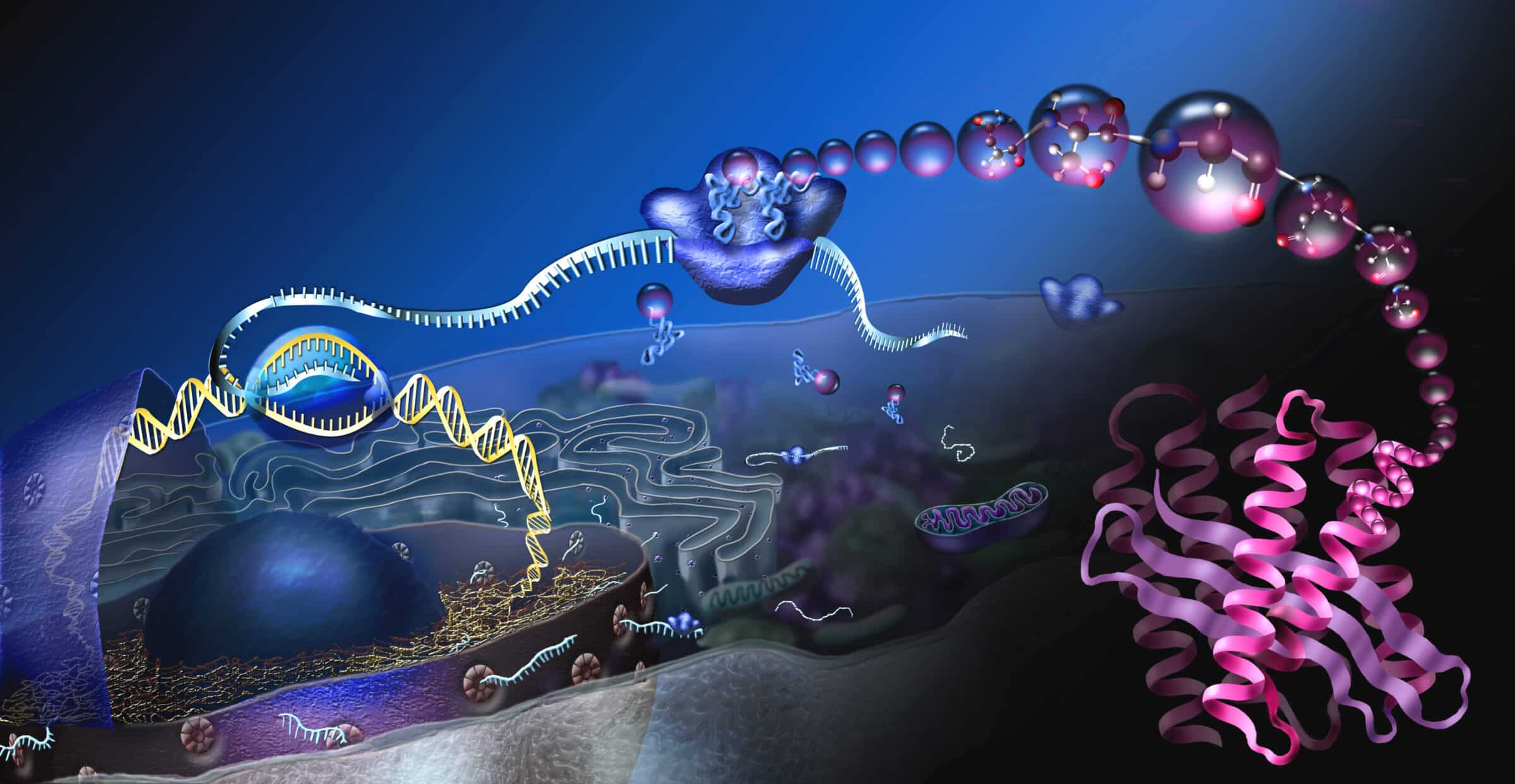
Ribosomes are the molecular machines, found in all Earth life, with the central role of translating the sequence information in nucleic acid (DNA and RNA) into proteins. Ribosomes are BIG and complicated. Moreover, they are essential. No free-living cell on the planet survives without plenty of ribosomes. A typical bacterial cell has tens of thousands of them.
But, for Lynch and Ellington, the first ribosome could not have been a ribosome. Nope, no way, anything but — because that would mean (insert the forbidden words here: thoughtcrime warning!). As they put it,
The origin of life is one of the great mysteries of science. Of the multiple unsolved problems, the origin of the translation system (the means by which the genetic code inscribed on chromosomes is converted into reliable protein sequences) remains the most enigmatic. A resolution of this problem is unlikely to be advanced by focusing on the features of the complex system found in today’s species, as the reliable production of complex proteins could not possibly have been the function of the earliest ribosome. [2026, 1; emphasis added.]
Stuff Just Happens
Any molecular machine as complicated and essential as a ribosome, given naturalistic evolutionary assumptions, must have started out as something else entirely, much smaller, doing a different task, or even no task at all (see below — Lynch’s idea, as you’ll see, is wholly consistent with his “stuff just happens” outlook).
But their claim that making proteins “could not possibly have been the function” of the original ribosomes does not come from the observational evidence we actually have. Ribosomes make proteins using the instructions in nucleic acid. That is what they do. Full stop.
“Could not possibly” is forced on Lynch and Ellington by the risk of (inferring the thoughtcrime word; be careful now).
So, what is their explanation? Guess what — it’s a story. And not a simple story, either. As their open access article argues, ribosomes got their start as molecular parasites, which sooner or later were given jobs to do by the cells they inhabited. The story is illustrated by a multi-stage figure with plenty of arrows and captions, fully as narrative-driven as any neo-Darwinian adaptive tale.
If biological evidence has to be forced into a naturalistic narrative, then story-telling is unavoidable. Once upon a time, there were these RNA parasites, you see…
Welcome to story hour, Professor Lynch. Have a seat over there next to Julian Huxley and Ernst Mayr.
References
- Lynch, Michael. 2007a. The Origins of Genome Architecture. Sunderland MA: Sinauer Associates.
- Lynch, Michael. 2007b. The frailty of adaptive hypotheses for the origins of organismal complexity. Proceedings of the National Academy of Sciences 104:8597-8604.
- Lynch, Michael and Bogi Trickovic. 2020. A Theoretical Framework for Evolutionary Cell Biology. Journal of Molecular Biology 432:1861-79.
- Lynch, Michael and Andrew Ellington. 2026. A symbiotic origin of the ribosome? PNAS Nexus https://doi.org/10.1093/pnasnexus/pgag019