






































Anything that is intentionally made starts with an idea. Leonardo da Vinci affirmed the primacy of mind over making:
In fact, whatever exists in the universe, in essence, in appearance, in the imagination, the painter has first in his mind and then in his hands…
Consider one who desires to build a house. He never starts with a list of materials: 27,480 nails; 18,500 board feet of lumber; 3,200 feet of electrical wire, etc. The builder starts with a finished design in mind, and then begins to collect the necessary construction materials.
What Will Your Book Be About?
Or the one who sets out to write a book, if asked, “What will your book be about?”, will never answer, “I have no idea. I plan to just arrange letters and see what comes out. I may experiment with focusing on words containing two vowels together, but trying to avoid any adverbs ending in ‘ly’.” To write a book worth reading, an author will start with an idea in mind of what the book will be about. The idea exists before the work begins.
Once the work of building a house or writing a book is done, the finished product might then be analyzed and digitized into a detailed instruction set, from which a copy could be made. But even AI can’t make, draw, or write something without an idea of what it is. When I asked AI (Copilot) to give me a short description of how to construct a “zorguk” (a made-up word), it couldn’t do it. It responded instead with information about making a ziggurat.
Thomas Woodward and James Gills, in their new book Epigenetics and the Architect, summarize an article by the late Jonathan Wells in which he challenged “the widespread assumption that an animal’s unique three-dimensional body plan could be specified from nothing more than a one-dimensional, letter-by-letter DNA code.”
In an earlier article at Science and Culture, I elaborated upon considerations of the fundamental electrical forces within a cell that would prevent anything like a sequential DNA code from being sufficient to build a living cell composed of interacting three-dimensional biomolecular components. In short, the nature of living things is manifested in their “wholeness,” which transcends bitwise assembly instructions.
Darwin’s Deceptive Idea
We all realize that nothing meaningful, complex, and functional is made by a willy-nilly juxtaposition of components. Darwin’s deceptive idea is that natural selection and survival of the fittest could ratchet up low levels of information to elegant design. I’ve written about this before:
The only way for this to happen is if the selection mechanism (in other words, the ratchet) is designed to produce the target outcome, and this means that the mechanism must already contain the information specifying the target. A physical mechanism cannot produce any information beyond what it already contains.
This would be like trying to program a computer to write a book by sequentially selecting letters that would most likely lead to a best-seller — all without any foresight of what a best-seller is.
In a previous article, I discussed why a living organism would defy any reductionistic analysis to an instruction set. To a large degree, living things fit the description of “all or nothing.” For example, one could randomly excavate 10 percent of a mountain and it would still be a mountain. But if you randomly excise 10 percent of a living creature, it would probably die, or end up crippled.
Even inanimate systems may reveal functionality that transcends human ingenuity or reduction to a set of instructions. For example, we can dump a bucket of sand and make a pretend mountain in a sandbox, but we could not orchestrate plate tectonics to make a Mount Everest. We can install a sprinkler system to water our lawn, but we could not make a planetary water cycle to sustain the continents with rain.
Finely Tuned Features
We build our houses with furnaces and air conditioners and a thermostat to maintain a comfortable inside temperature, but we could not make a star and planet system with long-term climate feedback mechanisms in place. Our continued existence depends upon many such finely tuned features to maintain the habitability of Earth over hundreds of millions of years for hundreds of thousands of different species of life. Could we write out a complete instruction set for how these conditions should be produced and maintained? Could we do so without any knowledge of all the fundamental forces of nature and the interactions of matter and energy that came into existence with the beginning of our universe?
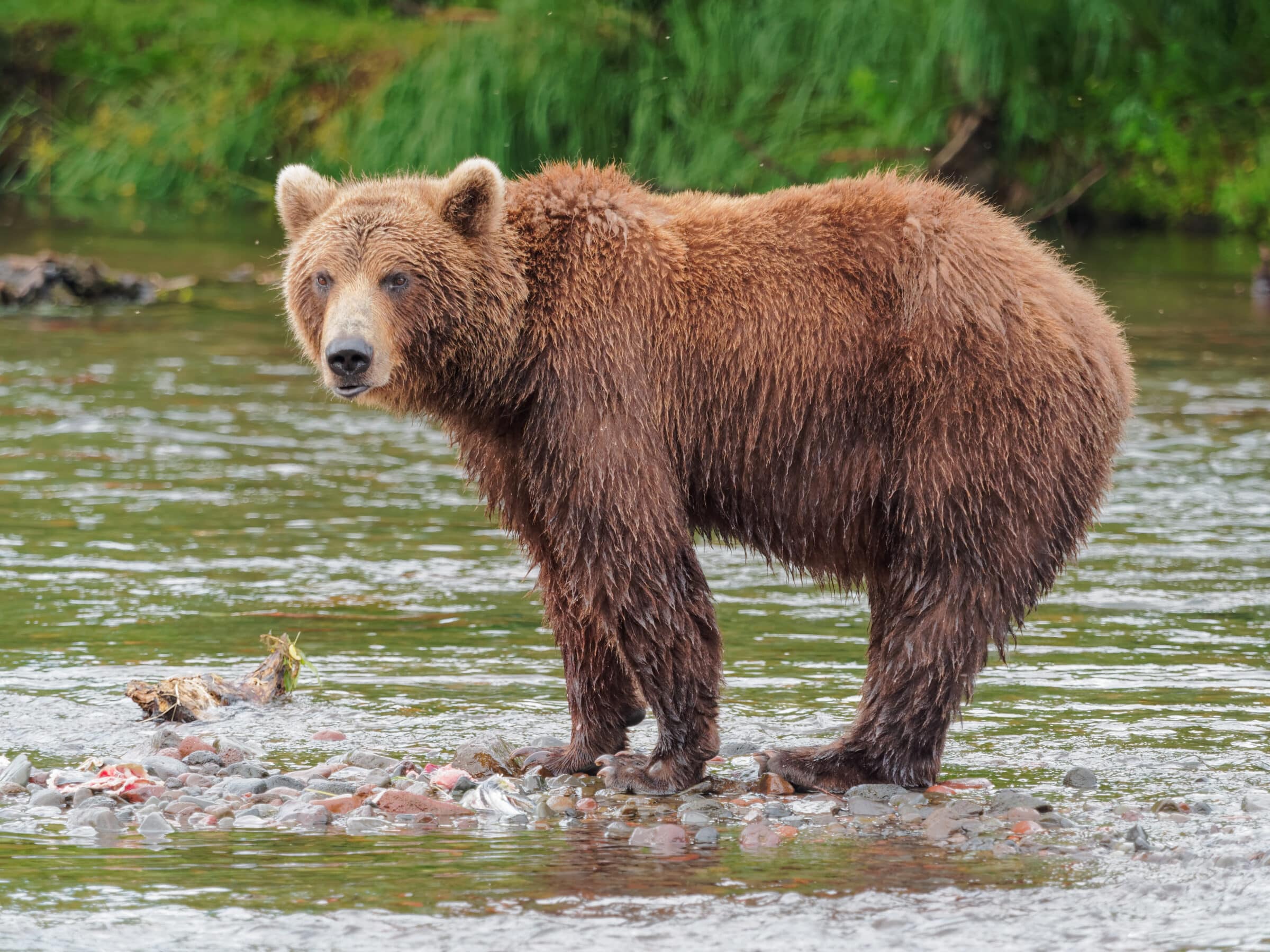
Every living thing, whether a beetle or a bat or a bear, is completely whole and is a uniquely (we might even say, perfectly) functional creature. Nobody looks at a bear and thinks, “If it only had a long tail, it would be more bear-like.” I would venture to say that the same “completeness” applies even to beetles — all 370,000 known species! And bats are likewise marvelous in their wonderfully designed “batness” — the only flying mammal — comprising over 1,500 species.
Evolution’s Crowning Achievement?
To imagine that each of the millions of species of living creatures on Earth “evolved” by a weeding-out process, undirected by any idea of the wholeness they would ultimately manifest, runs counter to our experience with functional design and the known limitations of the laws of nature. If prolific reproductivity is the “goal” of natural selection, why should life have ever evolved to anything beyond bacteria? Cancer cells, as a mutation from original design, would seem to be evolution’s crowning achievement.
The wholeness of living organisms testifies to their metaphysical origin as an “idea,” originating in the mind of their Maker. The evidence suggests that creatures exceed the boundaries of what is possible by undirected natural forces. Even information, as we understand it, appears to fall short as the groundwork for life. Apparently, life comes from life, and nothing else will suffice. Life is a brilliant idea!