






































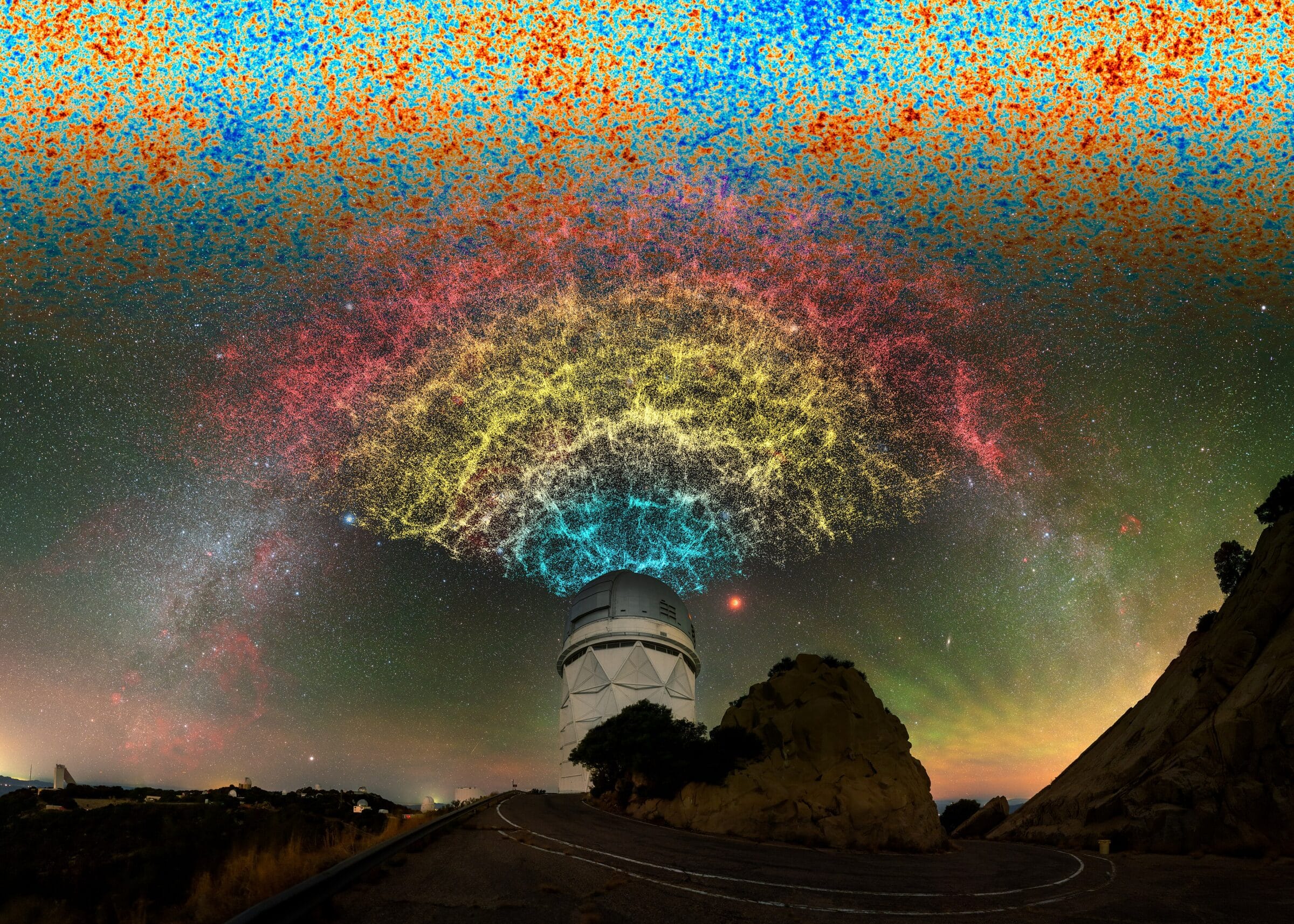
The Dark Energy Spectroscopic Instrument (DESI) has just completed a five-year survey of over 47 million galaxies and quasars, according to the Lawrence Berkeley National Laboratory, which manages this multinational endeavor. Analysis of the vast dataset from DESI’s observations has yielded some surprises regarding dark energy. DESI’s preliminary results, reported in spring 2025, give a first indication that dark energy may not be constant after all.
DESI explores the universe through the Mayall 4-meter telescope at Kitt Peak, Arizona, and its observations give us a high-resolution 3D map of galaxies throughout the universe. The significance of its mission is described at the Lawrence Berkley Lab website:
The fate of the universe hinges on the balance between matter and dark energy: the fundamental ingredient that drives its accelerating expansion. New results from the Dark Energy Spectroscopic Instrument (DESI) collaboration use the largest 3D map of our universe ever made to track dark energy’s influence over the past 11 billion years. Researchers see hints that dark energy, widely thought to be a “cosmological constant,” might be evolving over time in unexpected ways.
The DESI Astronomical Tool
To appreciate the technological prowess of the DESI astronomical tool, here’s a brief description of what’s entailed in its ability to observe our universe:
To map objects, researchers use specially-designed software to optimize DESI observations and decide where to point the telescope. Robotic positioners precisely line up optical fibers that are accurate to within 10 microns, or less than the width of a hair. Ten spectrographs then measure and split the light into its separate colors to determine each object’s position, velocity, and chemical composition.
Modern astronomy relies not only on bigger telescopes and more sophisticated instruments, but upon computational power to analyze and categorize the rivers of digital information generated by DESI’s 5020 separate fiber optic imagers:
Each night, roughly 80 gigabytes of data streams through ESnet, DOE’s high-speed science network, to supercomputers at Berkeley Lab’s National Energy Research Scientific Computing Center (NERSC). Initial processing lets researchers do quality assurance and make any adjustments needed for the next night of observations.
First Evidence of Dark Energy
Since the first evidence of dark energy showed up in 1998 with observations of an accelerating expansion of the universe, information on its nature and properties has remained one of the most profound mysteries in physics. DESI’s results have already shed more light on dark energy than cosmological research has found in the last quarter century. Michael Levi, director of DESI at the Berkley Lab, states,
Whatever the nature of dark energy is, it will shape the future of our universe. It’s pretty remarkable that we can look up at the sky with our telescopes and try to answer one of the biggest questions that humanity has ever asked.
The primary result from DESI’s data, after five years of extensive observations, is summarized below:
The new DESI data analysis, paired with other measurements, contributes to mounting indications that the impact of dark energy may be weakening over time — and that the standard model of how the universe works might need to be updated.
The “standard model” of cosmology is referred to as the Lambda Cold Dark Matter (ΛCDM) model, which includes normal matter, cold dark matter, and (constant) dark energy described by a cosmological constant.
Theory and Observation
As I discussed in my previous article here, the dark energy driving the accelerated expansion of the universe appears to be one of the most finely tuned parameters of nature. If dark energy is weakening over time, how would this affect the degree of fine-tuning required to explain the discrepancy between theory and observation?
The theoretical prediction of dark energy comes from calculating the vacuum energy of space. Since this result for the theoretical prediction of dark energy is 120 orders of magnitude larger than observations show, a slowing of the acceleration would only accentuate the conclusion of fine-tuning associated with dark energy.
If dark energy is changing and the “cosmological constant” is not exactly constant, what difference would this make in our universe? Physicists acknowledge that a changing dark energy could significantly alter the ultimate destiny of our universe.
Varying dark energy would vastly expand the range of possibilities for where the universe is headed. The expansion might grind to a halt, and gravity could bring everything crashing together.
The stringent fine-tuning of dark energy arises from its influence on the expansion rate of the universe over time, from the very beginning until now. The influence of dark energy affects the large-scale structure of the universe, including the average distance between galaxies and the number of small, satellite galaxies such as exist around our own Milky Way.
A potent threat to the long-term habitability of a planet comes from powerful astrophysical events known as gamma ray bursts (GRBs), resulting from the end-stage core collapse of giant stars into black holes. With regard to the danger they pose to life, GRBs can emit lethal doses of gamma radiation from distances up to 150,000 light years and have been proposed as a possible cause of major extinction events in Earth’s history.1
Researchers have therefore concluded that a lower bound exists for the cosmological constant based on the necessity of avoiding GRBs that would precipitate life extinction events.2 The amount of dark energy (expressed as a cosmological constant) is inversely related to the formation of satellite galaxies and subsequent GRBs.
The accelerated expansion induced by a cosmological constant slows the growth of cosmic structures and increases the mean intergalaxy separation. This reduces the number of nearby satellites likely to host catastrophic GRBs.
Sustaining Advanced Life
Cambridge University theoretical physicist David Tong states that a universe with more dark energy would also disfavor conditions suitable to sustain advanced life.3
…if the cosmological constant were much larger than we observe today, then galaxies would not have formed. We are, it appears, living on the edge.
The new results from the DESI collaboration do not overturn these earlier conclusions based on observations pointing to an accelerating expansion rate of our universe, as first discovered in 1998. As shown in the figure at this link, DESI’s results point to a weakening of the acceleration (the parameter q approaching zero) in the more recent history of the universe (on the left of the graph, for small values of the redshift parameter z).
The Influence of Dark Energy
DESI will continue to accumulate more observational data through 2028 and further analysis will sharpen constraints on the influence of dark energy in the universe.
We live in an incredibly exciting time for cosmology. While these DESI results are not a “smoking gun” that overturns our standard model, they are a powerful piece of evidence suggesting that the ΛCDM model may be incomplete. The sheer precision of the DESI measurements is a game changer: Any alternative theory for dark energy will have to align with these incredibly sharp measurements of our expansion history. DESI’s work sets a new benchmark for the field.
We live in an amazing time in human history, when our technological advancements have allowed us to perceive the interconnected intricacy within the cell and, at the other end of the size spectrum, to discern details of the expansion history of the entire universe. Evidence for design manifests at both extremes, and has culminated in human beings. We occupy a privileged space and are being given the opportunity to decide whether we will chalk it all up to chance or acknowledge these evidences for design as a gift from a divine Creator.
Notes
- A GRB event “is believed to have caused the Ordovician extinction, which wiped out 85% of all species present on Earth at the time.” Tsvi Piran, Raul Jimenez, Antonio J. Cuesta, Fergus Simpson, and Licia Verde. “Cosmic Explosions, Life in the Universe, and the Cosmological Constant.” Physical Review Letters 116, no. 8 (2016): 081301.
- Piran, et al., ” Physical Review Letters 116, no. 8 (2016): 081301.
- David Tong, https://davidtong.org/pdfs/teaching/cosmology/cosmo.pdf , p. 171.