






































In previous articles, I have described how origin-of-life researchers repeatedly repackage failed models and misleadingly present highly orchestrated laboratory experiments as evidence for processes that could have occurred on the early Earth (here, here). And every experiment conducted over the past seventy years reinforces the conclusion that life’s origin required a mind far superior to even our most talented scientists and engineers (here, here). Now, I will summarize a recent Scientific American piece that begins with a refreshingly honest assessment of the state of the field but quickly degrades into the common pattern of wishful thinking and speculative storytelling.
Assessment of Field
The Scientific American article is by science writer Sarah Scoles. She asks, “Will we ever know how life began? Scientists disagree on how biology got started and on whether we can ever know for sure.” It begins with a sober summary of the state of origins research:
Despite decades of increasingly complex research, a 2020 review noted that a then 45-year-old proclamation was still true. “It must be admitted from the beginning that we do not know how life began,” chemists Stanley Miller and Leslie Orgel wrote in their classic 1974 book The Origins of Life on the Earth.
The 2020 review is by Earth-life scientist James Cleaves, titled “The Origins of Life: A Review of Scientific Inquiry.” It includes the rest of Miller and Orgel’s quote:
…It is generally believed that a variety of processes led to the formation of simple organic compounds on the primitive Earth. These compounds combined together to give more and more complex structures until one was formed that could be called living. No one should be satisfied with an explanation as general as this.
Cleaves’s description of the field that Scoles summarizes is the following:
This assessment by two of the leading scholars attempting to understand the origins of life, now already 45 years ago, still rings true in many ways. This is not to say that no progress has been made in this area, indeed if anything there are not only more, but more detailed, models and theories for the origins of life now, but rather that it has proven to be a difficult problem, and scientific consensus on the topic has still not been achieved with respect to many questions.
The claim that “progress has been made” rests more on philosophical commitments than on compelling empirical evidence. A more objective assessment of the field is that its principal achievement has been to clarify, in ever greater detail, why intelligent agency is required to direct chemistry toward life.
RNA Production
Scoles eventually follows the lead of origin-of-life researchers by offering glimmers of hope that the enterprise is not, entirely, a fool’s errand. She presents the standard narrative of chemistry’s journey to the first cell:
Scientists also generally agree that life didn’t come into being in single flash but in an extended sequence. Over time chemical reactions produced early versions of metabolism, the ability for molecules to pass down information, and the formation of compartments that would become the boundaries of cells.
She then focuses on studies founded on the RNA World hypothesis. She highlights research by McMaster University physicist Maikel Rheinstädter that she describes as generating “RNA strands of about 100 bases” under conditions that “mimic the ancient Earth”:
[Modern] RNA wouldn’t have done well on the four-billion-year-old Earth. It’s too fragile. “If you take it out of the fridge, it degrades immediately,” Rheinstädter says. Maybe, he continues, that means the RNA in RNA World wouldn’t have been the same as the RNA in our world. He came to this idea somewhat by accident, while poking around the Planet Simulator. When the simulator was set to mimic the ancient Earth, Rheinstädter and his team found that molecules do link up to form RNA strands of about 100 bases long. “However, they’re not perfect,” he says. “They have structural defects.” But what they lack in prettiness they make up for in strength. “You cannot destroy them,” Rheinstädter says.
Yet this description does not accurately reflect what was reported by Simonis et al. (2026). The experiment started with high concentrations of pure nucleotides and other RNA precursors, and it applied carefully orchestrated cycles of drying, cooling, controlled condensation, reheating, and redrying. The output was “highly heterogeneous” molecular chains with no ability to encode information, perform biologically useful functions, or copy themselves. In short, the experiment bore little resemblance to any prebiotic environment, and the low yields of RNA-like products were biologically useless.
Phosphate Challenge
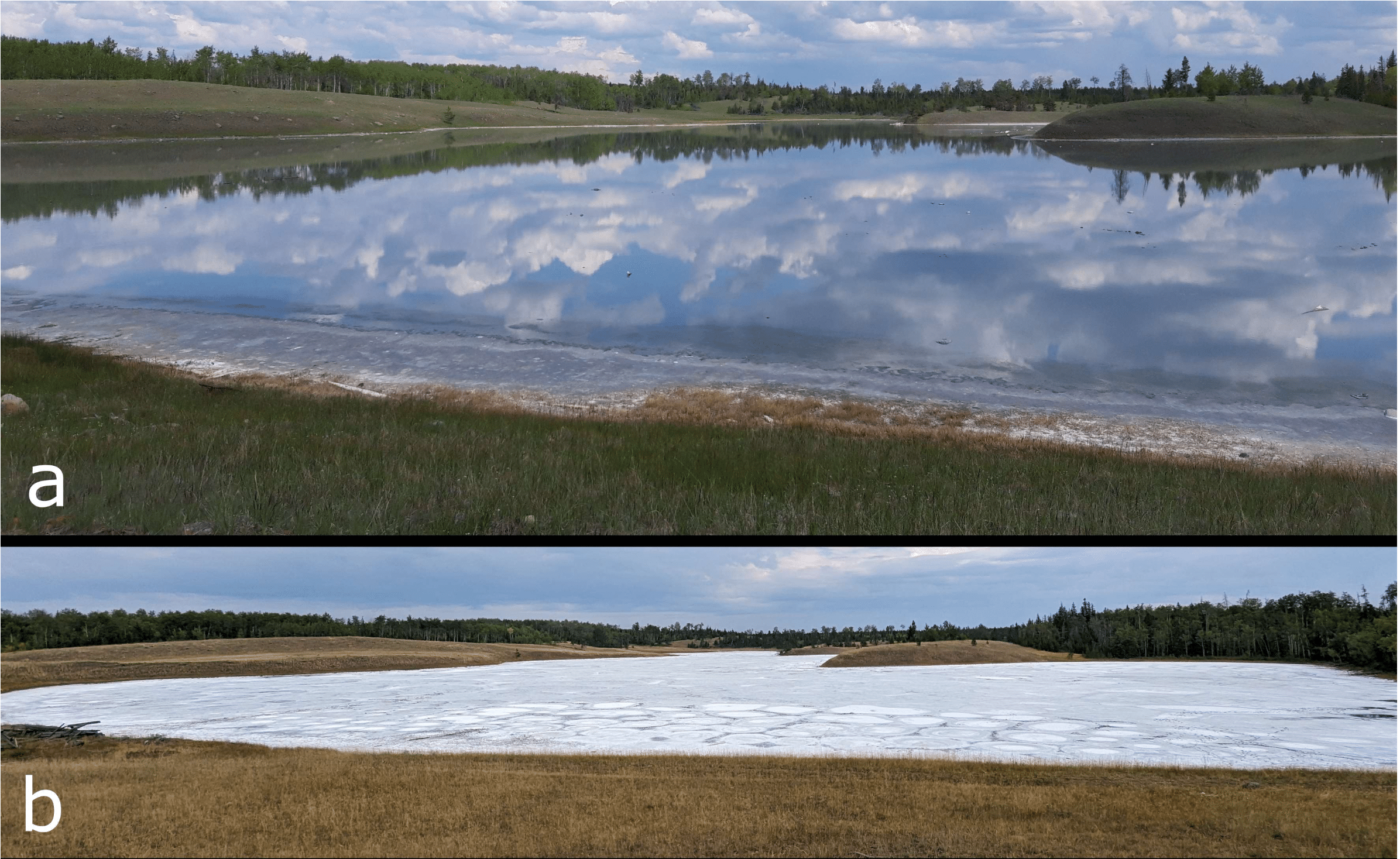
Scoles also highlights a proposal by University of Washington planetary scientist David Catling for addressing what origin-of-life researchers call the phosphate problem: naturally occurring phosphate is generally too dilute to support the production of nucleotides in more than trace quantities. Catling proposes that lakes with high concentrations of carbonate and salts and high pH could maintain highly concentrated phosphate:
The most phosphate-rich lake in the world is Last Chance Lake in Canada. In summertime, it — and most soda lakes — evaporates, leaving a crusty white landscape; as the seasons progress, they get wet and become like lakes again. The wet-dry cycle concentrates the existing phosphate. It could, Catling thinks, be precisely the type of place where chemistry and physics became biology. Maybe it would more appropriately be called First Chance Lake.
What Scoles does not mention is how the soda-lake environment introduces additional obstacles to the RNA World hypothesis (here, here, here, here):
- Ribose is chemically unstable under strongly alkaline conditions.
- High carbonate concentrations and alkalinity hinder sustained RNA copying, the central process in the RNA World hypothesis.
- High salt concentrations hinder sustained RNA copying. They also oppose fatty-acid membrane formation, growth, and division — another central component of many RNA World scenarios.
These challenges are in addition to the obstacles facing all RNA World scenarios (here, here, here). In summary, soda lakes could never have supported the emergence of a system of self-replicating RNA or any other origins scenario.
Lessons for Reporters
Scoles was acting in good faith in reporting on what she read in the scientific literature and was told in interviews. What she failed to appreciate was how researchers’ philosophical bias distorts their interpretation of experimental results and their assessment of proposed scenarios. What investigators often describe as plausible hypothesis are, in fact, little more than fanciful storytelling founded on voodoo science.
Since this situation will not likely change soon, reporters need to more carefully investigate experimental details and how they compare to natural environments. Ideally, they should also disclose the biases endemic to origins research. Most importantly, they should report the truth about where the evidence naturally leads, even if doing so agitates cultural gatekeepers who are committed to suppressing the evidence of design in nature.