







































In my last three articles (here, here, here), I explained how every origin-of-life experiment performed over the past 70 years has reinforced two conclusions:
- Not even one of a cell’s essential structures could have emerged through undirected natural processes.
- The evidence of design in even the simplest cells is decisive.
Here I will explain the thermodynamic reasons behind the first conclusion and the engineering reasons behind the second.
Natural Engines
A central challenge for any hypothesis of life’s origin is explaining how a naturally occurring chemical mixture could transition into the highly organized, high-free-energy state characteristic of life despite the thermodynamic tendency of spontaneous processes moving it back toward equilibrium. Any theory relying solely on natural processes must therefore identify natural engines: mechanisms capable of harnessing energy from environmental sources and coupling it to the specific chemical transformations required to drive a local system energetically uphill toward an autonomous cell.
Such a system would have to undergo a sustained increase in biologically relevant organization — corresponding locally to lower entropy and higher internal free energy — while continually resisting the processes that degrade that organization. Compounding the challenge, the farther a system moves toward the highly organized, high-free-energy state characteristic of life, the stronger the thermodynamic forces dismantling and degrading the emerging structures and overall cellular architecture (here, here). And the stronger those opposing forces become, the more of any supplied energy must be devoted to counteracting them, such as refolding proteins and repairing the cell boundary. Additional energy would still be required to advance the system toward greater organization and complexity.
The immensity of the challenge becomes evident when comparing the energy outputs of the most promising natural sources with the minimum energy expenditure required for cells merely to maintain their integrity. One of the most popular proposed natural engines is the charge gradients generated across mineral barriers in alkaline hydrothermal vents, which could in principle drive energetically uphill chemical reactions. Yet the chemical energy produced in experimental models, even under ideal conditions, is a miniscule fraction of what even the simplest cells must generate to prevent degradation (here, here). Moreover, the chemical products in all proposed models are at best dilute mixtures of organic molecules, such as formaldehyde, that could not assist in even the earliest steps toward life (here, here, here).
Insurmountable Barrier
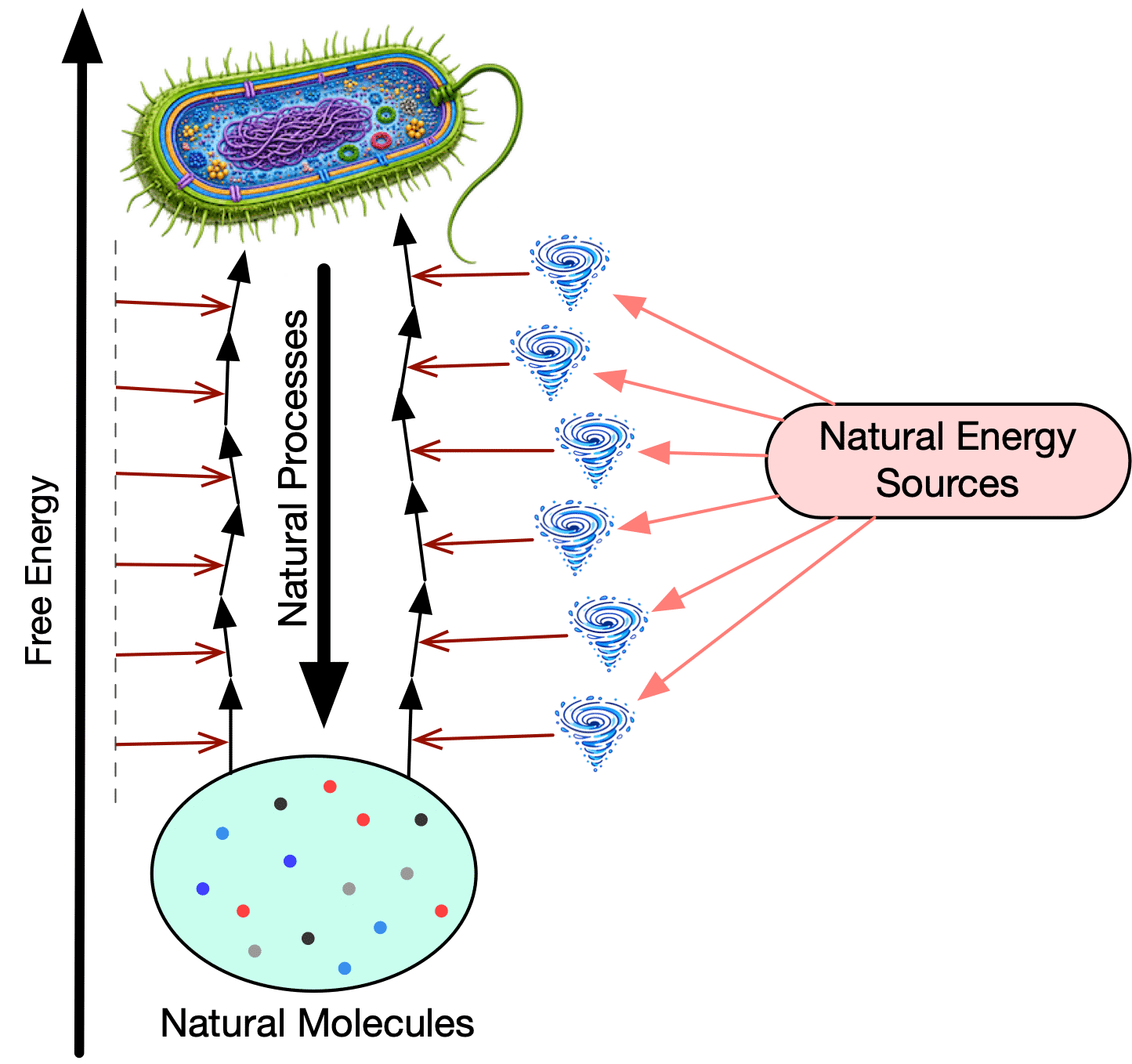
The insurmountable barrier is that multiple pathways are required to construct the components at each level of the organizational hierarchy (see Figure 1). Moreover, each pathway would require multiple distinct natural engines capable of directing the successive stages of synthesis, construction, and assembly. If even one critical step in any pathway failed, the emerging system would begin to break down, ultimately degrading into an amorphous, biologically useless chemical mixture.
What investigators must posit is a vast ensemble of natural processes — far more powerful, selective, and precisely directed than anything yet observed — arising at specified times within the same local environment and somehow coordinating numerous pathways toward the construction of life. At that point, the proposal ceases to be an inference from observations and known physics and becomes an appeal to the absurd. The alternative is acknowledging where the evidence naturally points.
Life as Engineering
The central problem is more foundational than the legion of specific challenges confronting origin-of-life theories. The overall organization of molecules in living systems is not reducible to the intrinsic physical and chemical properties of those molecules or to the physical processes acting upon them. Rather, it represents a higher-level functional architecture in which components are arranged, integrated, and coordinated to achieve specific ends. The cell’s material properties no more explain its organization than the material properties of metal, glass, and rubber explain the design of a car.
As I described in previous articles, such organization is characteristic of systems whose architecture has been conceived according to specific goals and engineering principles and then instantiated in matter. The fundamental question, therefore, is not merely how the requisite molecules could have formed, but how matter could have acquired the highly specific, system-level organization required for life.
The significance of this point is reinforced by the fact that even the minimal set of functions required for cellular life includes design patterns central to human engineering, such as information processing, feedback regulation, control systems, energy management, and coordinated manufacturing. Biology cannot be fully understood solely by cataloging chemical reactions, physical forces, and chance events. A complete account requires an engineering framework; one that investigates biological systems in terms of architecture, control, coordination, information, and ultimately the intentions of its creator.