






































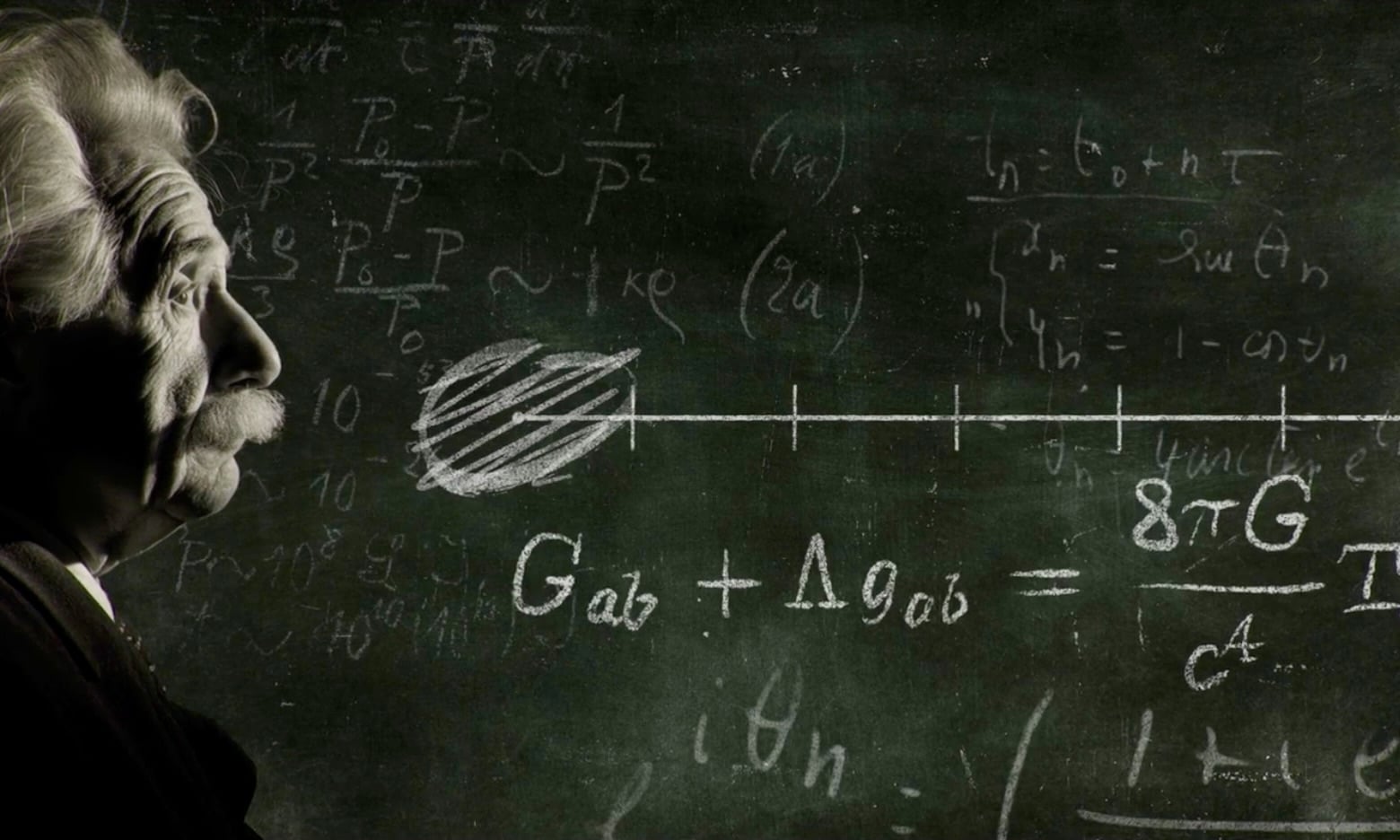
Where did everything come from? Philosophers and toddlers ask the same question. (Philosophizing toddlers, doubly so.) Our nature drives us to ask why we’re here. Our rational impulse compels us to search for answers. We find ourselves like men with amnesia, awakening in an elaborate, beautiful, and dangerous room. There is a weatherworn letter on the table. It tells us where we came from and who brought us here, but we don’t trust its words. Instead we seek our own rational answer to the riddle. The upcoming film The Story of Everything, opening in theaters nationwide on April 30, offers a collection of scientific evidence pointing to a single, beautiful conclusion: our universe, ecology, and biology were prepared by a mind beyond the universe itself. We are meant to be here. The film presents a compelling case for believing the words on the table.
Kairos or Chaos
The film presents two contrasting positions. The first is that of materialist atheists, men like Richard Dawkins and Lawrence Krauss, who see the universe devoid of transcendent significance, shaped by nothing but blind, pitiless indifference. For them, reality is but a chaotic progression that happened to produce a pocket of locally reduced disorder, spawning us as byproducts. We came from nothing and will return to nothing.
The opposition argues that the order of the cosmos implies forethought. Contrary to Dawkins and Krauss, science bears witness to the exquisite fine-tuning and engineering of ourselves, our universe, and our planetary home. There is no inference to indifference. Instead of chaos, we appear to be here at the right place and right time: kairos, recorded in stone and bone. We are not temporary illusions-of-self, staring up at meaningless voids; we are men and women who bear the marks of a master craftsman. A craftsman whose mathematical genius implies purpose and inspires awe, who motivated theists like Newton, Kepler, and Maxwell to pursue their scientific work. They looked at the stars and saw the glory of God. The same creative brilliance is revealed in the discoveries of modern science, as the film ably demonstrates.
Stories of Science
The film makes its argument through interviews and archival footage, featuring luminaries like Stephen C. Meyer, John Lennox, Brian Keating, and James Tour. It tells stories, allowing you to relive some of the greatest scientific discoveries of the modern era, through a series of four book-like chapters.
At the outset, we’re presented with a question: is the universe eternal? Pursuing the answer, we learn of Edwin Hubble’s famous discovery of an expanding universe, the redshifted cosmic microwave background, and the implications for a finite temporal beginning. We are introduced to Catholic priest Fr. Georges Lemaître, who proposed what came to be known as the “Big Bang” theory. As the film explains, an expanding universe, played backwards, brings us to a point — a beginning. For a priest like Lemaître, the theistic echo was immediate. Despite this, the Big Bang has become associated with atheistic origins in the public mind. It is a strange connection. An eternal universe provides a much more comfortable backdrop for a godless, uncaused cosmos.
The storytelling continues, as we’re dropped in the back of a cab with Einstein and Lemaître to overhear them debate the expanding universe. We watch as Einstein looks through the Hubble’s Hooker telescope, and finally admits Lemaître was right.
We’re then shown how our universe is fine-tuned for life. Physical constants balance on a knife’s edge: small changes in either direction render life of any kind impossible. Our existence demands the constants be consistent with life; it does not force us to expect the life-permitting regions to be so narrow. We’re not surprised we hit the targets — we’re surprised they’re so small. We had no reason to expect this. Luke Barnes, Jay Richards, and Stephen Meyer explore the surprising degree of fine-tuning embedded in physics.
The chapter weaves together the incredible story of Fred Hoyle’s prediction of carbon resonance, supported by beautifully crafted 3D animations. The commissioned animations for this film deserve special mention. The craftsmanship is levels beyond an editor slapping together off-the-shelf Getty Images B-roll. They add to the presentation’s beauty and force.
In a later chapter, we learn of Watson and Crick’s discovery of the structure of the DNA double helix, and explore the origin of the information along its sugar-phosphate backbone. I can go on. Were I an atheist, I would be tempted to watch the film for the history of science content alone. It can be enjoyed by anyone. Taken as just a history-of-science documentary, the beautifully illustrated stories are worth the price of admission.
But there is much more to commend.
Craft
The film is gorgeous. It was made by people who clearly care about the art of good filmmaking and storytelling. Their care is shown through detailed computer animations, clever analogies for abstract physics concepts, and meticulous, midcentury-inspired set design. The filmmakers make thoughtful use of archival footage and images, steering clear of shoddy AI slop. They express ideas through visual imagery instead of impenetrable math.
The film is visually delicious.
Like H.L. Mencken, I often find myself desiring simple competence in filmmaking, regardless of a film’s message. This movie delivers. The vessel is beautifully crafted, worthy of its content.
The musical score adds richness to the story. It gives the documentary a sci-fi tone reminiscent of films like Arrival or Interstellar. The sound design is also excellent. You feel the pulse of an expanding universe and are drawn into the squishy aquatics of the subcellular realm. The immersion is felt more than noticed.
In short, the documentary’s production value is top notch. Every aspect is artfully and thoughtfully crafted.
Potential Concerns
The film is not perfect. None are, except The Princess Bride, Seven Samurai, and The Lord of the Rings trilogy.
For example, I found myself a bit impatient at the section covering the multiverse. Though it was only five minutes, this portion of the film felt longer, since I thought the point had already been made. It could be simply because I’ve never found the multiverse compelling. It is devoid of empirical evidence and consequences, and comes across as near-infinite special pleading. As such, I was more interested in the other parts of the film. But I understand the need for the filmmakers to address that model. Five minutes out of a one-hundred minute film isn’t bad. Perhaps you, dear reader, find the multiverse plausible and will be challenged by what is presented in a way I was not.
Some Christians might also take issue with certain aspects of the film. It presents an “old earth” perspective on timelines, using standard dating of cosmological events (e.g., 13.8 billion years). This may give pause to young earth creationists (YECs) or others who hold to shorter timescales. Despite this, there is a lot for YECs to appreciate about what is presented. The documentary makes a compelling case for a cosmic beginning, the intelligent design of biological information, and the providential fitness of physical constants and the elements for human life. The gulf between an eternal cosmos and a 14 billion year old universe is infinite; the gap between billions of years and thousands of years is much less so. Doctrinal issues are important, but this film doesn’t take any hard doctrinal stances. It simply asks what contemporary physics, taken at face value, implies about an intelligence behind the cosmos. It makes a compelling case using standard dating and mainstream scientific discoveries.
Atheist viewers will likely have different concerns. After the film makes its case that the universe requires a first cause, the atheist might ask: why doesn’t its creator? If the creator can spring from nothing, why can’t the universe? A more sophisticated skeptic might wonder why the universe itself can’t be the original, uncreated thing.
Clearly a first cause is first, so cannot require a prior cause. This forces us to acknowledge an uncaused (or self-caused) basis for reality. As John Lennox explained elsewhere, “Who created God?” is thus an ill-formed question. The first cause cannot be in need of any other causes, nor can it be created. An uncaused physical universe runs into its own problems. Lastly, the film forcefully argues that the universe is not eternal. It therefore requires an explanation for its coming into being.
This movie will anger people. For atheists who place their faith in science, showing how science itself points to God can feel like a desecration of their sanctuary. (Perhaps ironically, science is an edifice originally built by devout theists for the study of God’s works.) The movie is respectful in how it addresses these questions, but it challenges perspectives at the heart of who we are. This is bound to upset some.
Daring to Ask
Yet the film doesn’t pull back. It dares to ask big questions. It doesn’t preach. The Story of Everything teaches and invites you to think about what it all means.
If you don’t see it, you’ll exclude yourself from the rich discussions that will surely follow its release.
The film ends with a comment from philosopher Tim McGrew, giving a two-sentence summary that perfectly captures its spirit:
The universe does not look like it’s been left to itself. It bears, everywhere, the fingerprints of its creator.
The Story of Everything shows these metaphorical fingerprints in glorious, vivid, multisensory detail.
My life has been enriched by watching this film. I was left in awe at our universe and the molecular machinery of life. Above all, I am in awe of the God that brought it into being.
Cross-posted at George D. Montañez on Substack.