






































Science and Culture Today Discovering Design in Nature
Topic

Proceedings of the National Academy of Sciences
dolphins-1

No Harm, No Foul — What If Darwinism Were Excised from Biology?

Considering several recent papers shows that eliminating evolutionary words and concepts simplifies and improves scientific explanations.  Read More ›
Tiktaalik

Darwin on Trial — As Fresh and Relevant as Ever

Because of Phillip Johnson’s leadership no informed person will ever again honestly say that Darwin’s theory flows straight from the data. Read More ›
andy-brunner-21063-unsplash 2
Photo credit: Andy Brunner on Unsplash.

Polar Bear Seminar: On Retracting — and Not Retracting — Errors 

It was Nathan Lents himself who wrote, “I’ve made mistakes, some I caught, others someone else caught. I always correct it the best I can. That’s what honest people do.” Read More ›
Christina Cheng
proteins
Photo: Christina Cheng, University of Illinois, by L. Brian Stauffer, via EurekAlert!

Jerry Coyne, Ken Miller Revive a “Fishy Story”
Coyne is sure this is going to come as a rude shock, to our colleague and contributor Dr. Behe in particular, “a slap in the face of IDers like Michael Behe — a fish slap like the one below.” Read More ›
Hubble
Hubble’s Law
Photos: Edwin Hubble (above) in 1931, by Johan Hagemeyer (1884-1962) [Public domain], via Wikimedia Commons.

Proper Credit — Who Discovered Hubble’s Law?
Many leading scientists of the day realized the implication of the cosmic expansion — there was a beginning!  Read More ›
Black-Bellied Seedcracker
Photo credit: A black-bellied seedcracker, by Dr. Tom Smith, UCLA, via EurekAlert!.

Encore Performances in the Design of Life
News from Princeton discusses the work of Tom Smith and Bridgett vonHoldt, who have solved a “long-standing finch beak mystery.” The answer turned out to be Mendelian, not Darwinian. Read More ›
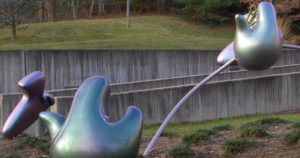
Polypeptides
Photo: "Waltz of the Polypeptides" (sculpture), Cold Spring Harbor, by Vik Nanda, via Flickr.

Protein Folds Violate Evolutionary Expectations
Protein folds show more flexibility than previously thought, but the flexibility appears designed. If it’s hard to get one fold to work, how about two in the same protein? Read More ›
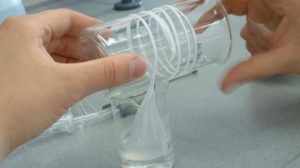
Nylon 2
Photo: Nylon in a laboratory setting, by Superplus [GFDL or CC-BY-SA-3.0], via Wikimedia Commons.

Adaptation in Action Yields a Repurposed Enzyme

“Nylon-eating bacteria? What the heck?” you say. “Why does this matter?” Read More ›
Homo_naledi_foot
Photo: Foot of Homo naledi, by Lee Roger Berger research team [CC BY 4.0], via Wikimedia Commons.

Studying Homo naledi Fossils, Paleoanthropologists Apply ID Principles
This fascinating study also counters arguments that Homo naledi was beginning to develop a human-like intellect. Read More ›
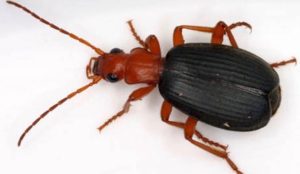
bombardier beetle
Photo: A bombardier beetle, by Patrick Coin [CC BY-SA 2.5], via Wikimedia Commons.

Pre-Adaptation: In Evolutionary Explanations, Too Much Serendipity

"The bombardier beetle’s ancestors simply pressed into different service chemicals that already happened to be lying around. That’s often how evolution works." Read More ›

© Discovery Institute