






































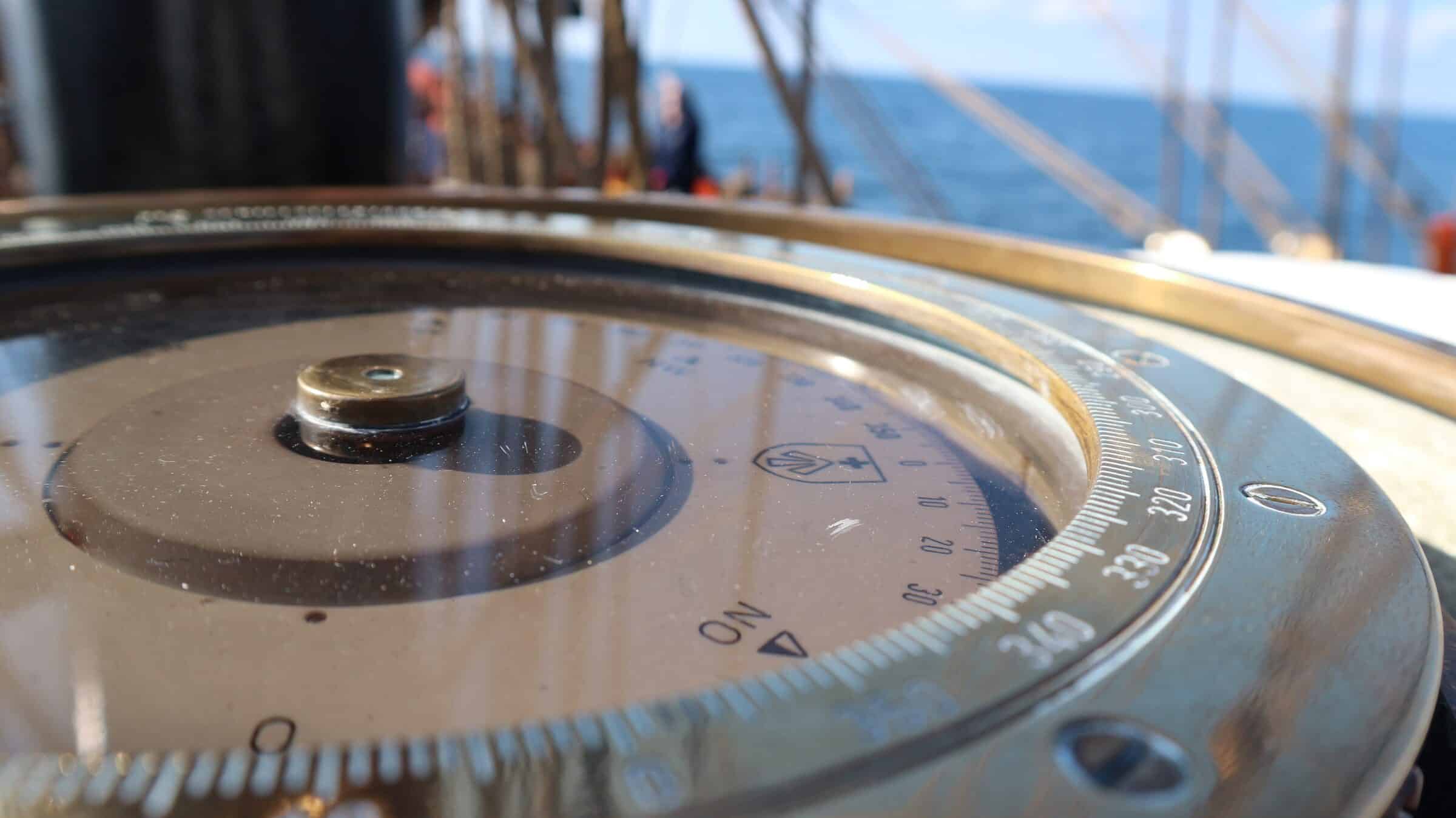
Research conducted by a group led by scientists from Cambridge University and the Max Planck Institute has found the oldest evidence for the possible use of a magnetic compass by an organism.1 The evidence exists in so-called magnetofossils found in marine sediments that have been dated to 97 million years old.
An Unknown Organism
The material in the fossils is magnetite, which is one of the theorized mechanisms for animal magnetoreception. Magnetite (Fe3O4) is an iron oxide usually found as single domain crystals approximately 20-50 nanometers in diameter, making it challenging to detect in organisms. The crystals are permanent magnets that align with Earth’s magnetic field. Several animal species have been found to form biogenic magnetite, including magnetotactic bacteria and some species of fish, including salmon and trout.2 There is also some evidence that a number of genes associated with the formation of magnetite in organisms (biomineralization) are shared by bacteria and eukaryotic (multicellular) animals.3 Bacteria use the compass to guide their movement in finding favorable conditions.
What makes the discovery of these fossils unique is their size. They are called giant magnetofossils because the particles are 10-20 times larger than those found in bacteria. However, the organism that produced the fossils is unknown. The research included 3D imaging of the magnetic structure which enabled determination of the magnetic characteristics of the fossil and its capability for detecting the Earth’s magnetic field. The results show that the structure is optimized for detecting both the direction and strength of the magnetic field. A word that could be substituted for “optimized” is designed. Magnetic field intensity and direction are the two key parameters that enable animals to use the information to navigate.
Not a Recent Phenomenon
The research provides further evidence that the ability of organisms to navigate is not a recent phenomenon, but rather is a capability that has existed for a very long time. This finding is not a surprise as the ability to navigate is nearly universal among animals as well as bacteria. Navigating in their environment is an essential ability for most animals, therefore it likely was present when most animals first appeared.
Another fact to keep in mind is that magnetite is just one of the three forms of magnetoreception for which there is evidence in different animals.4 The other types are a quantum effect known as the radical pair theory and magnetic induction. All three mechanisms and their use as a compass are complex and show evidence of design.
Notes
- Richard J. Harrison, et al., “Magnetic vector tomography reveals giant magnetofossils are optimized for magnetointensity reception,” Communications Earth & Environment (2025) 6: 810.
- Alberto Perez-Huerta, et al., “Biogeochemical fingerprinting of magnetotactic bacterial magnetite,” PNAS 2022 Vol. 119, No. 31.
- M. Renee Bellinger, et al., “Conservation of magnetite biomineralization genes in all domains of life and implications for magnetic sensing,” PNAS 2022 Vol. 119, No. 3.
- Eric Cassell, “Three Animal Magnetic Compass Mechanisms, All by Design,” Science and Culture Today, December 8, 2005.