






































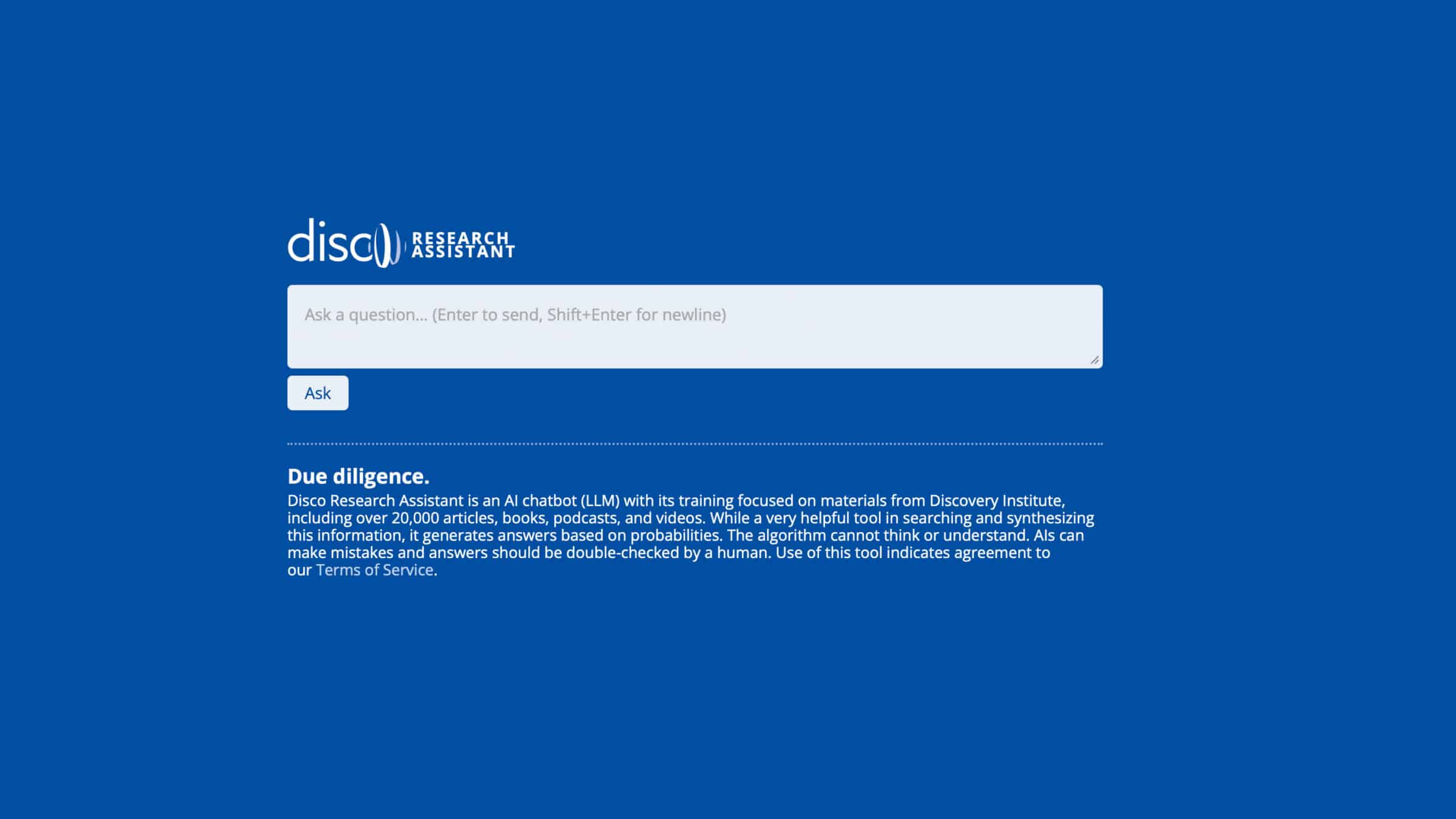
Today, Discovery Institute’s Disco Research Assistant debuts at disco.discovery.org and, when searching, at Science and Culture Today. This new tool is an AI-powered research assistant built to help readers and researchers sift and synthesize a vast well of over 20,000 Discovery Institute books, articles, and other materials. In contrast to general purpose large language models like ChatGPT and Gemini, it uses retrieval-augmented generation (RAG). This means that Disco Research Assistant searches and synthesizes a curated collection of Discovery Institute materials and predominantly uses those sources to prepare a response. Responses include links directly to the materials that inform each answer.
Why “Disco” Research Assistant?
Since early on in Discovery Institute’s history, “disco” has served as a shorthand for the organization among staff. Indeed, for a decade our Technology and Democracy Project blogged at disco-tech.org. Serendipitously, in Latin the root of disco means “to learn, to acquire knowledge.” Also apt, the French discothèque means a repository or library on records or disks; this is from whence comes the Studio 54, Saturday Night Fever sense of disco dance and music. Note that Disco is not a personal name and is not intended to anthropomorphize this tool. It has no avatar nor personality. If it could have one, it would be that of Sergeant Joe Friday: “Just the facts, ma’am.”
It’s Disco Research Assistant because, like other AI tools, it excels only when it’s wielded by human agents who ask good questions and engage critically with its answers. While it can very helpfully assist in your research, it cannot think for you.
Search and Research
Over the years, our team at Discovery has worked to add more and more horsepower to our site search engine to enable readers to find the needle in what has become a very large haystack. Author, date, and search result order are each customizable in our advanced search. Outstripping those improvements, Disco Research Assistant makes “fuzzy search” — finding half-remembered or roughly-formed ideas — much easier. For example, I had lost track of an article that had made a strong impression on me years ago. Using the Assistant, I searched for the one thing I remembered, a photo of “different colored caterpillars on pencils.” Where search understandably failed this query, Disco Research Assistant’s ability to relate terms scored the result: “Peppered Moths and More.”
In addition to its strength in searching, Disco Research Assistant excels at synthesizing ideas scattered across numerous pieces, from decades ago up to the present day, and from articles to videos. To test the Assistant, I’ve been working on a research project of my own, investigating the various models for integrating faith and science. It’s a subject that many Center for Science and Culture Fellows have spoken of in passing over the years. The Assistant has been invaluable in collecting those scattered references, with links to the source material.
I expect Disco Research Assistant will serve a wide variety of use cases. Students writing papers on origins, design, or the philosophy of science will be able to find the most relevant articles. Educators preparing lessons or responding to student questions will find ready answers. Journalists who want to represent the intelligent design movement accurately will be able to check the narrative against what Center Fellows in fact advocate. Like my own project, church and ministry leaders might explore the relationship between science and faith. Skeptics and critics wanting to engage the strongest form of our arguments will find them as our scientists and scholars have formulated them.
Due Diligence
Of necessity, all large language models come with disclaimers. Because they generate answers based on probabilities and have no understanding of their own, these tools are prone to fabricate or misrepresent views where there is ambiguity or a scarcity of information. Discovery Institute staff have extensively tested Disco Research Assistant to validate and improve the quality of its automatically generated answers. As reliable as it is in the majority of cases, it is imperative that serious researchers do their due diligence, checking the sources provided to ensure that answers accurately represent the source material.
A Team Effort
Led by Casey Luskin, a number of Discovery Institute staff have been instrumental in bringing Disco Research Assistant into service. Winston Ewert has been the principal developer, gathering and loading assets, fine-tuning the system prompt, and preparing the code for implementation on Discovery Institute’s websites. Katherine West has modified Discovery Institute sites to serve up the right data in the right way. I have styled and designed the interface. As always, John West has provided essential oversight. We hope this tool assists your own research, whether for an off-hand question or a deep-dive on a topic of investigation.