






































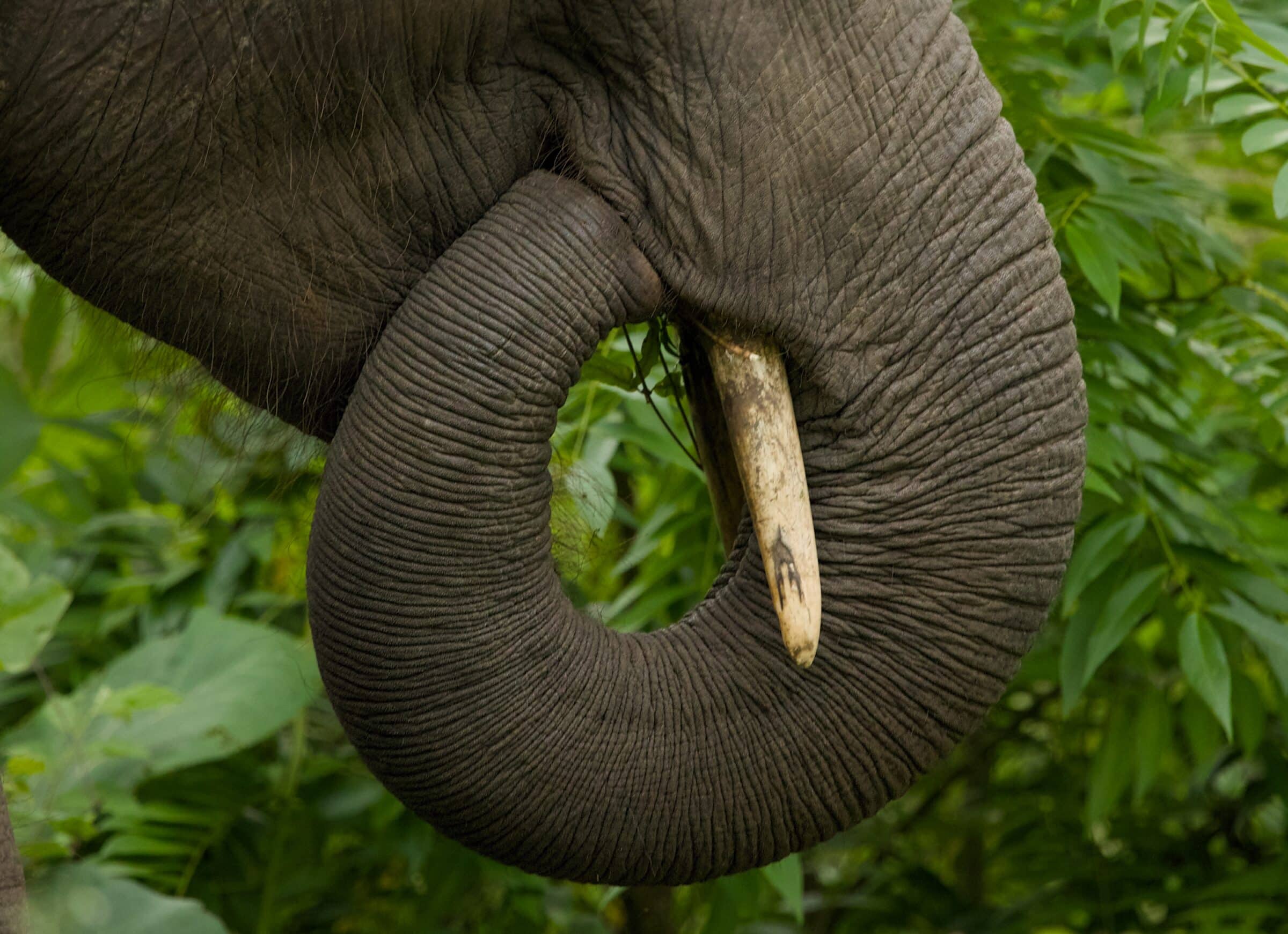
What do these animals have in common: a squid, a snake, an elephant, a chameleon, and an octopus? They belong to vastly different taxons, but each of them possesses a remarkable structure called a muscular hydrostat. These elegant, “beautiful,” and highly functional structures, exemplified by octopus arms and elephant trunks, are the subject of a fascinating Primer by Noel Naughton in Current Biology. Expect to be amazed at the engineering design of these boneless structures that can move with near-infinite degrees of freedom.
First, let’s review some terms and physiological facts. A hydrostat (“water-stationary” object) is any structure that can maintain its shape by means of fluid. A water balloon is an example. If you squeeze the middle of a long water balloon, Naughton explains, the rubber must stretch outward to maintain fluid balance. This is because water is nearly incompressible. Fluid-filled hydrostats exist in nature, such as with roundworms and earthworms, which can push the fluid into spaces to allow movement.
Muscular Hydrostats
Replace the fluid with muscle and you have a muscular hydrostat. Two of the best examples can be found in animals vastly separated on the evolutionists’ phylogenetic diagrams: the arms of the octopus, and the trunk of the elephant. Professor Naughton focuses on these amazing structures. They share surprising commonalities despite their presumed “evolutionary” distance.
Muscles can only pull; they cannot push. In the human body, we have opposing muscles to achieve a single degree of freedom. For instance, the biceps muscle pulls the forearm at the elbow, and the triceps muscle pulls it back. Six more degrees of freedom are granted by other sets of opposing muscles that allow twisting and lateral motions.
Naughton has diagrams of the musculature inside the elephant trunk. Figure 2B shows a cross section of the trunk, with muscle groups that “run longitudinally along their length, are arranged in the cross-section with a transverse, circular, or radial organization, or lie obliquely along a helical path.” What’s astonishing is that the same design is found in octopus arms, squid tentacles, and lizard tongues! This compounds the difficulty for evolutionists to explain the independent origins of muscular hydrostats with similar capabilities in unrelated organisms.
The muscle groups in these hydrostats are arranged in opposing pairs. This allows for bending and unbending, shortening and extending (both along transverse and radial axes), and twisting and untwisting. Opposing pairs are necessary for flexible motion. The ability of an animal to twist its muscular hydrostat, for instance, requires muscle groups that are right-hand-wound, but also muscles that are left-hand-wound to enable the animal to untwist. Otherwise, the hydrostat would remain stuck after the first twist. Similarly, without a triceps muscle, you could do one arm curl but not extend it again. A Bible story tells how evil King Jeroboam stretched out his arm against a prophet, but could not retract it again till he humbled himself and prayed for help.
Like the octopus arm, an elephant trunk consists of longitudinal, transverse, and oblique muscle groups, as well as a radial group that acts similarly to transverse muscles (Figure 2B).
Convergent Evolution Again?
Despite being separated evolutionarily by over half a billion years, there is a striking similarity between the muscular organization of elephant trunks and octopus arms, and indeed between all muscular hydrostats broadly.
How does Naughton explain this baffling similarity? He invokes the fallacy that a physical constraint compels natural selection to create a solution:
This similarity perhaps reflects the limited ways a one-dimensional muscle contraction can be translated into the three-dimensional deformations of bend, twist, extension, and shortening that a muscular hydrostat can perform.
Evolution even solved another problem: the law of gravity. That’s pretty astute for a blind watchmaker.
Morphological differences that do exist appear explainable as adaptations to the unique environmental constraints these creatures inhabit. Elephants live on land, where gravity constantly pulls their soft trunks down. Octopuses dwell underwater in a nearly weightless environment due to buoyancy effects. The symmetry of an octopus arm’s musculature facilitates deformations in any direction, because each direction is equally available as a result of the low gravity. In contrast, the elephant trunk’s dorsoventral asymmetry appears organized to counteract gravity’s constant pull.
“Organized” is a design word, is it not? All these muscle groups are organized together to give the creatures what they need. A chameleon may only need to extend and retract its tongue. But for the octopus and elephant, the full set of opposing muscle groups provides full flexibility with near-infinite degrees of freedom.
Design Requirements for Degrees of Freedom
Muscular hydrostats are not a series of joints and links like your arm but are rather continuously deformable. Mathematically, this means having an infinite number of degrees of freedom (compared to your arm’s seven), which dramatically complicates the neuromuscular control problem. Now, of course, no muscular hydrostat actually has an infinite number of degrees of freedom, though an elephant does have ∼90,000 individual muscle fascicles in its trunk. However, tongues, trunks, and tentacles exhibit a high degree of dexterous, fine-grained control all along their length such that they appear to possess an effectively infinite number of degrees of freedom. Solving this control task is a challenge, as any toddler learning to speak knows well.
Muscular hydrostats solve this control challenge several ways. One is by physically linking muscle groups. For instance, transverse muscles in the octopus arm extend through the longitudinal muscles to the outside of the arm by a series of thin projections called trabeculae. “When they contract,” Naughton explains, “they, along with a thin layer of peripheral circular muscle, squeeze the arm radially, causing the arm to extend axially to conserve volume.” Another method is behavioral. The elephant or octopus can wrap its muscular hydrostat around an object. “This allows a muscular hydrostat to forgo precise positional control, instead allowing the object to supply the shape by conforming to it.” A third method is to create “pseudo-joints” by bending the structure at one point.
Here, the animal generates localized bending at specific points along its length connected by straight, stiffened segments. This combination of localized joints and rigid links causes the arm or trunk to temporarily act like a rigid skeletal system, similar to your arm. Elephants employ this strategy when moving their trunk from point to point (Figure 3C), while octopuses use it to transport food to their mouths. Both actions require accurate control of the muscular hydrostat’s tip, suggesting that when positional accuracy is important, simplifying the arm or trunk to mimic a vertebrate skeleton structure may be necessary to reduce control complexity enough to achieve precise motions.
These three methods must be designed either into the structure or into the behavioral repertoire of the animal: i.e., in its brain software. An elephant trunk or octopus arm would be of little use to the animal without the behavioral program to operate it.
Follow the Design
Naughton ends with another design topic: biomimetics: “biology has solved and integrated numerous challenges that current engineering practice has yet to, making muscular hydrostats excellent examples of how biology can inform and inspire engineering practice,” he says, granting agency to the nebulous category “biology.” Bio-engineers looking for projects will find plenty here in the captivating and beautiful study of muscular hydrostats.
Despite immense progress, only a handful of muscular hydrostats have been studied in detail, and even then, often in only a few species. Studies of octopus arms have focused on only a small fraction of the roughly 300 recognized species and the immense diversity of animal tongues remains to be fully examined. As a result, there continues to be much to be discovered about muscular hydrostats, making these unique structures an exciting area of continued study for those of us captured by their mechanical beauty.
ID is the Future, indeed.