






































Recently I was alerted to an essay, “True Humans,” by Stephen M. Barr in First Things. Fr. Michael Chaberek has commented on it as well. Actually it is a review of Kenneth W. Kemp’s The Origins of Catholic Evolutionism, 1831-1950 (Catholic University of America Press, 2025). However, I’ll restrict myself here to Barr’s review alone; my own review of the book itself will be forthcoming.
Barr’s long (and rather tedious) essay is a curious case. His analysis suffers from three major problems: two serious conflations and one bad conclusion.
The first of these is conflating Darwinian evolution with science. I’ve written many times before that Darwin’s theory is not a scientific conclusion drawn from evidence, but a metaphysical position (positivism to be more precise) made from certain a priori assumptions learned early on from the atheist Robert Edmond Grant (see, for example, my Intelligent Evolution). Darwinism isn’t science; it is its own brand of scientism. The second is conflating evolution with Darwinism itself. Evolution — simply change through time — can mean many things and can be approached in many different ways; to employ the term evolution as a synecdoche for Darwinism is historically and definitionally wrong. The third issue, stemming from the two previous ones, is Barr’s contention that the Church never condemned Darwin’s theory. It’s true that neither Origin of Species nor Descent of Man ever appeared on the Church’s Index Librorum Prohibitorum, but that begs the question: What did the Church think of the theory?
No Need to Condemn Darwin
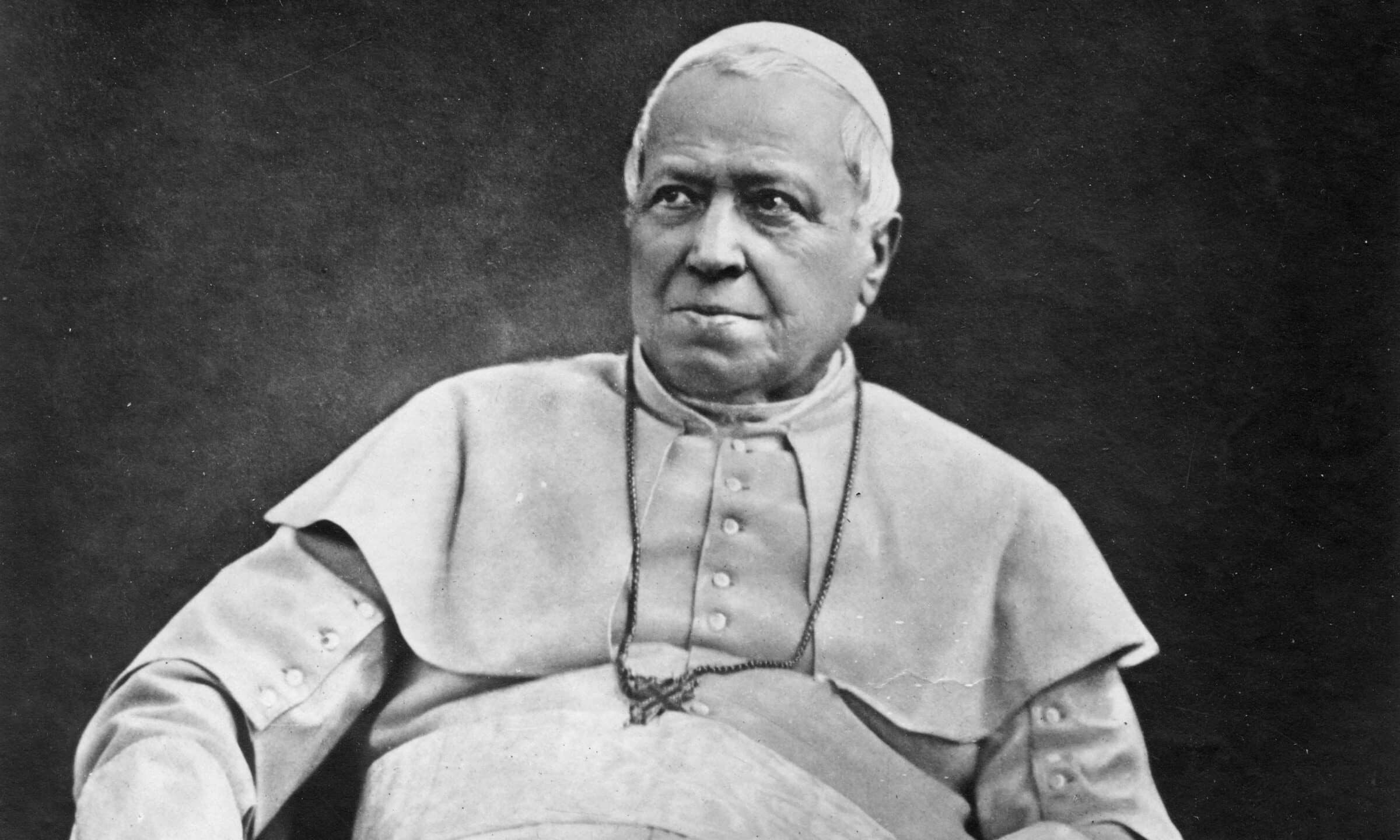
If the Church never condemned Darwinism, it’s because it probably never felt it had to. (And here it must be added that comparing this with the Galileo affair as Barr suggests is wrongheaded. Michael Keas’s excellent book Unbelievable [2019] has much to say on this as does James Hannam’s The Genesis of Science [2011]). The Church’s position on evolution must be placed in context. When Pope Pius IX (pictured at the top) awarded St. George Jackson Mivart a doctorate (as Barr correctly notes), he was not by implication casting his imprimatur or approval on evolution and the so-called natural explanation of human origins so much as he was specifically endorsing the most thorough and detailed denunciation of Darwinism up to that time. That fact is obvious from even the most superficial reading of Mivart’s On the Genesis of Species (1871).
So, if the Church never condemned Darwinism, that’s because it had Mivart — Darwin’s vehement denouncer — on its side. Mivart was a follower (with certain amendments) of Richard Owen’s structuralism and utterly opposed to Darwin’s functionalism; in fact, Owen was Darwin’s archenemy. The theological heresies — and there are many — in Descent of Man were ably addressed by its leading Christian soldier, Mivart. Therefore, in the Church’s eyes placing Darwin’s works on the Index would only have drawn attention to them. Indeed, even today The Catholic Encyclopedia cites Mivart not Darwin on the subject of evolution.
The fact that the Church considered Darwinism passé by the 20th century is clear. For example, in The Teaching of the Catholic Church by Canon George D. Smith, in multiple printings from 1927 through 1956, it was stated in a footnote, “Modern scientific philosophy has discarded Darwinism in favour of a theory of a God evolving with the universe in which he works creatively. But to require development in God is pure anthropomorphism.” Furthermore, Catholic biologist Philip G. Fathergill in his 1952 Historical Aspects of Organic Evolution stated without equivocation that “Straight-line evolution [orthogenesis], or the idea of definite trends or directions in evolution, has long been recognised, and is now an accepted evolutionary theory” (p. 274).
“The Law of Higgledy-Piggledy”
When Sir John Herschel first read Origin he called Darwin’s theory “the law of higgledy-piggledy.” He wasn’t the only one; indeed, many well-known biologists (Mivart among them) agreed — chance is not an explanation. Given the persistence of Darwinian evolution, we might charge Catholicism with perhaps an ill-founded premature burial of the theory, but surely not its tacit endorsement as seems implied by Barr’s review. No wonder, then, that more recently Cardinal Schönborn registered surprise “at the self-assurance and emphasis with which the ‘Darwinist version’ [of life] is recounted.”
“Chance,” he adds, “in the sense of something unplanned happening, does exist, but it is not the great creative principle that ideological Darwinism would like to make of it” (Chance or Purpose? [2007], pp. 168, 169-170). On the question of chance or purpose, the Cardinal clearly sides with purpose. We might more likely ascribe the remarkable ability of Darwin’s most strident apostles — Richard Dawkins, Jerry Coyne, Sean Carroll come to mind — to keep the zombie alive to the power of petulant secularism than to any pursuit of science in its most objective sense.
An Apologetic for Darwinism
So, Barr’s review seems little more than an apologetic for Darwinism supported by slapdash history and questionable logic. Yes, questionable logic. It assumes that a lack of explicit condemnation suggests an endorsement. This is the fallacy of the false dilemma (positions are narrowed to two either/or choices when, in fact, many exist). It is buttressed by the fallacy of argumentum ex silentio where silence is turned into agreement, in which mere omission is enlisted to serve as an existent fact.
Again, I emphasize here that I am here only responding to Barr’s essay. It may or may not accurately reflect Kemp’s book. It most surely does not reflect an accurate historical assessment of Mivart, the Church, or Darwinism.