






































This week marks 25 years since the shocking attacks of September 11, 2001. Except for pockets of barbarity cowering in sleeper cells and caves, the entire world lauded the first responders, mourned the lost, and soundly condemned the perpetrators.
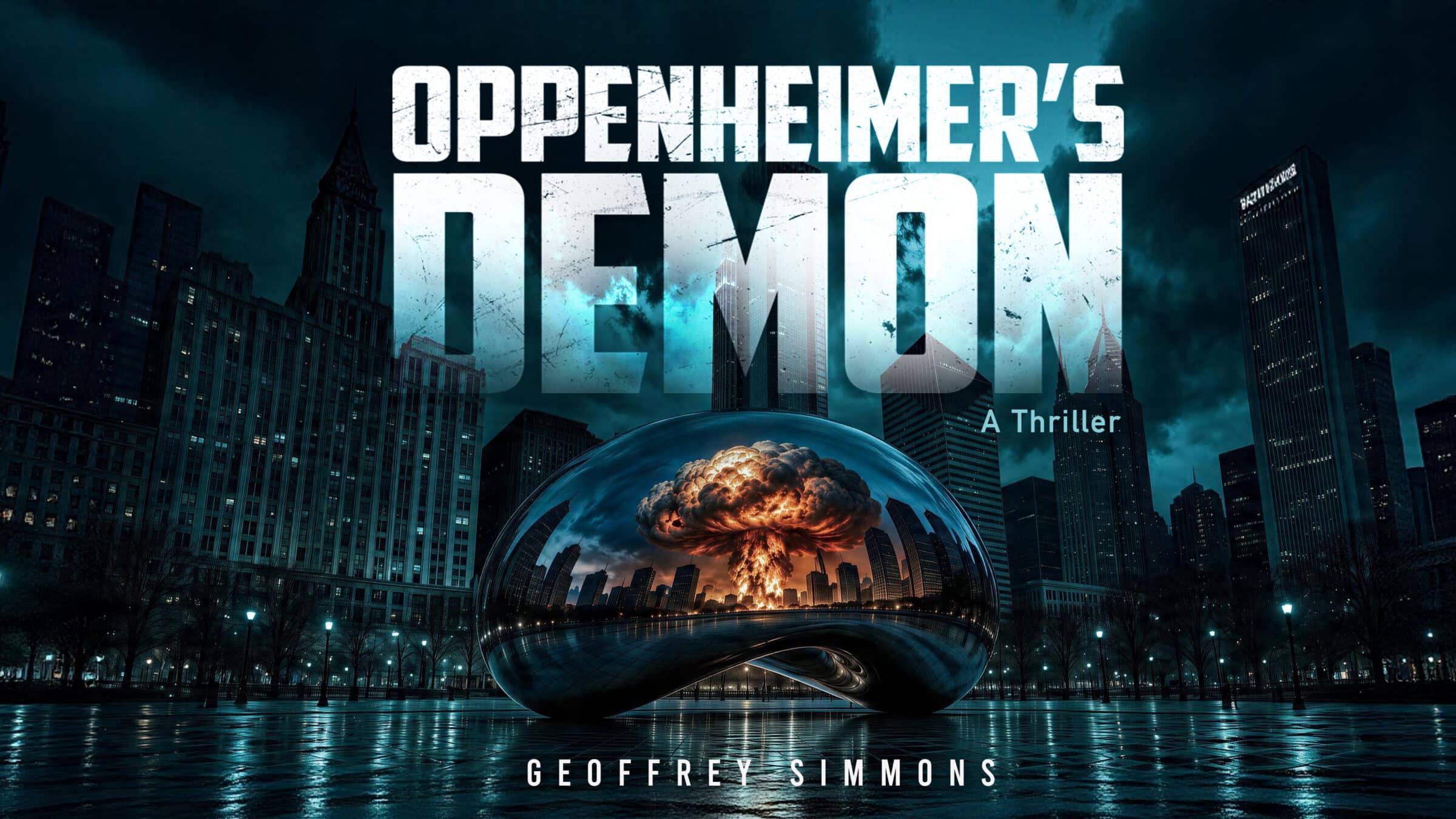
Quite timely in that respect is the new Discovery Institute Press novel, which is very much an edge-of-your-seat page-turner. Oppenheimer’s Demon, by Geoffrey Simmons, joins a long list of disaster thrillers, and it checks all the boxes associated with the genre: high stakes, good vs. evil, authentic human characters whose actions drive the drama forward, and a setting rife with the grit of life’s truth and consequences.
There is courage, fear, and risk. There is human frailty, life-and-death choices, and collateral damage. There are moral complexities; people are confronted with hard decisions that simultaneously reveal and forge their character. There are critical moments that call for wrestling with big questions: Is there purpose to life, and if so, can it be known? Are there things worth dying for, and if so, how should I spend my life? Does Darwinian secularism explain everything, or does reality involve more than the material?
Perennial Themes
Having read the novel, I can tell you it lives up to the best you might expect of the genre. An aggrieved survivor of Hiroshima has meticulously planned out his own personal scorched-earth revenge on the nation that left him orphaned and scarred for life. As clues begin to surface, a team that begins with a Chicago DA grows to comprise the city’s emergency management coordinators, two physicians, local and federal law enforcement, national security agents, military specialists, and more, all mobilizing to piece together clues, locate the threat, and against all odds minimize damage while also managing the specter of growing public panic. All of it takes place against a ticking clock whose countdown duration is unknown.
Others have offered reviews and teasers of the drama (see here and here, for starters), but I’d like to explore why we are perennially drawn to this kind of story. Consider a few basic features of the genre. First, the problems to be solved carry high stakes, usually life and death. Second, while characters are multidimensional, there are clear, discernible lines between good and evil. Protagonists must press beyond what they feel are their limits and rise to the challenge of confronting evil. They do so, not for anything immediate or self-serving, but for reasons that go beyond the materially tangible. It may be love for the ones they protect. It may be a call to duty obeyed. Or it may be mere stubborn but righteous indignation’s refusing to allow evil its way. It may be a combination of all three. (Think of Gandalf before the Balrog, “You shall not pass!”) And third, while evil is not without effect, good prevails.
The Good Story: Material or Teleological?
Consider these recurring themes of good stories. Are our affinities for them better explained on a materialistic or teleological account of reality?
On a materialistic view, every thing reduces to the sum of its constituent parts, the arrangements of which are incidental and could as easily have been otherwise. Furthermore, every seemingly nonmaterial thing, like our loves and desires and joys and sorrows, are likewise ultimately reducible to material accidents of nature. There is no meta-rhyme or reason that explains why things are the way they are. They just are, and we dance to their cacophony for a passing blip of cosmic expansion.
A teleological worldview, by contrast, holds that everything is part of a meaningful whole. While we may not fully comprehend it, the universe and all life within it, up to and including rational man, are inherently ordered toward a purpose. Humans are independent moral agents with minds that can choose good and evil and then act to carry out their choices, which lead in turn to meaningful effects in history.
Obviously, these two explanations of reality are mutually exclusive. Let’s examine the features of the thriller in the context of each one.
High Stakes. Without high stakes, a story won’t hold our attention. This may seem like a no-brainer but the very fact that human lives hanging in the balance are high stakes presupposes that human life matters in an ultimate sense. Other personal concerns, say a potential home foreclosure or mounting credit card debt, would certainly hold the affected individual’s attention. But as material for a thriller, they wouldn’t cut it. The fact that we want our protagonists to succeed and innocent people not to die is an inner witness to a moral fact of existence — and that we know it is true. A materialistic world gives us no reason whatsoever for feeling this way.
Good vs. Evil. A story without a moral dimension won’t inspire anyone’s interest. To be sure, there is a profound moral difficulty lying behind the vengeful designs of the Hiroshima survivor, who was only ten years old when his city was bombed and his life forever changed. Simmons leaves this matter to our own judgment, neither accusing nor excusing historical figures on either side of World War II. But the fact remains that no legitimate discussion about the justice or injustice of any action can take place until there is an agreed upon objective foundation for moral reasoning. And this is precisely what materialism fails to provide. Matter and energy in motion know nothing of the concepts of good and evil. Any attempt to derive morality from a materialist paradigm commits the is/ought fallacy.
Human Characters. We like stories about interesting people, and any good thriller will give us an assortment of them. There will be at least one heroic, though realistically flawed, character we pull for, and the typical storyline will involve a collection of allies committed to thwarting the designs of nefarious actors. The team must put their heads together and orchestrate deployment of their skills to solve problems, which usually keep cropping up in rapid succession. There are often competitions of wits, and the good guys must best the bad guys or all is lost.
Consider the elements in play here: minds, wits, skills, orchestration, problem solving, planning and replanning as circumstances change, all so that evil will be thwarted, innocent lives preserved, and good people live to fight another day. These have always been the makings of great stories.
The Darwinian narrative, which says that our minds evolved for survival, offers a shallow explanation that doesn’t hold up very long. Think a second time and you see that it is a cheap pseudo-explanation. It doesn’t tell us why we prefer good over evil, or why saving lives is worth great effort, or why we have throughout history gravitated toward high-stakes stories of good facing down evil.
Good vs. Evil in Real Life
The narrative of Oppenheimer’s Demon involves Chicago’s emergency response operations, those authorities charged with maintaining readiness and springing into coordinated action in the event of impending destruction. The story also includes some encounters that take place in a hospital. But why do we invest limited public resources on disaster preparedness and hospitals? We do these things because we intuitively know that human lives matter, but no materialistic account of reality provides us any rationale for doing so. Darwin himself recognized the irreconcilable tension between his theory and the compassionate inclinations of British society. Some of his devotees went on to criticize hospitals, asylums, and charity on explicitly Darwinian grounds, and their logic was more coherent than his in this respect.
To return, then, to this week’s solemn commemoration, why did the civilized world respond as it did to 9/11? That’s an appropriate question to ask as you read Oppenheimer’s Demon. The answer is that we know human lives matter, we know good and evil are real, and we know that it is always right to take courage and choose good over evil. The fact that we know these things should also clue us in to the woeful inadequacy of Darwinism as an explanation of our lives.
Order your copy of this page-turning thriller, and while you’re enjoying the story, pay attention to these themes, and note how they resonate with all the great stories of history.