






































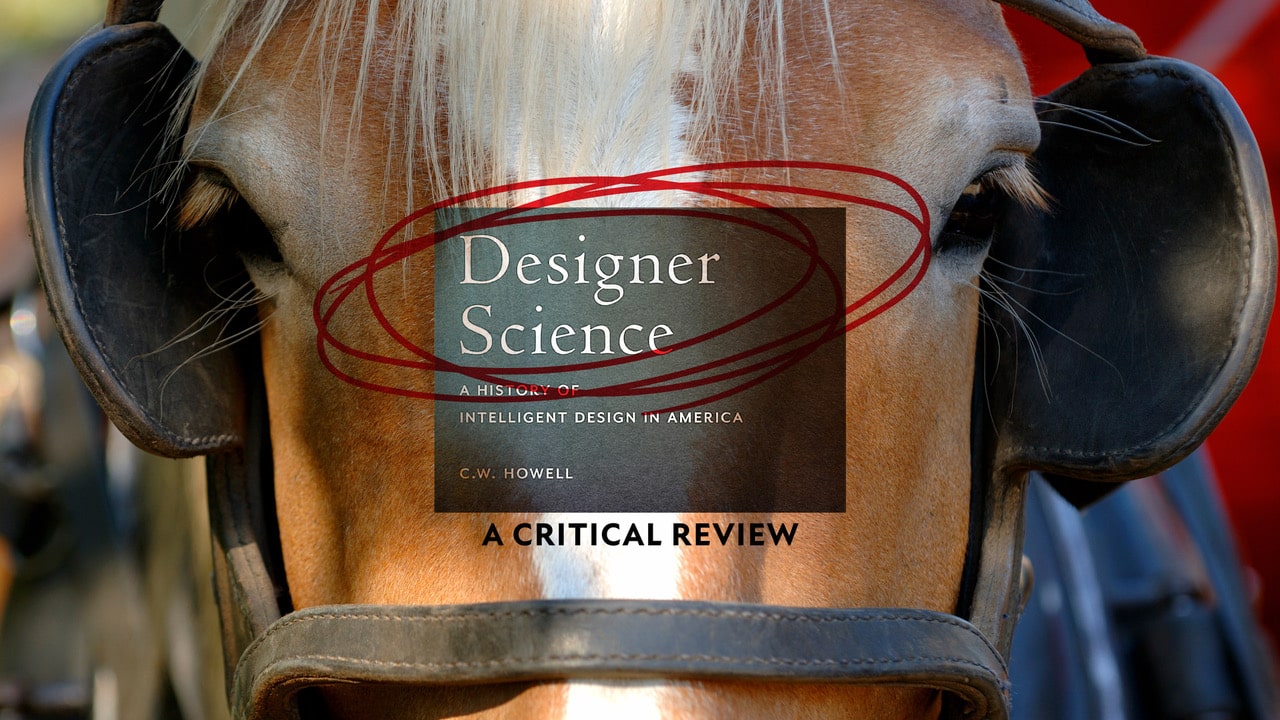
As I noted yesterday, a book from New York University Press, Designer Science, by Dr. C. W. Howell, purports to provide a “full” history of the intelligent design movement. As I showed, key parts of this peer-reviewed (!) work’s case that ID is not science hinged on a fake quote from biochemist Michael Behe, cribbed from Dover ruling of Judge John E. Jones via a brief by the ACLU that was itself inaccurate. In the context of that invented quote, one falsehood is built atop another. Fortunately, when confronted with its publication of the fabricated quote, New York University Press expressed its intention to withdraw the existing edition and completely excise references to the fake material.
But the errors in the book go much deeper than a single invented quote and span far longer periods of ID’s history. Early in the book Howell states as follows:
Since 2005, ID has hardened into a more inflexible ideology, and its leading thinkers and writers have doubled down on the same arguments they had made in the ’90s… (p. 12)
Later he again says that ID saw a “doubling-down on previous arguments” (p. 199) post-Dover. He claims that “nearly all of the material produced by ID’s leading lights after 2005 were recapitulations, replications, and restatements of prior arguments” (p. 167). Howell’s take-home message is clear: He wants readers to think ID is a stale movement that has produced nothing intellectually new since the Dover case in 2005.
Historian Edward Larson (one of my professors in law school, teaching a class on science and the law that I thoroughly enjoyed!) seems to have imbibed Howell’s message uncritically. Reviewing the book in Christianity Today, Larson asserted that ID has “wilted” and is a “flickering flame” because it cannot offer any “positive scientific alternative.”
The truth is that Howell’s narrative is stuck in the past. He is the one “doubling-down on previous arguments” against ID, recycling old stereotypes without regard to the actual record.
And Howell’s failure is worse than one particular fake quote. It’s two decades of fake history. The blame here falls on Howell but also on all the academic reviewers who approved his book, a true system-wide scholarly breakdown. He makes his case less by error and more by omission — essentially choosing to just ignore a huge body of ID scientific research and literature that directly contradicts his thesis. Let’s consider some key peer-reviewed journal articles and then books showing ID’s intellectual novelty and productivity over the past 20 or so years. Everything we’ll discuss here is part of the public record, yet for some reason Howell leaves it out.
The Real ID Research Program
From Howell’s promise to offer a “full-length history of ID,” you would expect an accurate, objective, and, well, “full” history of ID’s science research program. The information about it is public if you want to find it. But Howell seems to be unaware of the vast majority of new — and even much not-so-new — science behind ID. Or perhaps worse, he’s simply uninterested in reporting on it — not in “full” and not even barely.
In that regard, it’s true that Howell will on occasion briefly allude to ID’s research program. The book notes that one of intelligent design’s earliest goals was to establish “a positive scientific research program” (p. 4). Later Howell says that “In the post-Dover world, ID — and the Discovery Institute behind it — would divert more resources to articulating a positive vision of design and would attempt to establish a research program based on it.” (p. 155) He includes a short quote from an article I wrote in 2011 about “pro-ID scientific research and peer-reviewed scientific publications.” (p. 157) These nods to ID’s science research program are appreciated, but they only serve as a foil for his greater point because Howell then immediately asserts:
ID did not disappear after Dover; its scientific projects continued, but cultural and political campaigns became the dominant focus. (p. 157)
Again he seeks to tie ID to politics and activism:
While there have still been efforts at mainstream, or at least mainstream-like scientific enterprise — in the establishment of journals, the publication of findings, the funding of lab work (as with BioLogic [sic]) — there has been a far stronger strand of defiance, anti-establishment rhetoric, and the denunciation of experts qua experts. (p.199)
That’s the strategy. Briefly mention the science so people can’t say you entirely ignored it. But then focus on emphasizing and inflating the politics, religion, activism, and culture war stuff. That’s where he goes into the details and that’s what he’s interested in talking about.
One Statistic Tells the Story
Howell claims his book would be a “full” history of ID, but where I come from, that’s what we call fronting. Consider this statistic: Howell’s bibliography includes about 500 references. Yet only TWO of his bibliographic references are to peer-reviewed pro-ID scientific papers. That means about 0.4 percent of Howell’s bibliographic entries are to peer-reviewed pro-ID papers. It means he gives ID’s science near-negligible coverage in the book.
So what are those two papers? He cites one from 2004, in Journal of Molecular Biology, by Douglas Axe, and another by Stephen Meyer, also from 2004, in Proceedings of the Biological Society of Washington. Howell mentions Axe’s paper in the body of the book but never actually cites Meyer’s (it just appears in the bibliography). Beyond that, Howell ignores nearly all peer-reviewed pro-ID scientific papers published since 2004, only to claim that ID hasn’t produced anything new since 2005.
His claim doesn’t match reality. At the time his book appeared, around 300 peer-reviewed pro-ID papers had been published (and over 150 were summarized at our peer-reviewed articles page, linked below). That means Howell covered about 1 percent of ID’s peer-reviewed science. This is, remember, supposed to be a “full-length history of ID.”
These peer-reviewed articles were not hard to find. Here is a non-exhaustive list of “Peer-Reviewed Articles Supporting Intelligent Design.” Or, we have an ID 3.0 Research Program Home Page here, also posted long before his book came out, that covers many (though definitely not all) of the research projects, principal investigators, and peer-reviewed papers connected to our research program. That page says the following:
The ID 3.0 research program comprises this community of scientists who have collaborated to publish peer-reviewed scientific papers related to the evidence for design in prominent journals, including Nature, ACS Nano, ACS Applied Materials & Interfaces, Nature Nanotechnology, Journal of Bacteriology, Scientific Reports, Frontiers in Microbiology, Frontiers in Genetics, Annual Review of Genomics and Human Genetics, Biosystems, BMC Evolutionary Biology, BMC Genomics, Molecular Biology and Evolution, BIO-Complexity, Springer Proceedings in Mathematics and Statistics, PLOS One, Journal of Theoretical Biology…
Yet Howell discusses zero of the scientific papers mentioned above, and he committed just 0.4 percent of his references — and probably about the same proportion of overall space in his book — to covering ID’s research program.
Abandoning or Abandoned by “Traditional Science”
After completely ignoring virtually all of the mainstream journals where ID proponents are publishing, Howell claims that ID proponents abandoned trying to publish in mainstream journals:
BIO-Complexity’s (and the existence of its doomed forebears) suggests an important development in design strategy. Any attempt to gain acceptance through the traditional mechanisms of scientific progress were squashed; the establishment of peer-reviewed design journals instead signaled the creation of an alternate ecosystem, a parallel scientific world in which design was the reigning hypothesis and where Darwinism had been displaced. (p. 162)
No, that is far from the truth.
First, as you can see from the list above, ID proponents have not “squashed” attempts to publish in mainstream journals. This is a false statement on Howell’s part, and we’ve seen many pro-ID peer-reviewed papers published in mainstream journals. For whatever reason, Howell failed to explore the many peer-reviewed papers that we have been publishing in such journals.
Second, Howell gets the situation backwards. BIO-Complexity is an extremely good journal with a top-notch editorial board. It gives great peer-review and publishes high quality material. We love to publish in it! But BIO-Complexity isn’t some replacement for publishing in what Howell calls “mainstream” journals, since ID theorists are publishing so much in journals that undoubtedly Howell would consider “mainstream.” BIO-Complexity is an additional credible outlet for cutting-edge material as the ID research community continues to grow. Discrimination still exists, but it isn’t ubiquitous, and for an increasing number of people in the scientific community, good science trumps anti-ID prejudice.
Howell’s Dismissal of ID Science
Unfortunately, Howell nearly entirely dismisses the growing body of ID research and essentially doesn’t even engage with it. In fact, “dismissal” is the exact word that William Dembski used when describing Howell’s method as a scholar. Dembski provides a nice summary of what Howell left out. We’ll come back to some of the things he notes, but this struck me as particularly telling:
Howell, despite extensively citing me, gives no indication of research I’ve done post 2005. In the span of 2009 to 2013, I published a number of peer-reviewed papers (principally with collaborators Bob Marks and Winston Ewert) on evolutionary informatics — see the publications page at EvoInfo.org. These were in the engineering literature (such as IEEE). Just last year, I published a peer-reviewed monograph on conservation of information.
Howell’s dismissal of intelligent design as non-science or failed science therefore rings hollow.
Indeed, Dembski, Robert J. Marks, and Winston Ewert, and their colleagues have published some two-dozen peer-reviewed scientific papers on evolutionary informatics from the late 2000s to the present, yet not a single one is cited in Designer Science. The book’s bibliography contains over 25 entries by Dembski and/or Marks, yet not one points to their scientific papers. Winston Ewert — a prolific ID researcher with about 20 peer-reviewed pro-ID publications — isn’t even in Howell’s index. And there are literally hundreds of other interesting peer-reviewed pro-ID scientific papers that Howell similarly ignores.
Now let’s look at something that Howell does talk about a lot: ID books. In that area, is ID really just recapitulating ideas from the 1990s? Again, no, and Howell ignores many key new ideas we’ve been publishing in books.
Ignoring Behe’s Darwin Devolves Thesis and Other Post-Dover Developments
In addition to being misquoted, Michael Behe also receives the “dismissal” treatment. Howell asserts that Behe’s post-Dover writings had nothing new to say:
Nearly all of the material produced by ID’s leading lights after 2005 were recapitulations, replications, and restatements of prior arguments — notably Michael Behe’s The Edge of Evolution and Darwin Devolves. (p. 167)
If you know the real history here, this is just stunning. Behe’s The Edge of Evolution (2007) and Darwin Devolves (2019) are both post-Dover books. In The Edge of Evolution (2007), Behe for the first time rigorously investigates exactly how many coordinated mutations Darwinian evolution can produce, something highly relevant to defending irreducible complexity, but not a topic he had explored in his previous book.
Behe’s 2019 book Darwin Devolves presented an entirely new thesis. Another one of the many peer-reviewed pro-ID papers that Howell ignores is a 2010 paper that Behe published in the highly respected (and mainstream) journal Quarterly Review of Biology (QRB), titled “Experimental evolution, loss-of-function mutations, and ‘the first rule of adaptive evolution’.” There, Behe presented a new ID argument — that Darwinian evolution does occur and have effects at the molecular level, but those effects tend to break or diminish function far more often than they build new functions. He reviewed many scientific studies of molecular evolution to make this case.
Howell recognizes none of these innovations — neither Behe’s peer-reviewed paper, nor his entirely novel argument expanded into a book derived from that paper — instead trying to paint these books as representing failures by ID to break into mainstream academia. As Howell writes, “these books were printed by popular and not academic presses” (p. 167).
If your thesis is that ID is failing academically, wouldn’t it be important to mention that one of the books was an expansion of an argument first developed in an important peer-reviewed scientific paper? Of course, the answer is yes. And wouldn’t it be important to note that both the paper and the book broke new ground with novel arguments? So why didn’t Howell mention any of this? Presumably because it doesn’t fit his thesis that ID has nothing new to say.
False Claims About Stephen Meyer
Next we have the new work that Stephen Meyer did post-2005 advancing the case for ID. Howell repeatedly labels ID as “anti-evolution,” as if the case for design were wholly negative. That is untrue. Consider the positive case for design developed by Meyer in works like his 2004 paper in Proceedings of the Biological Society of Washington, Signature in the Cell (2009), and Darwin’s Doubt (2013), reviewed in part here. These are highly important developments from Meyer’s book that helped build the theoretical case for ID, and they go unmentioned by Howell.
Regarding Darwin’s Doubt, Howell writes:
Much of Meyer’s argument was a recapitulation of Signature. Though he focused on development of animal body plans and the problem of transitional fossils in the Cambrian era (or lack thereof), he also trod the same paths as before, relying on Doug Axe’s work on protein folds and on Michael Behe and David Snoke’s 2004 paper regarding proteins, genes, and irreducible complexity, as well as Axe and Gauger’s work at BioLogic [sic]. Meyer directed the reader to refer back to Signature for a fuller explanation of the argument. Darwin’s Doubt was derived largely from Signature, but Signature was a rejuvenation of arguments made by Thaxton and Company in Mystery of Life’s Origin. (p. 166)
There’s so much that’s wrong in that paragraph.
First, Meyer develops many novel ID arguments in Darwin’s Doubt beyond just fossils regarding (a) the origin of new body plans and why developmental gene regulatory networks (dGRNs) pose a major challenge to animal evolution (Chapter 13), and (b) recent discoveries in epigenetics, various sources of epigenetic or ontogenetic information, how they apply to ID, and why neo-Darwinism cannot create the new epigenetic information (Chapter 14). Meyer incorporates both dGRNs and epigenetics into his positive argument for design, pointing out that they represent sources of “information.” In Chapters 15 and 16, Meyer also offers (c) a fantastic review (which is still very current!), never done by ID before at that time, of various post-Darwinian models of evolution (e.g., self-organization, natural genetic engineering, neo-Lamarckism, evo-devo, neutral evolution, and symbiogenesis), and why non-Darwinian evolutionary models also cannot explain how new complex features arise. Meyer ties it all together noting that none of these mechanisms can account for the new information needed to build animal body plans — and the only known cause that can generate this information is intelligence. As Meyer writes:
Several of the new evolutionary theories discussed in the previous chapters presuppose, but do not explain, the existence of both genetic and epigenetic forms of information, highlighting the need for a cause capable of generating such information in the first place. …
[I]n Signature I did not try to argue that intelligent design might help explain the origin of the information necessary to account for the origin of new animals from simpler preexisting forms of life. That would have required a separate demonstration showing the inadequacy of natural selection and mutation as a mechanism for generating new genetic information in already living organisms. This book — in Chapters 9–14 — has provided that demonstration. These chapters show how neo- Darwinism fails to explain the origin of genetic information—at least, in amounts necessary to build a new protein fold. Chapters 15 and 16 showed, in addition, that the other main materialistic evolutionary theories also fail to account for the information necessary to build new forms of animal life. These theories presuppose, rather than explain, the origin of the information necessary for structural innovation in the history of life. And since the Cambrian explosion of animal life is an explosion of information and structural innovation, that raises a question. Is it possible that this increase of biological information not only represents evidence against materialistic theories of biological evolution, but also positive evidence for intelligent design?
[…]
The answer is: intelligence. Conscious activity. The deliberate choice of a rational agent. Indeed, we have abundant experience in the present of intelligent agents generating specifi ed information. Our experience of the causal powers of intelligent agents — of “conscious activity” as “a cause now in operation” — provides a basis for making inferences about the best explanation of the origin of biological information in the past. (Darwin’s Doubt, pp. 357, 360, 393)
These are new ID arguments and/or important new additions to ID arguments that Meyer wrote in Darwin’s Doubt. Howell mentions none of them.
In fact, there’s quite an irony here. When Meyer wrote Signature, some critics attacked him for only dealing with the origin of life and not addressing the Darwinian evolution of life, claiming that this explains how new biological information arose. Of course that wasn’t the topic of Signature, but Meyer was happy to do what the critics requested. So then Meyer wrote Darwin’s Doubt to address the evolution of animal life. Agree or disagree with the argument, Meyer covered many new topics in Darwin’s Doubt that he didn’t cover in Signature. But now he’s being accused of doing nothing new in Darwin’s Doubt, and merely providing a “recapitulation of Signature.” I guess with ID critics you just can’t win!
Second, Howell knows too little about ID science to appreciate what’s new in Darwin’s Doubt. While Howell very briefly alludes to Meyer’s 2013 book, Darwin’s Doubt, as “relying on … Axe and Gauger’s work at BioLogic” [sic] (this is literally all he says about that entire body of research!), he says that this meant Meyer “trod the same paths as before,” in Signature. Howell apparently doesn’t realize that this was actually new ID research that Meyer had not covered in Signature because it was all published from 2010 onward — after Signature was published in 2009! I know that in Darwin’s Doubt, Meyer wrote about what was at the time new ID research from Biologic because I was Steve’s research assistant for the book and I remember well that he included a review of new post-Signature ID research precisely so that critics (like Howell!) could see that ID was making advances.
For example, in Darwin’s Doubt, from pp. 250-253, Meyer cites or discusses research by Gauger et al. (2010), Gauger and Axe (2011), and Axe (2010) — all novel laboratory, experimental, and theoretical ID research published after Signature which showed ID extending new arguments challenging the evolvability of new proteins. It’s important to appreciate why Gauger and Axe et al.’s research is so important: After Behe wrote Darwin’s Black Box in 1996, arguing for irreducible complexity, critics claimed that new parts can easily be “co-opted” into irreducibly complex systems. The Biologic Institute research put that claim to the test and showed that proteins are not at all easy to modify and change to acquire new functions. This body of research goes entirely undescribed by Howell, though we recently reviewed it here, and it was and is directly relevant to debates over ID and evolution which showed that some of ID’s core arguments remained valid. Howell wrongly claims that Meyer presented nothing new in Darwin’s Doubt.
A third error: Howell is correct that Meyer mentioned Behe and Snoke’s 2004 paper in both Signature and Darwin’s Doubt — though for some reason Howell never mentions that this paper appeared in a respected mainstream journal, Protein Science, and it isn’t even listed in his book’s bibliography. But Howell makes it sound like that paper was a major part of Meyer’s argument in Signature, which he then recapitulated in Darwin’s Doubt. It wasn’t. In Signature Meyer barely deals with this paper — citing it only once briefly along with multiple other papers in a single endnote to support a simple point that “several other” pro-ID scientific paper had been published since his 2004 paper in Proceedings of the Biological Society of Washington — and then giving the paper no further discussion. In contrast, Darwin’s Doubt was the first and only book where Meyer discussed the scientific implications of Behe and Snoke (2004), and there he devotes nearly two pages to reviewing the findings of this paper.
This brings us, fourthly, to Howell’s statement that in Darwin’s Doubt, Meyer simply “directed the reader to refer back to Signature for a fuller explanation of the argument.” The context here is supposed to be ID’s scientific arguments regarding protein evolvability and irreducible complexity. Once again, Howell has made a false statement.
I went through Darwin’s Doubt and cannot find any instance where Meyer refers readers to Signature to learn about things like Axe’s research on protein evolvability or other ID work on irreducible complexity, etc. Chapters 8, 9, 10, 11, and 12 are the portions of Darwin’s Doubt where Meyer covers protein evolvability, and Signature in the Cell is never mentioned in the body of any of those chapters. The endnotes have a brief citation of Signature at the beginning of Chapter 10 to learn more about Dawkins’ famous “weasel” simulation, and there’s another citation at the end to learn more about Dembski’s universal probability bound. There’s another endnote citation of Signature in Chapter 12 to cover a minor historical point. That’s it. Meyer never refers to Signature in Darwin’s Doubt regarding protein evolvability or irreducible complexity.
When we dig into Howell’s citation justifying his claim, it’s to pages 359, 389, and 392 of Darwin’s Doubt (see Howell’s endnote 39 on page 235 of Designer Science). Yes, Meyer does reference Signature in those pages, but none of these citations are regarding ID research or ID’s scientific claims. Instead they are regarding another innovation that Meyer developed both in Signature and Darwin’s Doubt: detecting design by making an “inference to the best explanation,” and philosophy of science regarding the testability of intelligent design. The one place in Darwin’s Doubt where Meyer says “Readers may wish to consult Signature in the Cell for a more detailed response to these specific arguments” (p. 389), he’s talking about philosophy of science and the testability of intelligent design, epistemologically speaking, not ID research. Meyer did review and discuss then-newly published ID research in Darwin’s Doubt, yet Howell fails to recognize this and instead spins a tale that it was all old, rehashed material.
Last, we have Howell’s claim that “Signature was a rejuvenation of arguments made by Thaxton and company in Mystery of Life’s Origin.” This is like saying that nothing new has been done in evolutionary biology since 1859 because anytime anyone talks about natural selection they’re just rehashing what Darwin wrote.
The Mystery of Life’s Origin (“Mystery”) was published in the mid 1980s, and Signature in the Cell in 2009. In between, Meyer received his PhD from Cambridge on philosophy of historical sciences, and how it applies to the origin of life. Yes, both books deal with arguments about how information in DNA provides evidence for an intelligent cause. That’s old news to everyone that these ideas were part of ID from the beginning. But Signature covers many new developments in thinking about the origin of life — including the RNA world, self-organization, and updated treatments of protein evolvability based upon bodies of scientific research that post-date Mystery. Meyer also provides much material explaining how we detect design by making an inference to the best explanation. To suggest that Meyer has nothing new to say in Signature compared with Mystery is incredibly false.
The Mystery of Howell Ignoring ID’s Novel, Up-to-Date Arguments
On p. 167, Howell lists a 2020 re-release of Mystery as another alleged example of how “nearly all of the material produced by ID’s leading lights after 2005 were recapitulations, replications, and restatements of prior arguments.” It’s true that Discovery Institute Press re-released Mystery in 2020, but the 2020 rerelease included an additional 150 pages: five new chapters, with contributions from newcomers to the ID literature like James Tour and Brian Miller. Tour and Miller’s chapters offer important new arguments. Howell does in fact mention these new chapters, but then immediately says they represented a “repeated repudiation of familiar material and argumentation” (p. 173). He doesn’t explain any of the novel arguments, nor all of the recent science they covered.
For example, Tour’s chapter provides an updated take on many of the prebiotic synthesis experiments that took place in the 2000s and 2010s (all post-Mystery) and shows how they do not simulate natural earth conditions. Indeed, a lot of new prebiotic synthesis research took place during those years (say 2005 to 2019) by researchers such as Sutherland, Powner, and others, and it needed to be addressed. Thus, Tour cites and critiques recent papers on the origin of life such as Barge et al. (2019) in PNAS, Fayolle et al. (2017) in Scientific Reports, Albertsen et al. (2017) in Scientific Reports, Gibson et al. (2010) in Science, Niederholtmeyer et al. (2018) in Nature Communications, Ritson and Sutherland (2012) in Nature Chemistry, Sutherland (2017) in Nature Reviews Chemistry, Gibard et al. (2018) in Nature Reviews Chemistry, and Gerbelli et al. (2017). One would think the proper response from a historian like Howell to Tour’s chapter would be to point out that it shows ID books are remaining current and up-to-date on the literature! But somehow Howell spins this into a negative. Apparently, according to Howell, anytime anyone in science does the normal practice of providing an updated review of a field, it’s just a “repeated repudiation of familiar material and argumentation.”
Moreover, Tour’s chapter brings new types of critiques of prebiotic synthesis experiments. A synthetic chemist, Tour is an expert on how to design chemistry experiments, and he offers new arguments that I don’t believe anyone had ever made regarding obstacles like the ‘mass transfer problem’, where there is so little product at each step of the reaction series that eventually you have essentially no material to work with. Tour then describes “relay synthesis” — how origin of life theorists essentially cheat by buying large quantities of pure materials to start the next step as a strategy of avoiding the mass transfer problem. These are devastating critiques of origin of life research that Tour makes in his chapter in Mystery that I don’t think anyone had ever made before. To this day Tour’s arguments really haven’t been answered. Howell mentions none of this novelty.
Howell also briefly notes there is “an essay on thermodynamics and abiogenesis from Brian Miller” (p. 172) but says nothing more and again, leaves out all the novel arguments Miller made. With a PhD in the physics of complex systems, Miller is a leading expert on thermodynamics and the origin of life, and Miller argues that thermodynamics presents a fundamental barrier to a naturalistic chemical origin of life. Miller shows that under natural conditions, chemistry will spontaneously give you low order / high energy systems (like volcanos or hurricanes), or high order / low energy systems (like crystals), but it never spontaneously gives high energy / high order systems. Yet this is precisely what life is. So how does life maintain this high energy / high order state? It constantly overcomes thermodynamic barriers through the work of molecular machines which, much like human machines, use chemical energy to do mechanical work to maintain an extremely high state of order and energy in the cell. And where do these molecular machines come from? They are manufactured using other molecular machines interpreting information encoded in the DNA. Thus, life is totally unlike all other natural systems: life uses machines encoded in a chemical language to maintain a high order / high energy state. Such a complex system doesn’t happen naturally, and it absolutely requires intelligence for its origin. Miller has made novel argument — and a very powerful one — that Howell just ignores, instead categorizing it as “familiar material and argumentation.”
The same year the rerelease of Mystery came out (2020), Miller had an exchange with the MIT origin of life theorist Jeremy England about thermodynamics and the origin of life in the journal Inference Review. That this happened shows high-level scientists engaging with ID theorists. Howell ignores all this too.
Then there’s Guillermo Gonzale’z chapter on astrobiology, which covers discoveries that all post-date Mystery. Howell mentions Gonzalez’s chapter as discussing “what astrobiology — that is, the story of life and how it may have arisen on other planets — could teach us about the origin of life on Earth” (p. 173). That’s a fair description, but again Howell shows no appreciation of just how current Gonzalez’s treatment is, and how badly needed it was in an updated book on the origin of life. In fact, Gonzalez’s chapter opens by saying “The modern era of astrobiology research began in 1995–96 with two momentous events: the discovery of the first planet around another Sun-like star (October 1995) and the announcement of evidence of ancient Martian life in the meteorite ALH84001 (July 1996).” Thus, virtually the entire field that Gonzalez’s chapter is reviewing arose post-Mystery and therefore badly needed an updated treatment. The average publication date of Gonzalez’s 40+ scientific citations is 2011, and the median is 2014. This gives you an idea of how current his review is of the literature. Why should this be a negative?
There’s more that can be said here, but the point is this. It’s bizarre that Howell is trying to spin into a negative the fact that scientists writing in an ID book provided updated reviews covering a field’s recently published literature. Indeed, in the mainstream scientific world, scientists write these kinds of updated reviews all the time. And when such reviews confirm that the field has not made significant progress, then such updated treatments become highly valuable. In Howell’s world, none of this matters — all ID can muster is “familiar material and argumentation” — provided you ignore all the novelty.
Other Recent Books about the Design of the Human Body and Mind
Howell’s comments about the rerelease of Mystery bring us to the year 2020. But his book Designer Science was not published until 2025, and strangely, there’s zero mention in it of the many important novel arguments published on ID between those few years. Let’s briefly review some of these developments.
Over the past couple of decades, University of Bristol engineering professor Stuart Burgess has published a myriad of peer-reviewed pro-ID scientific papers exploring the design of the human body, especially looking at the design of joints and limbs. In February 2026, he published a book, Ultimate Engineering: An Engineer Investigates the Biomechanics of the Human Body. That book came out too late for Howell, of course. But the great portion of Burgess’s research that went into Ultimate Engineering was published prior to Designer Science, in the form of peer-reviewed scientific papers, and we reviewed much of it at Evolution News (now Science and Culture Today). One of my favorite examples is a novel argument Burgess published in 2024 in the peer-reviewed journal Bioinspiration & Biomimetics showing that similarities in vertebrate limbs are due to their efficient functional design, not common ancestry (nicely reviewed by Brian Miller here). As usual, Howell ignores all of this.
Burgess’s book followed the publication of Your Designed Body in 2022 by engineer Steve Laufmann and physician Howard Glicksman. They look at the interdependent nature of our physiological systems at both the macro and biochemical levels, and offer a novel case that this requires a highly intelligent engineer. Howell ignores this book.
On the theme of humanity’s design, there’s also the 2012 book Science and Human Origins which I co-authored with Doug Axe and Ann Gauger. That book expanded ID arguments into the terrain of human origins, including much material on paleoanthropology and human genetics that I wrote, and that had never been published in any ID book before. This material was expanded in a chapter I published in a 2022 open access book by an academic publisher in South Africa. ID broke a lot of new ground post-Dover by talking about human origins. For good measure, none of these books appear in Howell’s bibliography and he ignores this entire development too. Why?
In recent years intelligent design has also broken new ground exploring the nature of consciousness, and the origin of the human mind and complex animal behaviors. All of this is ignored by Howell.
Last year (2025), neurosurgery professor Michael Egnor along with science writer Denyse O’Leary published The Immortal Mind: A Neurosurgeon’s Case for the Existence of the Soul which makes a case for the immaterial nature of the human mind. But as it came out just a few months before Designer Science, which was likely completed by then, I’ll give Howell a pass on it, but this is generous, since Egnor has been writing about the origin of the human mind in ID literature for quite a few years, if Howell had cared to mention it. Egnor is mentioned a few times in Howell’s book but only as an “ID proponent,” and never in the context of his being a neurosurgeon arguing for design of the human mind. Egnor’s novel scholarly contributions within his field of expertise are completely ignored.
The Immortal Mind is not the only ID foray into the origin of the mind, and perhaps the most important work long-predates Designer Science. A much more detailed investigation of the nature of consciousness is contained in Minding the Brain: Models of the Mind, Information, and Empirical Science, published in 2023 by Discovery Institute Press. That book included contributions by computer scientists, neuroscientists, philosophers, and other experts bringing their unique perspectives on why the mind must be immaterial, unevolvable, and distinct from the brain. It too is ignored.
So is another book in a similar vein, Animal Algorithms: Evolution and the Mysterious Origin of Ingenious Instincts, published in 2021, which explores the astounding complexity and diversity of animal behaviors. This book shows that many “complex programmed behaviors” (CPBs) in animals require multiple components — navigation systems, sensors, information processing and calculation, and outputs — in order to work. Many examples show that irreducible complexity and the case for design extend deep into neural modules that control animal instincts.
Howell shows basically zero interest in mentioning a great body of novel ID books published since 2005 on the origin of the human body and the mind. Could that be because it would refute his thesis that ID has nothing new to offer since the Dover trial?
Extending and Expanding Previous Design Arguments
We haven’t even talked about how Stephen Meyer’s book Return of the God Hypothesis, published in 2021, which breaks much new ground about cosmology including novel arguments about why information is needed to fine-tune the mechanisms that are said to generate our universe. This book reviews older ID arguments and Howel mentions that. But he says nothing about the new material Meyer develops there.
Then there is Plato’s Revenge: The New Science of the Immaterial Genome, where David Klinghoffer recounts the highly original arguments of Richard Sternberg that organismal development and cell homeostasis requires so much computation that it could never be encoded in the few hundred megabytes of information contained in the typical genome. That came out in 2025, likely as Howell was putting the finishing touches on his book. No mention.
There is also the revised and expanded edition of The Design Inference (2023), by William Dembski and Winston Ewert, which improves methods of design detection by sharpening our ability to measure specification. Perhaps Howell would dismiss this book because it is the second edition of a previous book. But the second edition doubles the size of the original, adding 90,000 words of new material that refines, elaborates, and extends the ideas developed by Dembski. The book offers many fresh ideas — many of them developed in peer-reviewed scientific papers that Dembski and Ewert have published — such as the new insight that human language is precisely formulated to identify specified objects/events, since we often use words to describe things that match particular patterns that are interesting. The work of Dembski and Ewert has significantly improved the measurement of complex and specified information. The new edition was praised by Sergiu Klainerman, Higgins Professor of Mathematics at Princeton and a member of the National Academy of Sciences. If you’re suspecting Howell ignores this book as well as all the peer-reviewed papers that helped develop its arguments, you’re right!
There is more, which also gets no attention from Howell, but I think the point is made.
Like It Never Happened
Let’s remember the context of why we’re talking about all of this. To review, Howell alleged that “nearly all of the material produced by ID’s leading lights after 2005 were recapitulations, replications, and restatements of prior arguments,” and that post-Dover we simply saw “doubling-down on previous arguments.” I already quoted Howell from p. 12 of his book, but I now want to expand the quote:
Since 2005, ID has hardened into a more inflexible ideology, and its leading thinkers and writers have doubled down on the same arguments they had made in the ’90s, insisting that they were scientifically valid and that the only reason for their defeat was ideological prejudice. (p. 12)
Notice that I’m not attributing, in his phrase, “ideological prejudice” to him. He’s wrong about that as well. But given the falsity of Howell’s claims and the magnitude of his omissions about ID scholarship, we have to ask: Why did Howell ignore such a large volume of ID literature that has developed new arguments since the Dover trial in 2005? It’s all quite disconcerting.
I’ll mention here that some friends in the ID community urged me to be “nice” to Howell in my response because they thought he was trying to be fair in his book. I want to be nice, but I also want to be truthful. I want to be fair to Howell, but I also want to be fair to my colleagues in the ID community who have worked hard developing and publishing new ID arguments over the past 20 years. Why does Howell largely ignore what they’ve done, only to claim they have been entirely unproductive over that period of time?
I will return later in this series to acknowledge that Howell’s book is often “fair” on the small things. But in the larger context, no, he has not been either fair or accurate. To claim this book provides a “full-length history of ID” is simply not an accurate way to describe it.
The Lessons Learned: The obvious lesson is probably to not call your book a “full-length history” if you’re going to ignore nearly all the major innovations across the second half of your subject’s duration. But everyone probably knew that already. So a more useful lesson here is probably that one should be fair — or at least try to be fair — to your subjects when doing history. Pay close attention not just to what they were doing then, but also to what they’re doing now. Don’t assume people can’t come up with new ideas and try hard to understand what they’re thinking about. Be charitable and don’t always look for ways to spin positives into negatives. Don’t try to paint people as impotent and unproductive when they are in fact working hard to produce large volumes of novel intellectual material.
Tomorrow, “Is Intelligent Design the Root of All Science Skepticism?”