






































Not all late Victorians were as Darwin-centric in their preoccupations or as overawed by the great man as much formal historiography might have us think. Alvar Ellegård, in his pioneering Darwin and the General Reader, first published in 19581, established that the average man or woman riding atop the Clapham omnibus (to use the Victorian cliché), was distinctly “underwhelmed” by Darwin’s Origin of Species. Very many Britons (then as now) regarded Darwin’s work as “just a theory” (much to the fury of Darwin’s vociferous apostles!). Yet this theory was accepted — indeed, adopted with missionary zeal — by the intellectual élites, who turned it into scientific dogma. I propose here to consider how and why such a major cultural upheaval gained acceptance, taking a longer historical perspective.
The rise of materialism in the 19th century, though closest to us in time and therefore more vividly in our awareness, was not the only instance of a major cultural and spiritual revolution in the English-speaking world. It could in fact be argued that the worldview underpinning Darwinism was enabled by past events: three principal turning points, starting with the conversion to Christianity of the Anglo-Saxons, followed by the Reformation under Henry VIII, and finally the Enlightenment and the French Revolution with its continuing intellectual entailments.
Turning Point 1: A Sparrow Flies Through the Banquet Hall
It is well enough known that our remote ancestors, the Anglo-Saxons, were originally polytheists who had voyaged over the English Channel from various parts of Germany and Scandinavia, bringing with them their allegiance to such gods of Northen Europe as Wodan, Freia, Balder, and other divine figures who typically constitute the dramatis personae of Wagnerian opera. The circumstances of the conversion to Christianity of the Anglo-Saxons have been recorded in medieval historical documents, in particular the Ecclesiastical History of the Venerable Bede (731 AD),2 one of the last Fathers of the Church before the Great Schism that separated the Eastern and Western Churches. Bede’s account of the conversion of the Northumbrians is noteworthy for the details it gives of the process followed and the reasons given to turn away from the pagan gods.
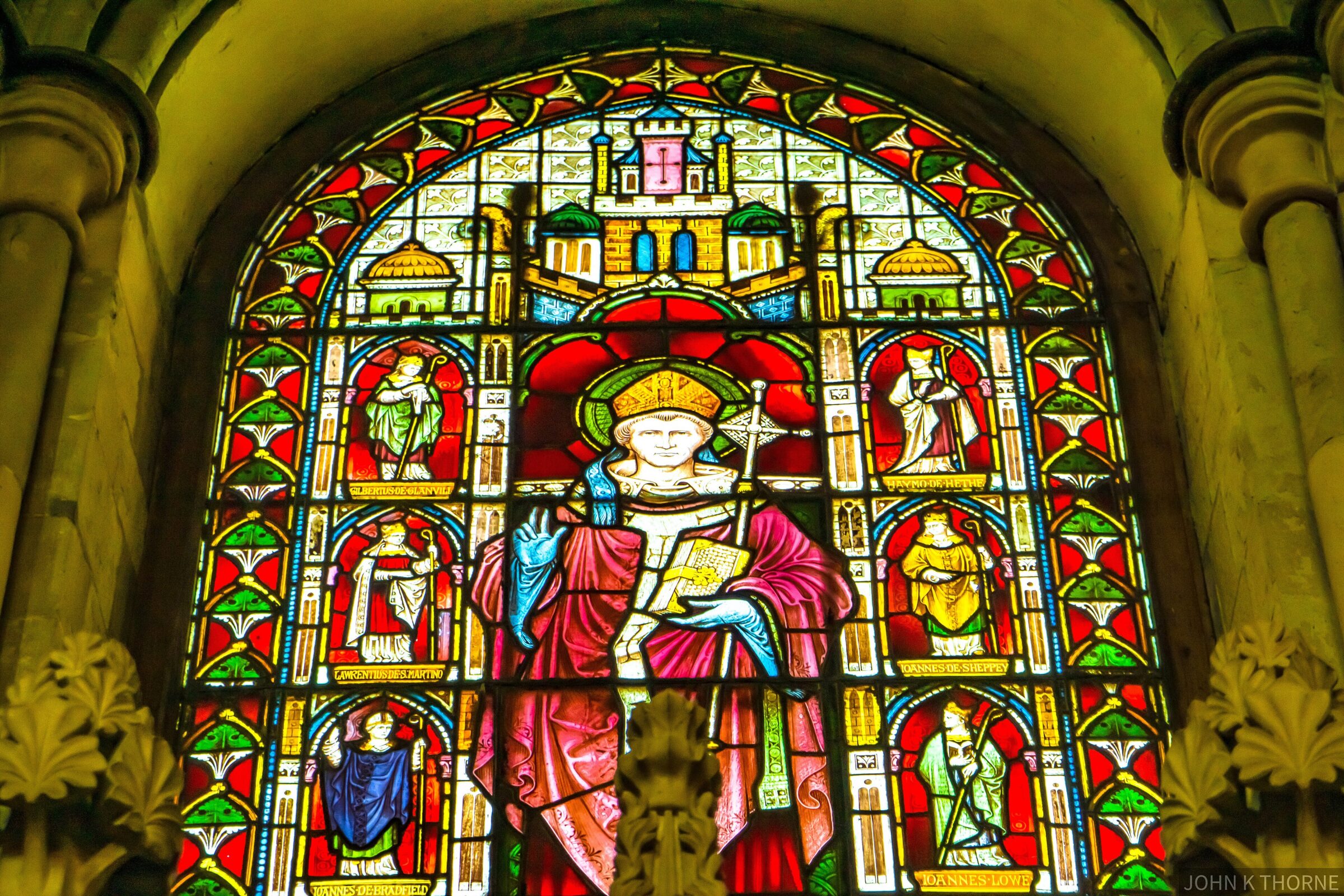
In a passage that deserves to be quoted at length, Edwin, King of Northumbria, is urged by his wife Ethelberga and Bishop Paulinus (pictured at the top) to embrace Christianity. He declares his willingness to do so,3
but that he wished, nevertheless, to confer about it with his principal friends and counselors, to the end that, if they also were of his opinion, they might all be cleansed together in Christ, the Fount of Life. Paulinus consenting, the king did as he said; for holding a council with the wise men, he asked of every one in particular what he thought of the new doctrine and the new worship that was preached.
Edwin is asking here to follow the customary Anglo-Saxon political process, which demanded that the king seek the advice of his nobles and secure their assent before any important decision. The account of the debate foregrounds the reasons for acceptance of Christianity, as one would expect, but the arguments put forward are threefold. The pagan high priest, Coifi, first presents the pragmatic case:
[…] The chief of his priests, Coifi, immediately answered: “O king, consider what this is which is now preached to us; for verily I declare to you that the religion which we have hitherto professed has, as far as I can learn, no virtue in it. For none of your people has applied himself more diligently to the worship of our gods than I; and yet there are many who receive greater favors from you, and are more preferred than I, and who are more prosperous in all their undertakings. Now if the gods were good for anything, they would rather forward me who has been more careful to serve them. It follows, therefore, that if upon examination you find those new doctrines which are now preached to us better and more efficacious, we should immediately receive them without any delay”
In other words, their pagan religion did not work, their gods do not reward devotion, and if a better, more effective set of beliefs is offered, it makes sense to adopt them. Note the “if”: Coifi is not at this point accepting that the proposed new religion is indeed superior.
The next voice is that of the king’s retainers, who consider the issue from a different, eschatological viewpoint:
Another of the king’s chief men, approving of Coifi’s words and exhortations, presently added: “The present life of man, O king, seems to me, in comparison with that time which is unknown to us, like to the swift flight of a sparrow through the room wherein you sit at supper in winter amid your officers and ministers, with a good fire in the midst whilst the storms of rain and snow prevail abroad; the sparrow, I say, flying in at one door and immediately out another, whilst he is within is safe from the wintry storms but after a short space of fair weather he immediately vanishes out of your sight into the dark winter from which he has emerged. So this life of man appears for a short space but of what went before or what is to follow we are ignorant. If, therefore, this new doctrine contains something more certain, it seems justly to deserve to be followed.”
The argument here is a spiritual one; Christianity offers answers where paganism does not. The image of the sparrow flying through the hall back into the bitter winter cold is a powerful poetic image that has rightly made this passage an anthology piece. Whereas Coifi had focused on the absence of any advantage of their pagan faith in this life, Edwin’s nobles are concerned with the fate of the human soul after death.
In conjunction, these two considerations result in a unanimous decision. Coifi requests further information about the Christian religion before giving his approval, Paulinus duly provides it, and Coifi is convinced:
Coifi, hearing his words, cried out: “I have long since been sensible that there was nothing in that which we worshiped, because the more diligently I sought after truth in that worship the less I found it. But now I freely confess that such evident truth appears in this preaching as can confer on us the gifts of life, of salvation, and of eternal happiness. For which reason I advise, O king, that we instantly abjure and set fire to those temples and altars which we have consecrated without reaping any benefits from them.”
Coifi’s speech picks up his previously stated unhappiness with the old religion and reaffirms the argument put forward by the nobles, explicitly quoting the “gifts of life, of salvation, and of eternal happiness” brought by Christianity. The new religion is adopted and Coifi then proceeds to destroy the old shrines in person.4
There were of course strong personal and political reasons for Edwin to wish to embrace the Christian faith, but this account shows that it was not a rigidly top-down imposition upon the Northumbrians. That the new faith did indeed resonate with the English people is attested by the rapid rise of native saints and the superb artwork and literature inspired by the Christian message. The relapse to paganism after Edwin was killed by the pagan king Penda, in 633, was short-lived.
This is not to say, of course, that pagan practices were entirely wiped out; there remains evidence that in the field of folk medicine in particular, practitioners hedged their bets by invoking both the pagan and the Christian God. The Ecclesiastical History does in fact report a pagan incantation being used in conjunction with the singing of the Mass as the means by which an animal’s injury could be cured.5 Whether this can be construed as indicating a genuine survival of the older belief system is dubious, though it hints at a period of syncretism at the grassroots level.6 Whatever the truth of the matter, the reasoning set out in Bede’s account is important, as it can be argued that it reveals the cultural faultlines that eventually lead to what many have seen as the dechristianisation of Britain in the 19th century.
Turning Point 2: Henry VIII and the Break with Tradition
When King Henry VIII broke with Rome in 1531, it is unlikely that he fully realised the extent of the cultural upheaval this would bring upon his realm; as we know, his motivation was of an erotic rather than a spiritual nature. This was a fully top-down decision, imposed with little preparation for the British people who appear on the whole to have experienced this sudden change as traumatic and unsettling — an aspect explored by Eamon Duffy’s The Stripping of the Altars.7 It also marked the beginning of a grim era of religious persecution (on both sides) and a resurgence of quasi-pagan practices as the population looked for substitutes to the now forbidden old customs of visiting shrines for help at times of mental and physical stress.
An instance of the erosion of Christian orthodoxy may be found in the south-western English county of Dorset, where a 180-feet giant is hewn all too graphically into the chalk landscape and endowed with what might be termed a megalophallus 30 feet in length and of considerable girth, pointing heavenwards. The Cerne Abbas Giant (as it is known) is thought by many scholars to represent an ancient god of fertility. Among the flights of fancy of early antiquarians, one may mention the late 18th century scholar Richard Payne Wright,8 who saw in the figure evidence of an enduring cult of Priapus, a supposition seemingly confirmed by the local custom of couples wishing for a child to have intercourse on the figure. In fact, we do not know when the giant was carved — it is first mentioned in sources in the 16th century only, at a time when the nearby abbey would have been dissolved, its monks long gone, and with them the medical and spiritual support they offered the local faithful.
More importantly, Protestantism encouraged literacy across England. Being able to read enabled direct personal engagement with the Scriptures: interpretation of the divine message was no longer the preserve of priests. Neither, however, was it necessarily guided by religious tradition, resulting in misunderstandings (the Old Testament is not an easy read) and an increasingly privatized set of beliefs that sometimes strayed some way from Christian orthodoxy. President Thomas Jefferson’s revision of the Bible to make it conform to his own standards of logic may be seen as the logical outcome of this development.9 The validation of independent thought did not only lead to the questioning of religious authority; it equally encouraged the rejection of political authority, resulting in the execution of King Charles I in 1649 and the abolition (albeit temporary) of the English monarchy. It can be argued that the free-thinking Enlightenment and its political legacy, the French Revolution, are the unintended outcomes of a culture of increased individualism that would doubtless have horrified Edwin’s Northumbrian nobles.
Turning Point 3: The Rise of Post-Christian Britain
The French Revolution is known for the Declaration of Human Rights and for the extreme violence of the Terror under the ideologue Robespierre. What is perhaps less known is that revolutionary France was the first European state to be openly anti-Christian. There were plans to demolish the cathedral of Clermond-Ferrand, while Strasburg cathedral was covered by a huge Phrygian bonnet, to cover the towers that offended the revolutionaries’ sense of égalité. The new French state was deist at best, with attitudes towards religion heavily influenced by Enlightenment figures such as Voltaire, who openly and vocally rejected any belief in a loving, personal God who allowed evil and suffering to flourish in the world. This view became trendy among the intellectual élites of Europe. The stage was set for the dechristianization of England, to echo the title of Callum Brown’s important book.10
A Divided Society
A salient feature of early modern and modern society is the cultural chasm between the common people and the élites. The rise of printed media bridged the gap somewhat, but the world of Darwin was one where the divide between haves and have-nots was not just financial. It was also, perhaps even fundamentally, one of education and social standing. This explains why Darwinism survived to become the quasi-religious creed we now know: it was championed by the right people in the right place at the right time.
It is tempting to assume that those who talk loudest are also representative of the views held by the majority of their society. Yet, as we know, most Victorians viewed Darwin as someone who had flouted any form of logic that was even remotely familiar to them. Darwin’s notion of the survival of the fittest in a fight for slim resources was rejected on the grounds that the habitat of most animals gave them a sufficiency of nourishment: there was no need for some bellum omnium contra omnes in the animal world11. Against the Darwinian claim that over “deep time” there must have been evolution from one species into another, they objected that there was no evidence for such metamorphoses, either on the grounds of (exiguous) fossil remains or on any other known, physiological grounds. There was, in point of fact, no evidence that “natural selection” could be creative of anything. Indeed, the whole descent-with-modification theory was widely rejected as being quite literally impracticable and as an unrealistic theory concocted to do away with the need to invoke the originating presence of a creator God.
The materialistic worldview had implications beyond the field of scientific theory, as it was just a short step from denying the existence of any god, including the loving, personal God of Christianity — and therefore, the certainty of redemption and eternal life that Edwin’s Northumbrians had embraced. The sparrow only lives when it flies through the hall, so to speak. It is perhaps therefore unsurprising that the 19th century is one of spiritual exploration, as people searched for comfort outside of the supposedly discredited Christian creed. One such movement was spiritualism; another, an idealized cult of nature.
The Theosophical Society was founded in 1875 by the rather enigmatic figure of Madame Helena Blavatsky (together with Henry Allcott and William Judge). Blavatsky, whether rightly or wrongly, was accepted as being a psychic and the avowed purpose of her society was “to investigate the hidden mysteries of Nature and the power latent in man”.12 Similar societies were to spring up, such as the Society for Psychical Research in 1881 and in the same era the Hermetic Society of the Golden Dawn. There was also a trend for séances which became popular in the late Victorian period (and even beyond the era of the First World War) which even Sir Arthur Conan-Doyle, creator of that arch-rationalist Sherlock Holmes, was known to attend (as did Alfred Russel Wallace).
Whatever was lost in the decades following the publication of Origin, therefore, it was not that foundational sense of the numinous analyzed by German theologian Rudolf Otto (whose 1917 volume, Das Heilige, appeared in English in 1923 under the title of The Idea of the Holy). It just found other avenues of expression. In this regard the more important “influencer” for many Victorians than Charles Darwin was Britain’s foremost poet of Nature and sometime Poet Laureate, William Wordsworth (1770-1850)13 whose lyrical hymns to external Nature led many to see a pantheistic streak in his makeup. (One might with some justice even regard him as an early prophet of the ecology movement.) Wordsworth had one particular follower (“disciple” would not be too strong a word), William Hale White, who, when plagued by religious doubt, had his faith restored and indeed strengthened when he made the acquaintance of Wordworth’s acclaimed Lyrical Ballads, which turned out to be little less than an epiphany for the tortured soul of the struggling clergyman. Now, explained White, God no longer seemed a remote or notional presence or a purely theoretical postulation of the deists, for He had descended from the invisible realms and taken up a new abode in the woods and fields of Nature itself.14 The huge popularity of Wordsworth, who rejected the “gaudy and inane phraseology” of the previous Augustan age used by Erasmus Darwin in favor of a plain man’s English, suggests that Wordworth had and has more ardent followers than did Charles Darwin. His vivid evocations of a divine presence haunting the hills and mountains of the English Lake District (which so entranced Hale White) will have resonated with his followers far more than the chilly nihilism of what we now term Darwinism.
Some — perhaps most — chose to interpret Darwin’s evolutionary ideas not in a nihilist spirit but as a form of theistic evolution where God moved invisibly behind the scenes to maximize the well-being and development of His creatures — a conception very far distant from Darwin’s metaphysically denuded universe.
For such persons Creation was (pace the Deists) an ongoing process superintended by God himself. It was said by some at the time that Darwin had come as an enemy but had turned out to be a friend since the conviction of a superintending God working behind each stage of the evolutionary process gave rise to the conception of theistic evolution (which of course requires God’s continuous presence) — an understanding that was endorsed by many persons in Britain and America.15 In other words, an irreducible core of faith remained, even if that faith was not necessarily orthodox Christianity. In parallel, Darwinism was being promoted as scientific truth, achieving the status of a quasi-religious dogma by the 20th century humanists.
Evolution: A Creed Ripe for Replacement?
When Professor Richard Dawkins was imprudent (and discourteous) enough to suggest that anybody not convinced by Darwin’s ideas was, if not a knave, then certainly a fool, he (predictably) succeeded only in swelling the ranks of anti-Darwinists by his vitriolic remarks. No few persons read his book The Selfish Gene as an atheistic polemic, and his subsequent publications did little to quell their suspicions, many readers sensing that were being “got at” by a materialist zealot. Yet even setting aside the author’s promotion of materialism as the absolute (and purportedly indisputable) truth about the human condition, his book was also thought to be suspect on purely scientific grounds, triggering a renewed impetus to put Darwinist beliefs to the test. In particular, Dawkins’s uncritical taking over from Darwin the term “natural selection” gave legs to Darwin’s inept analogy between how cattle breeders shrewdly rear their stock in selective (and therefore remunerative) ways. Such premeditated ways clearly stand in complete contradistinction to the witless ways in which unselective Nature operates: in the latter case a random rolling of the dice might have been the apter analogy.
Darwin’s claimed equivalence between the methods of animal breeders and Nature itself has been widely thought to be so perverse as to invalidate the theory of Darwin and Dawkins alike and even to hoist a large red flag over the whole theory of evolution itself simply because, without natural selection, what force was there to drive evolution? This simple objection, first pointed out by Britain’s premier geologist, Sir Charles Lyell (and supported by Alfred Russel Wallace!), as long ago as 1860, has existed as a form of dormant reproach to posterity for more than a century and a half. However, in recent decades Lyell’s cudgels have at last been taken up again by such distinguished scientists as A. B. Mueller, Nick Lane, Jerry Fodor, and Massimo Piattelli-Palmarini, and by a whole host of other Australian and American specialists, many with an affiliation to Discovery Institute in Seattle and who will certainly need no special introduction here.
Darwin might well have been turned into the poster boy for materialism, but in truth, Darwinian evolution is no more considered a tenet of absolute truth now than it was in the 19th century. When one scratches the surface of people’s convictions, the argument offered most often for its acceptance, in my experience, is that there is nothing else to replace it. The scientific world appears to be in the same place, metaphorically, as the Northumbrians of old: they make do with something that does not work and is not satisfying, sticking with it until something better comes along. If we have to wait for a truly effective theory of everything, though, we had better not hold our breath. Medieval philosophers would have pointed out that total knowledge and understanding cannot be mastered by fallible human beings; in a sense, Darwinism can be read as an attempt to transcend this limitation, by denying meaningfulness entirely. But that is philosophy, not science.
Notes
- Alvar Ellegård, Darwin and the General Reader: The Reception of Darwin’s Theory of Evolution in the British Periodical Press 1859-1872 [1958] (Chicago: University of Chicago Press 1990).
- Bede, Historia Ecclesiastica, edited by Judith McClure and Roger Collins (Oxford U.P. 1994)
- Bede, Historia Ecclesiastica, edited by Judith McClure and Roger Collins (Oxford U.P. 1994), Book 2, p. 95.
- For a detailed analysis of this passage, see Catherine Cubitt, “Narrating providential history: Bede’s account of the conversion of King Edwin of Northumbria in his Historia ecclesiastica,” Early Medieval Europe 3.1 (2025), pp.26-49.
- An interesting survival of pagan invocations in a medical setting is to be found in the Old High German Merseburg charms. One of the charms recalls the god Wodan healing the leg of an injured horse, followed by the magical incantation “As it was in the case of Wodan, bone to bone, let the broken bones knit together.” In other versions of the same charm the spell is baptized, so to speak, when Jesus Christ is made to take the place of Wodan. See Tobias Wolfsberg, The Merseburg Charms: Ancient Spells and Germanic Magic (Hudson Valley: Nightfall Arcana Press, 2025), pp 11, 55
- See for example Ronald Hutton, Queens of the Wild: Pagan Goddesses in Christian Europe: An Investigation (New Haven and London: Yale University Press, 2022).
- Eamon Duffy, The Stripping of the Altars: Traditional Religion in England, 1400-1580 (New Haven and London, Yale University Press,1992; 2nd ed. 2005).
- Hutton notes the republication in 1865 of this book, entitled A Discourse on the Worship of Priapus, first published in 1786. Wright’s treatise deals with fertility rites and the ancient linkage between the quasi-divine status traditionally attributed to Priapus and people’s natural desire to produce thriving progeny.
- See Tim H. Blessing, “Revolution by Other Means: Jefferson, the Jefferson Bible, and Jesus,” in Godly Heretics: Essays in Alternative Christianity in Literature and Popular Culture (Jefferson, North Carolina: M. Farland and Co, 2013).
- Callum C. Brown, The Death of Christian Britain: Understanding Secularisation, 1800-2000 (London and New York: Routledge, 2001).
- Except of course in fighting over sexual rights to females, but that is of course an extraneous issue.
- P. G. Maxwell-Stuart, Wizards: A History (London: Tempus, 2004), p. 175
- I have discussed Wordsworth and his influence on people’s spiritual lives both in Britain and America more fully in my False Messiah (2025), especially pp.158-161.
- William Hale White, The Autobiography of Mark Rutherford, Dissenting Minister [1881], ed. William S. Peterson (Oxford: Oxford University Press, 1990), pp. 22-3.
- For a detailed study of this topic see James Moore, The Post-Darwinian Controversies: A Study of the Protestant Struggle to Come to Terms with Darwin in Britain and America (Cambridge: Cambridge University Press, 1979).