






































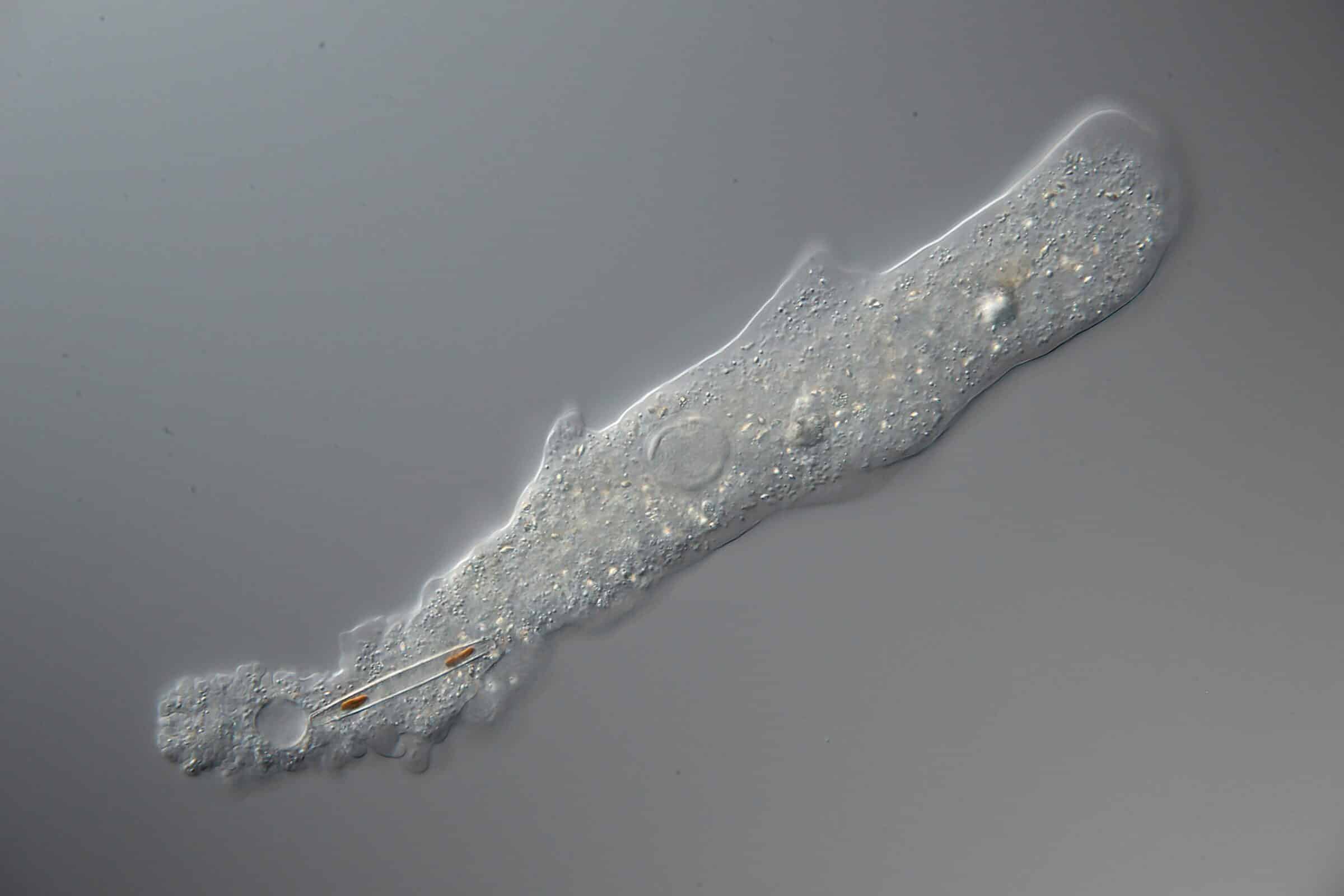
We have been looking at Christoph Adami’s book, The Evolution of Biological Information. Today, we are continuing to consider Chapter 4, entitled “Experiments in Evolution.” Adami discusses work by Reverend William Dallinger, a contemporary of Charles Darwin, who performed an early evolution experiment on a population of amoebas. Dallinger sought to demonstrate Darwin’s theory experimentally.
Dallinger subjected his amoebas to gradually increasing temperatures. Over time, they adapted to the higher temperatures, becoming able to survive in temperatures that would have killed the original population. In addition, they lost the ability to survive in their native environment.
Valuable Points, and a Crucial One
Adami draws lessons from this story about how to design good evolutionary experiments. The lessons include studying an organism that is well described and replicates quickly. The populations should be kept in a stable, controllable environment where they can be continuously observed. It is also helpful to replicate parallel experiments and to keep a “fossil record” of the history of the experiment.
These are all valuable points. However, they neglect a very crucial point, which is necessary in order to draw accurate conclusions about the abilities of evolutionary processes. It is crucial that we understand the mechanisms involved in the adaptation. If the amoebas adapted through developing sophisticated techniques to adapt to higher temperatures, then that would powerfully confirm the power of evolutionary mechanisms. However, if the adaptation instead occurred by activating pre-existing functionalities or making small adjustments, then this would show the ineffectiveness of the evolutionary mechanism.
Evolution of Biological Information?
The ability to adapt to high temperatures might be pre-existing in a variety of ways. The population might contain more heat-resistant variants of genes, and those genes might recombine in a new way to adapt to high temperatures. Alternatively, there might be epigenetic effects where markers are activated to turn on pre-existing systems. It is also possible that mutations to regulatory genes changed regulation in a way that allowed the amoebas to cope with higher temperatures. Or mutations might have disabled certain genes that failed at high temperatures but which the amoebas could do without.
Dallinger was experimenting long before it was possible to determine what mechanisms were involved. Adami’s own statement is “in hindsight, it is not clear whether all of the adaptations observed in the experiment [were] genetic in nature.” But without an understanding of the mechanisms involved, we have little to no idea whether this experiment demonstrates the evolution of biological information.