






































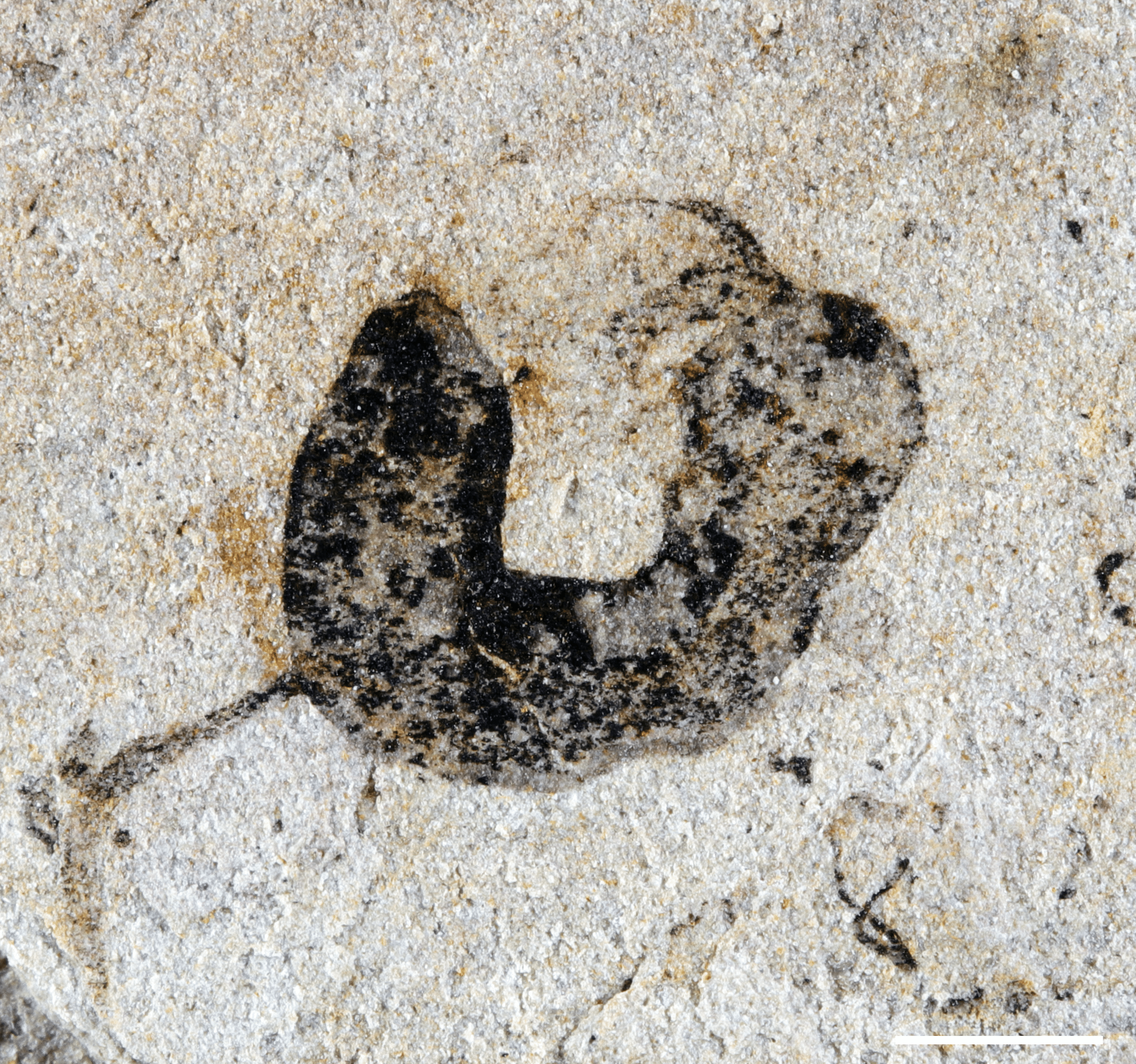
I have been looking at a new paper in Science which claims to have discovered bilaterian animal fossils (animals with symmetrical left and right sides) in Precambrian Ediacaran strata from China. They make a pretty bold claim that “free-living bilaterians in the Jiangchuan Biota suggests a potentially diverse assemblage of bilaterians” in the late Ediacaran. In my previous post we saw that Scientific American suggested these new fossils show that bilaterian animals were “diverse and flourishing” in the Ediacaran. A closer look at the fossils discovered shows that this claim is not supported.
Non-Bilaterian Fossils
Figure 2 of the Science paper describes “Nonbilaterian animals from the Jiangchuan Biota,” discovered by this paper. One organism, Haootia (labeled A to D), is assigned to cnidarians (jellyfish), which have radial symmetry. But cnidarians have been long known to exist in the Precambrian so this isn’t anything new. Another fossil (E to G) is called “a putative ctenophore,” which if validated would extend phylum ctenophora (comb jellies), which have biradial symmetry, back into the Precambrian. If this is in fact a ctenophore, it would add a new animal phylum to the Precambrian — but given how similar cnidarians and ctenophores are (on a general level), and given that cnidarians have long been known from the Precambrian — I don’t think anyone is too surprised to also find potential ctenophores in the Precambrian as well.
Another fossil (H) is called a mackenziid, already known from Cambrian fossils, and already known to be so similar to other Ediacaran fauna that it was called “a possible surviving member of the Ediacaran macrobiota” that is a “non-bilaterian” with “no direct affiliation to the crown or total, group of either the Porifera (sponges) or the coelenterate phyla (cnidarians and ctenophores).” In other words, no connection to modern Cambrian animals.
Lastly, there’s a fossil (I and J) that clearly has radial symmetry. It’s a strange looking disc-shaped animal that to my eyes resembles other long-known Ediacaran fauna.
All of these fossils have radial or biradial symmetry and even the paper identifies them as non-bilaterians. But that’s not what anyone came to hear about!
Purported Bilaterian Fossils
Figure 3 of the paper is titled “Bilaterian animals from the Jiangchuan Biota.” These generally fall into three categories: (1) Not good direct evidence of a bilaterian; (2) Potentially consistent with bilaterian symmetry but also potentially not bilaterian symmetry; (3) Decent case for a bilaterian but not a good candidate for an ancestor for any Cambrian animals. While these newly discovered Ediacaran fossils are well preserved compared to many other Ediacaran fossils, they are not nearly as well preserved as we see in many typical Cambrian animal fossils (see the photos here or here, for example). This makes the Science paper’s claims difficult to accept with high confidence.
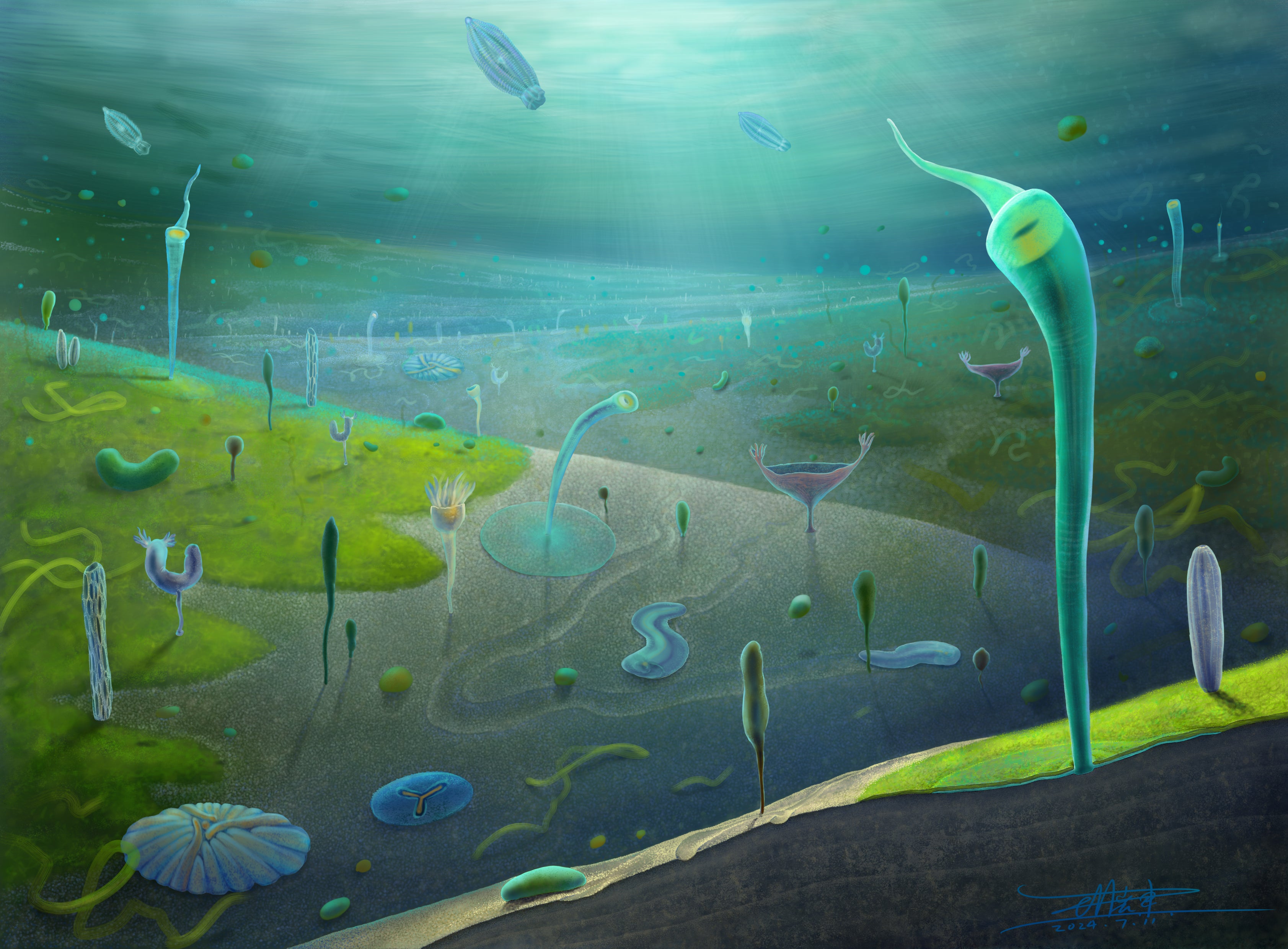
Starting with category 1 (not a good candidate for a bilaterian) is the organism labeled “A to E,” which the paper calls “the most numerous bilaterian fossil” at this location. This tall stalk-like organism has a “basal holdfast disc” which anchored it to the seafloor, a little bit like kelp, and not entirely unlike other long-known Ediacaran fauna. It’s seen in the cross-sectional foreground of this illustration, also sticking out across the landscape looking kind of like a desktop microphone. Quite unexpectedly, the paper labels this organism “an elongate worm,” but I see no convincing evidence it is a worm or a bilaterian. All the fossil photos and drawings seem completely consistent with biradial symmetry, perhaps at best something not entirely unlike a crinoid (though lacking the feathery fronds). The paper infers a bilaterian body plan based upon the claim that its “feeding structure would require mesodermal musculature not present outside Bilateria.” But poor preservation means that the nature of the “feeding structure” — or whatever it is — is hardly clear. The bilaterian claim seems to be 100 percent an inference, not based upon hard evidence; I see nothing in the photos and drawings that requires that inference. Even the paper admits that for a free-living organism with such a large holdfast anchoring structure to be an animal would be “unusual”:



An enlarged anchoring structure in such a macroscopic, free-living, and presumably macrophagous animal is unusual. Although posterior adhesion structures are present in many extant bilaterian worms, they are most common in parasites or meiofauna, with tube building or infaunality instead being common adaptations to sessile modes of life in large-bodied extant taxa.
I suspect the bilaterian nature of this “most numerous” fossil will be challenged as more studies come out on these newly discovered Ediacaran organisms.
Also landing in category (1) is an organism in Figure 3 labeled “I to L.” This elongated tubelike organism is not amazingly well preserved, but what can be seen shows that it exhibits some type of radial or biradial symmetry. I see literally zero direct evidence that the symmetry of the fossil they reported is bilateral. So why call it a “bilaterian”? It’s another chain of inferences: The paper’s claims aren’t based upon the morphology of the fossil itself but upon another organism — not known from Ediacaran rocks, but found in Cambrian strata some 40 to 50 million years later — that is associated with structures that look kind of like this Ediacaran organism. The paper thus claims that this Ediacaran organism has “similar features” to “the Cambrian Margaretia dorus, most recently interpreted as a dwelling tube for enteropneust hemichordate worms,” which are bilaterian animals from phylum hemichordata. But this is an inference — not based upon the morphology of the actual fossil that was recovered in Ediacaran strata. Where’s the direct evidence of bilateral symmetry? It’s simply not there.
And since “similar features” count as evidence, to my eyes this fossil doesn’t even appear “similar” to an animal. It looks plantlike, or perhaps some kind of ancient algae. It also looks similar to coral (phylum Cnidaria) maybe or even a sponge (phylum Porifera) — both organisms long known to have existed in the Ediacaran. Indeed, Margaretia (which it’s said to be “similar” to) was previously classified as a type of green algae (i.e., a somewhat plant-like organism that is not an animal) or a coral (prior to the more recent finding that it houses this bilaterian worm). But this Ediacaran organism is significantly smaller than the Cambrian Margaretia fossils, and there is another very reasonable option the paper doesn’t consider — namely, convergence.
The main argument for the Margaretia assignment is the long tubelike structure and possible perforations along the tube. Poor preservation makes the perforations difficult to make out, but they could be there. However, these poorly preserved similarities should be hardly conclusive in the weird world of Precambrian life. Strangely, another possibility that the paper doesn’t even consider is that the similarities between this Ediacaran organism and Margaretia are due to convergence. It would not be the first time that an Ediacaran organism exhibited morphology that was convergently similar to later forms (especially with Cambrian organisms). The Ediacaran frondlike species Charnia, for example, is thought to have a strong convergent similarity to modern sea pens, and there are other example as well. Indeed, another paper observed “extensive convergent evolution”between Ediacaran organisms with “fractal-like branching structures” and many later organisms “across the tree of life” as diverse as “bacteria, protists, plants, fungi, and animals.” Given the frequency of convergent similarity between Ediacaran fossils and other organisms, it’s strange that the real possibility of convergent similarity isn’t even considered and the Science paper runs straight and only to the “bilaterian” interpretation. In any case, the actual morphology of the fossil discovered here shows no bilaterian symmetry, so this one also goes into category (1).
Two final organisms presented — “F to H” and “M to P” (+ “Q and R”) — appear to be potentially wormlike (“vermiform”) animals of some kind, which could lend themselves to bilaterian interpretations. But again it’s not at all clear and the bilaterian nature is highly inferential.
The organism in Figure 3 labeled “F to H” appears fairly undefined, though it presents as S-shaped, which the paper says is “potentially indicating body contraction after death or during burial.” The paper further says, “It has a circular terminal opening interpreted as a mouth,” which is possible, but it’s certainly an interpretation, and not at all clear from the fossil material that is shown. Even the figure says “mo?” and “go?” which I take to mean “mouth” with a question mark and “gut” with a question mark (the caption reads “possible mouth and gut”). It’s pretty ambiguous. Later in the paper they abandon the cautionary language when they assert that “the terminal mouth of one of our new specimens (Fig. 3H) may place it among cycloneuralian worms” — i.e., a bilaterian. Perhaps, but this fossil is poorly preserved and other interpretations seem more than possible. I see no reason to exclude the option that this tubelike organism had some form of biradial symmetry, perhaps with a body plan akin to a sea cucumber. In my view this fossil is too poorly preserved to say for sure. It could be bilaterian but that is far from definitive. I place this one in category (2).
The latter fossil, labeled “M to P” (+ “Q and R”), shows a coiled body with tentacles of some kind and a stalk. It’s decently well preserved and I think that much is clear from the fossil. The organism is said to be similar to Cambrian animals such as Herpetogaster or Phlogites, both organisms called “cambroernids.” From looking at the fossils, this seems plausible. Cambroernids are strange animals, not assigned to any modern animal phylum. They also don’t exhibit a single distinct form of symmetry. Some cambroernids had largely radial symmetry (Eldonia) though some of these had bilaterally paired tentacles, and others such as Herpetogaster are said to be similar to echinoderms (which have bilateral symmetry as larvae and biradial symmetry as adults), and Phlogites (which is said to have bilateral symmetry).
Whatever this organism is, it seems to be the best case for bilateral symmetry reported in the paper. But even if it is a cambroernid, that doesn’t qualify it as ancestral to any Cambrian animal phyla or any living organisms. As much as I’m loathe to cite Wikipedia (the paragraph I’m about to quote will probably be deleted simply because I cited it), Wikipedia accurately summarizes the mainstream view when it says that Cambroernida are
genera noted as “bizarre” or “orphan” taxa, meaning that their affinities with other animals, living or extinct, have long been uncertain. While initially defined as an “informal stem group,” later work with better-preserved fossils has strengthened the argument for Cambroernida as a monophyletic clade.
Indeed, an authoritative 2023 paper in Current Biology noted that cambroernids are so enigmatic that they have been previously assigned to groups as diverse as cnidarians, lophophorates, and ambulacrarians (a clade that includes the phyla echinodermata and hemichordata). Importantly, that 2023 paper found cambroernids are a monophyletic side-branch of animals that went extinct. In other words, just like Wikipedia says, they weren’t directly ancestral to any of the major Cambrian animal phyla or any animals alive today.
This 2023 paper did claim that cambroernids have a close though non-ancestral relationship with ambulacraria (again, a proposed clade which includes echinoderms and hemichordates), but the case for that relationship is dicey. The paper links cambroernids to ambulacrarians based upon their shared (a) tentacles / feeding appendages, (b) u-shaped gut, and (c) non-oral pharyngeal openings/pharyngeal bars. However, many other deuterostome phyla also have similar traits, leading the 2023 paper to conclude that convergent evolution is rampant among deuterostome animals:
These results allow us to reconstruct the ancestral body plans of major clades of deuterostomes, revealing that key traits of extant forms, such as a post-anal region, gill bars, and a U-shaped gut, evolved through convergence.… Historically, uncertainty regarding the plesiomorphic character states of deuterostomes has hindered efforts to reconstruct ancestral body plans; our analyses suggest this is because major characters, including a post-anal region, gill bars, and a U-shaped gut, evolved through convergence rather than shared ancestry. These results confirm that the integration of unique fossil anatomies is critical for uncovering the origin and earliest evolution of deuterostomes.
But of course if all those fundamental traits, such as a post-anal region, gill bars, and U-shaped gut, evolved convergently, who is to say that the “unique” shared tentacles and other traits that supposedly link cambroernids to ambulacrarians didn’t also evolve “through convergence rather than shared ancestry”? Indeed, the 2023 paper even states that “ancestral state reconstructions are equivocal as to whether a branched tentacular system is plesiomorphic [i.e., present in the common ancestor] for ambulacrarians,” and a cladogram in the graphic abstract seems to suggest the “tentaculate feeding strategy” might have arisen independently in cambroernids, echinoderms, and hemichordates, respectively. Moreover, the 2023 paper notes that “Cambroernids possess several characters that are observed in chordates but not in living ambulacrarians.” This suggests that now we have not only convergence making this phylogenetic association dicey, but also losses of traits.
In other words, as much as our evolutionist brethren may wish this to be a Precambrian bilaterian animal closely related to more modern phyla known in the Cambrian, such a diagnosis is not clear at all. Since the tree of deuterostome animals involves so much homoplasy — i.e., convergent gain and loss of fundamental traits — it’s hard to make any claims of associations with high confidence.
What is clear about this Ediacaran organism is that if it is a bilaterian, it does not show “obvious counterparts among living species” and “modern animals,” as the authors’ article at The Conversation seemed to promise we would find. It also should not be considered ancestral to any of the modern animal phyla that appear in the Cambrian explosion. Indeed, despite all the fanfare about how these fossils supposedly solve the Cambrian explosion, it’s noteworthy that the technical paper in Science does not even contain the words “ancestor,” “ancestors,” or “ancestral,” presumably because they don’t have a compelling arguments that anything they found is actually ancestral to the Cambrian animals. This fossil belongs in Category (3): Decent case for a bilaterian but not a good candidate for an ancestor for any Cambrian animals.
Bilaterian Bust
My first post mentioned the danger of retroactive confessions of ignorance that acknowledge a problem but then aren’t accompanied by evidence that actually solves that problem. This seems to be precisely what is going on here. To appreciate why, the analysis I’ve presented reveals the following totals:
- Category (0): The paper diagnoses the fossil as a non-bilaterian animal: 4 organisms
- Category (1): Claimed to be bilaterian, but not good direct evidence of a bilaterian: 2 organisms
- Category (2): Potentially consistent with bilaterian symmetry but also potentially with non-bilaterian symmetry: 1 organism
- Category (3): Decent case for a bilaterian but not a good candidate for an ancestor of any Cambrian animal phyla: 1 organism
- Category (4): The paper classifies as macroalgae: multiple fossils.
- Category (5): Non-bilaterian animal clearly representing a major animal phylum that was previously thought to have first appeared in the Cambrian: 1 organism (belonging to Ctenophora)
- Category (6): Precambrian bilaterian animals that can serve as ancestors to the Cambrian phyla: 0 organisms.
What none of these categories represent are organisms in Category (6) — Precambrian bilaterian animals that can serve as ancestors to the Cambrian phyla. Nor are there any bilaterian fossils with “obvious counterparts among living species” or “modern animals.” They certainly don’t reveal a “diverse assemblage of bilaterians” or show that bilaterians were “diverse and flourishing” in the Ediacaran. And none of these newly discovered organisms represent clear or direct ancestors to the major Cambrian bilaterian animal phyla.
Yes, this paper shows a couple Ediacaran animals that could potentially be bilaterians. One of them is highly equivocal, but in another instance, I think they have a good case. It’s a cool discovery! But does this find or anything else in this paper negate the explosiveness of the Cambrian explosion? As Category (6) suggests, and we’ll also see in a further post, the answer is no.
This post has been updated.