






































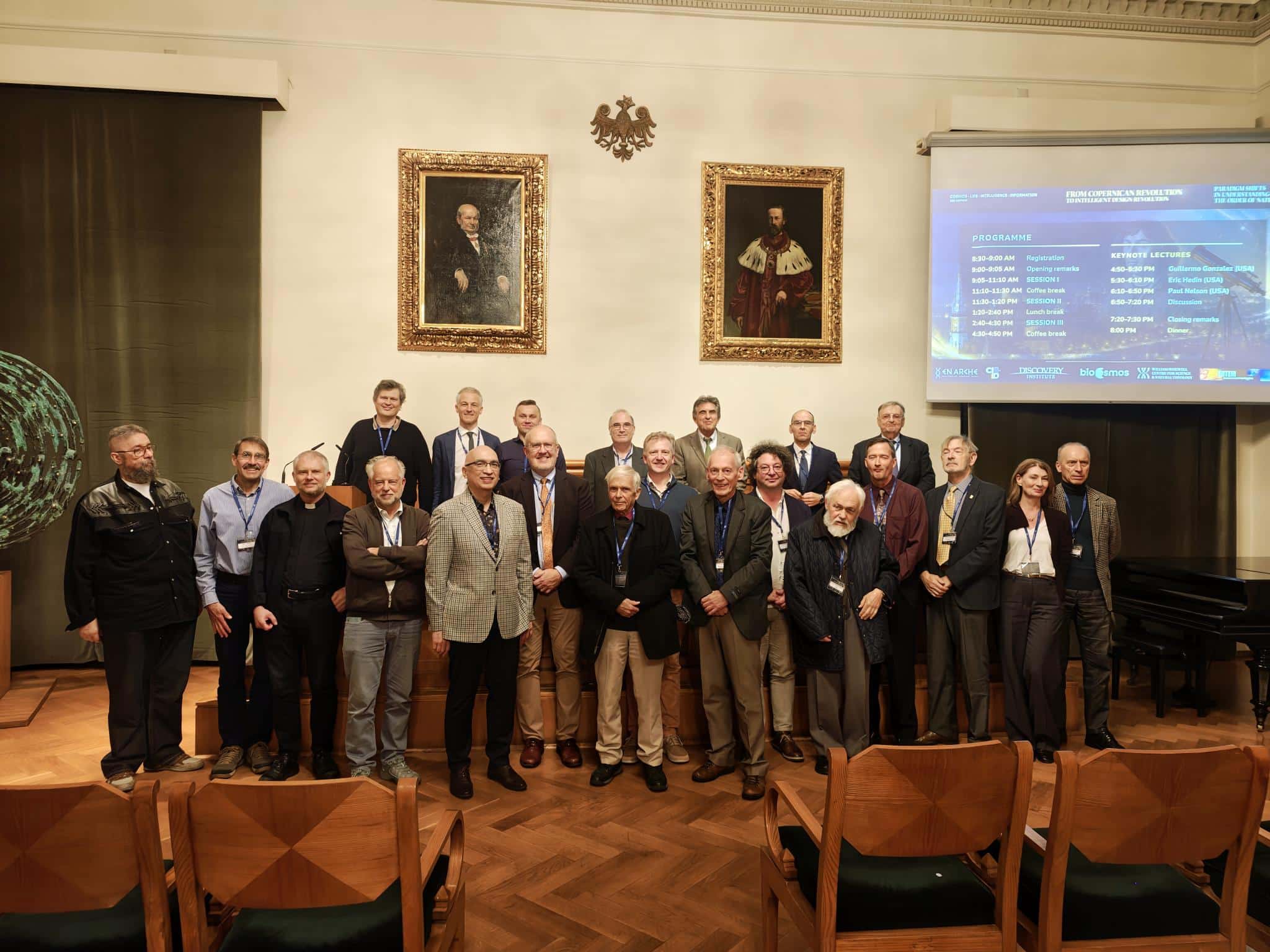
Recently, Poland’s En Arche Foundation hosted an international conference on intelligent design in Kraków that brought together scientists and other scholars from multiple countries. Along with two other Fellows of Discovery Institute’s Center for Science and Culture — Guillermo Gonzalez and Paul Nelson — I had the great privilege of giving a keynote talk at the conference.
Held in the Polish Academy of Arts and Sciences, the conference presentations highlighted a fascinating array of insights from researchers of multiple scientific disciplines. I found it greatly encouraging to hear from speakers representing different cultures and rich historical backgrounds.
Hospitality the Polish Way
Our hosts from the En Arche Foundation welcomed us with abundant hospitality, including a marvelous pre-conference dinner featuring live Polish folk music and dances. To everyone’s surprise, audience participation wasn’t optional! Even physicists who were more familiar with black holes than dance steps got pulled into the fun.

Conference meals at a nearby historic hotel offered opportunities for conversations and building acquaintances with colleagues. I had the pleasure of talking with Steinar Thorvaldsen, director of the Norwegian foundation BioCosmos. In discussing the acceptance of intelligent design within the academic setting at University of Tromsø, where he is professor of information science, he shared that at the world’s northernmost university, it’s too remote and isolated for colleagues to afford much argumentation. I found it refreshing to hear that the common anti-ID rhetoric could be softened to acceptance and respect within a university surviving on the frontiers of civilization.
The Revolutionary Heliocentric Model
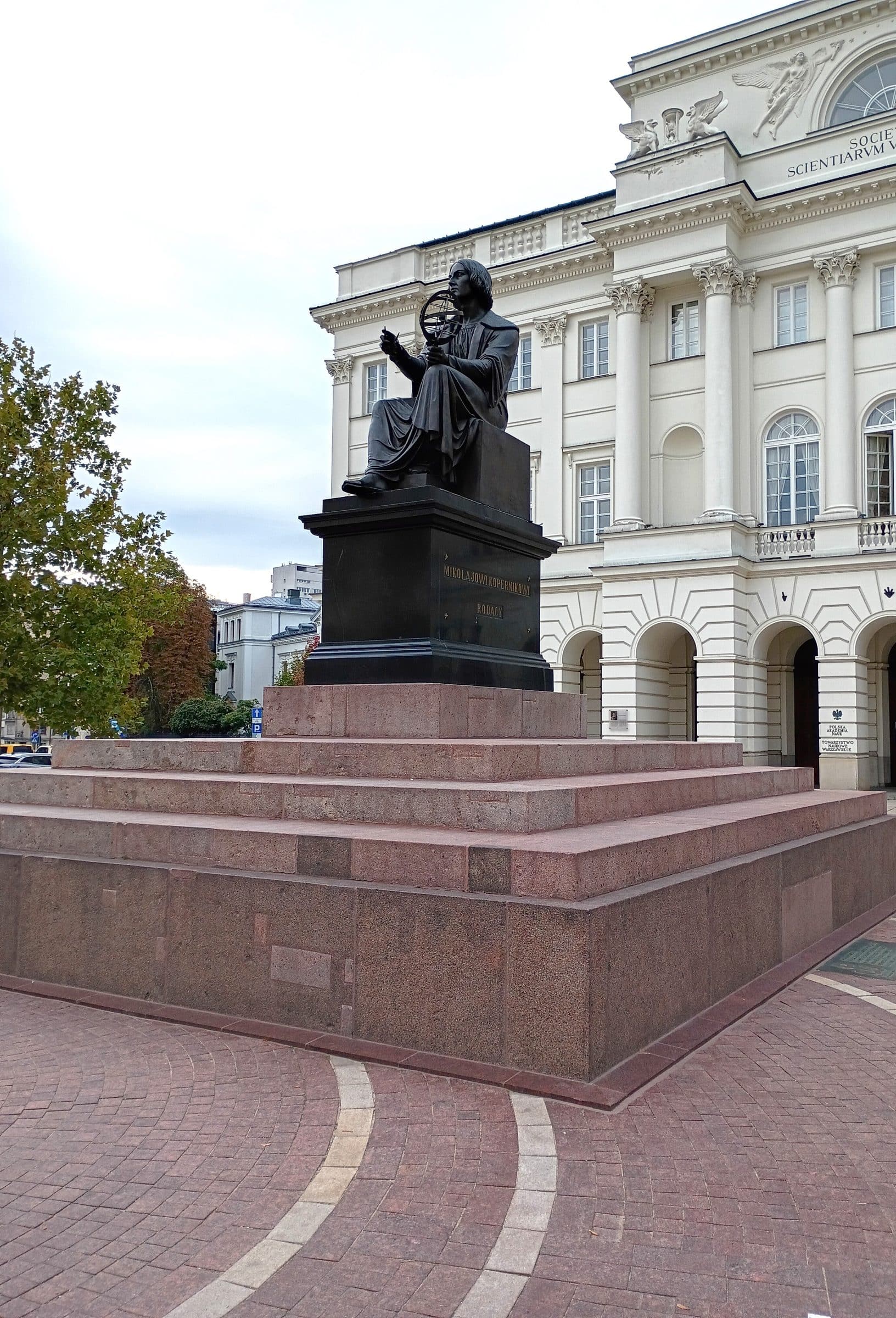
Being in Poland brought me to a closer appreciation of the country’s famous astronomer and polymath, Nicolaus Copernicus (1473-1543). On my first day in Warsaw, I came across a large bronze monument of Copernicus, surrounded in the open square by a representation of his revolutionary heliocentric model of the solar system.
The conference theme, “From Copernican Revolution to Intelligent Design Revolution”, commemorates both the revolution in worldview brought about by Copernicus’ heliocentric model of the solar system and the progress that ID has made in shifting the current paradigm of scientific thought. In nearly every field of science, the evidence is refocusing our understanding of nature away from atheistic materialism and revealing multiple layers of design.
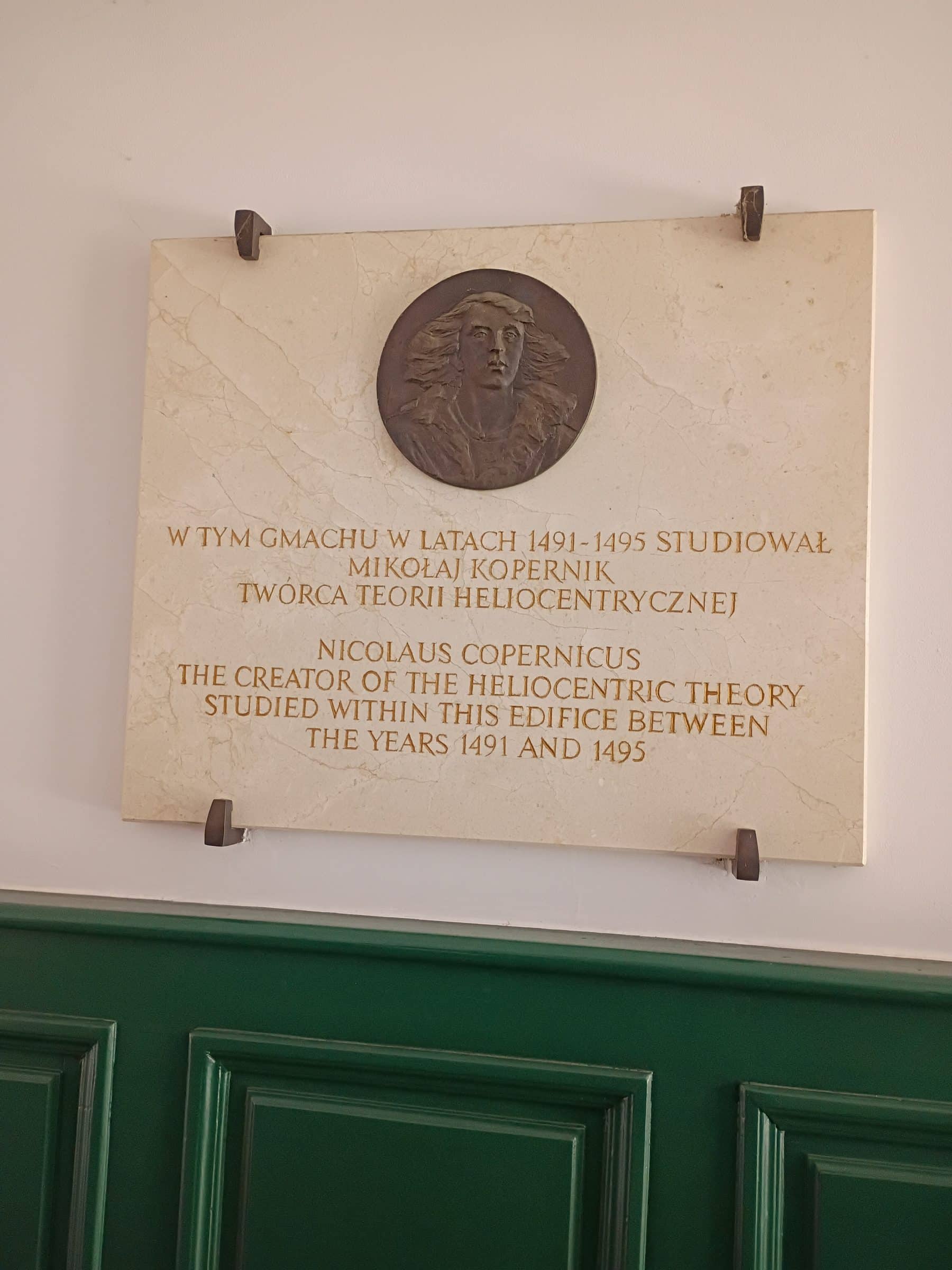
I encountered Copernicus again in Kraków the day after the conference, when my wanderings through the city’s fabulous Old Town region brought me to the Collegium Maius, Poland’s oldest intact university building. A plaque on the entryway to the inner courtyard of this impressive building told of Copernicus’ years of study here, from 1491-1495.
No Overnight Success
The Copernican heliocentric model of our solar system, although far more accurately representing reality than the prevailing geocentric model, didn’t gain acceptance overnight within the scientific community. In a similar way, the replacement of naturalistic materialism with an acknowledgment of the reality of evidence for intelligent design can be expected to make gradual progress.
The truth of a proposition is immediately perceived by some people, but with others, long-held contrary views obscure what reality is revealing to us. Nonetheless, once the true nature of reality is revealed, there’s no going back. A false proposition can only survive in the dim light of ignorance. Truth, once clearly perceived, cannot be hidden and grows like a seed planted in fertile soil. The growing acceptance of the design worldview among the scientists of Europe affirms the truth of the evidence for intelligent design.