






































As we saw yesterday, a working definition of beauty is “that which pleases when seen” — or more precisely, “that which elicits disinterested pleasure when contemplated.” We can now address the question — the subject of a series of posts here — of whether and how the relationship between science and beauty point us toward God. For considering this, the contemporary theologian John Frame offers a useful framework known as triperspectivalism. According to this framework, any given subject can be analyzed from three distinct yet related perspectives: the normative, the situational, and the existential. Or in simpler terms, you can approach any subject from the perspectives of the Word, the world, and the self.
The normative perspective, or the Word, concerns the norms, rules, or standards by which a subject should be evaluated. This is where the idea of “oughtness” comes into play — what ought or ought not to be done. The situational perspective, or the world, concerns the facts relevant to the subject at hand. This is where “isness” — or truth and falsehood — comes into play. And lastly, the existential perspective, or the self, concerns the knower himself who approaches the subject.
Beauty’s Relationship to Science and Faith
All three of these perspectives have bearing on the study of beauty’s relationship to science and faith. From the normative perspective, we can analyze the criteria by which we judge beauty. From the situational perspective, we can consider particular manifestations of beauty in the world. And from the existential perspective, we can see how human beings are uniquely equipped to perceive beauty.
The normative perspective is already a point of controversy. Because to claim that there are any criteria at all presupposes that beauty itself must be objective rather than subjective. Why not suppose that each person is free to determine his own personal criteria for beauty? It is common today to say that beauty is in the eye of the beholder, but this widespread notion comes into conflict with a number of other undeniable features of beauty.
For one, it conflicts with the experience of the ordinary individual who feels that his own aesthetic taste improves over time. You may have looked at old photos of yourself in a high school yearbook or photo album, and felt a tinge (or more) of embarrassment at your juvenile fashion sense. Or you may have re-watched a beloved childhood movie after decades, only to realize how corny or kitschy it was. Go ahead, admit it: you had bad taste!
Another problem with the relativistic view of beauty, according to British philosopher Anthony O’Hear, is that it can’t explain the fact that “experienced, knowledgeable, and sensitive judges of works of art tend over time to agree in their judgements.” And even when these experts disagree with each other in their artistic judgments, they are able to provide mutually intelligible reasons for their disagreement.
Additionally, the relativistic view of beauty can’t explain why there should exist aesthetic criteria shared between separate, independent fields of study. Both the art critic and the scientist rely upon common notions of beauty in forming their respective judgments. The fact that such shared criteria should emerge in different domains of knowledge is strong evidence in favor of the objectivity of beauty.
So Exactly What Are These Criteria?
There is no definitive, universally agreed-upon list, but there is considerable overlap in the criteria identified by leading thinkers. Aquinas himself proposed three basic elements of beauty: integrity, proportion, and clarity. In his book The Evidential Power of Beauty, Thomas Dubay identified three similar elements of beauty in science: simplicity, harmony, and brilliance. And evangelical theologian Jonathan King highlights a single overarching criterion: fittingness.
To the non-scientist, it may come as a surprise that scientists would appeal to aesthetic standards in evaluating the validity of scientific theories. You might naïvely assume that science is a left-brain endeavor, whereas questions of beauty belong to the right brain. But those more familiar with how scientists operate know otherwise. In his bestselling book The Elegant Universe, physicist Brian Greene acknowledges a limited but important role for beauty as a filter for scientific theories. He writes:
It is certainly the case that some decisions made by theoretical physicists are founded upon an aesthetic sense — a sense of which theories have an elegance and beauty of structure on par with the world we experience. . . . Especially as we enter an era in which our theories describe realms of the universe that are increasingly difficult to probe experimentally, physicists do rely on such an aesthetic to help them steer clear of blind alleys and dead-end roads that they might otherwise pursue.
In assessing theories, scientists rely upon a number of criteria. These criteria, the theoretical virtues, include empirical fit, coherence, fruitfulness, and several more. Philosopher Michael Keas has classified these theoretical virtues into four main categories, one of which comprises the aesthetic virtues of beauty, simplicity, and unification. Keas asserts that these aesthetic virtues all possess a particular aesthetic shape which he refers to as “fittingness” — the same criterion proposed by theologian Jonathan King. Thus we find a striking convergence in the methodologies of science and theology.
Manifestations of Beauty
Having identified the objective criteria of beauty in science from a normative perspective, we can now move to the situational perspective and examine particular examples of beauty in the natural world. The challenge we face is an overwhelming abundance of options. Which manifestations of beauty most deserve our attention? Dubay classifies nature’s marvels according to their size: macromarvels, midimarvels, and micromarvels. The macromarvels include astronomical phenomena — from the Sun and planets, to the Milky Way, to pulsars and supernovae in the distant reaches of the universe. The midimarvels cover the level of ordinary human experience, including elegant forms of flora and fauna. And the micromarvels include beauty at very small scales — from subatomic particles to single-celled organisms.
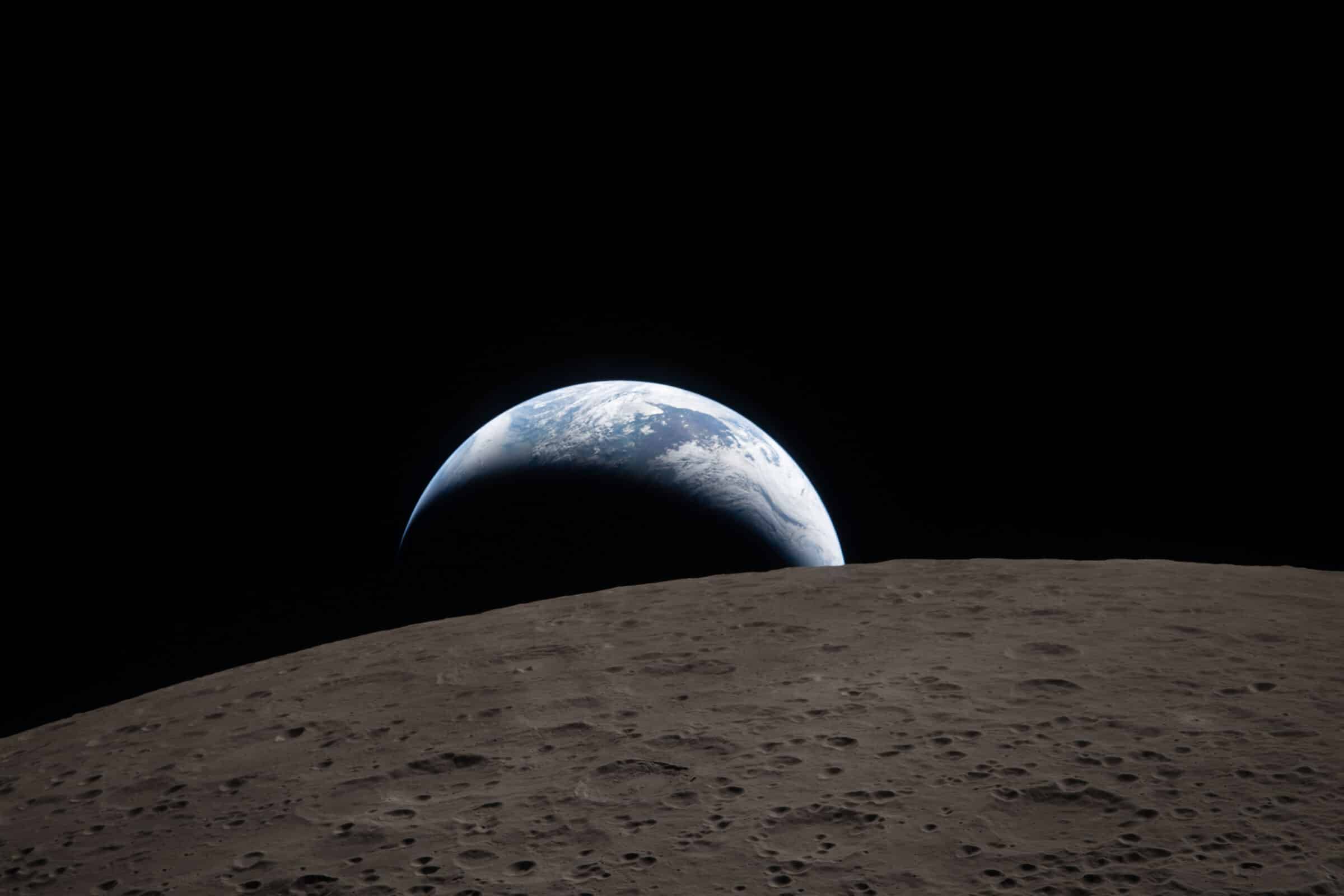
Here is one especially illuminating example of beauty: the Moon. Many were awestruck by the recent photos sent from the Artemis II mission — photos of the far side of the Moon, of the Mare Orientale basin, or of the so-called “Earthset” (pictured at the top), the view of our home planet receding behind the lunar horizon. The Moon has always been an object of wonder and delight. Less appreciated is the fact that the Moon is also finely tuned to allow for scientific discovery on Earth. We see this through one of its most striking features: the occurrence of total solar eclipses.
As Guillermo Gonzalez and Jay Richards describe in The Privileged Planet, a total solar eclipse takes place whenever the Moon perfectly aligns with the position of the Sun, blotting out the Sun’s photosphere and revealing its eerily pink chromosphere and the ghostly silver halo of its corona. A total eclipse is only possible because the apparent sizes of the Sun and Moon happen to match almost perfectly: the Moon being 400 times smaller than the Sun, but the Sun being 400 times farther away. There is no physical reason why these perfect proportions should exist. It’s purely gratuitous that we happen to find ourselves on a planet where total solar eclipses can be observed.
A total eclipse is so captivating that some enthusiasts spend their lives chasing them. One enthusiast, Serge Brunier, describes the sensation this way:
There is the same astonishment and, each time, the feeling grows stronger that eclipses are not just astronomical events, that they are more than that, and that the emotion, the real internal upheaval, that they produce — a mixture of respect and also empathy with nature — far exceeds the purely aesthetic shock to one’s system.
A Distorting Effect on Spacetime
In addition to their exceeding beauty, total eclipses provided the occasion to confirm one of the most revolutionary scientific theories of the 20th century, Einstein’s general theory of relativity. According to Einstein, gravity has a distorting effect on the fabric of spacetime, such that light waves bend as they pass by massive objects. In 1919, Sir Arthur Eddington was able to verify Einstein’s claim by observing the change in the perceived position of stars near the Sun during a total eclipse. Eddington’s observation was only possible because, during an eclipse, he was able to measure stars that would otherwise have been obscured by the brightness of the Sun. In this case, a beautiful natural phenomenon helped give birth to a beautiful scientific theory.
Scientists today widely acknowledge that one of the distinctive qualities of general relativity is its mathematical beauty. Nobel Prize-winning physicist Steven Weinberg once noted how many of his own colleagues had embraced the theory even before its final empirical confirmation, simply on the grounds of its elegance. Weinberg wrote:
Perhaps all of us were just gullible and lucky, but I do not think that is the real explanation. I believe that the general acceptance of general relativity was due in large part to the attractions of the theory itself — in short, to its beauty.
It’s worth asking why there should be such a correspondence between physical beauty and mathematical beauty at all.
Tomorrow, “Physical Beauty, Mathematical Beauty, Scientific Beauty.”
Editor’s note: This article was first delivered as a speech at the Spring 2026 conference of the Cornwall Alliance for the Stewardship of Creation in Memphis, Tennessee.