






































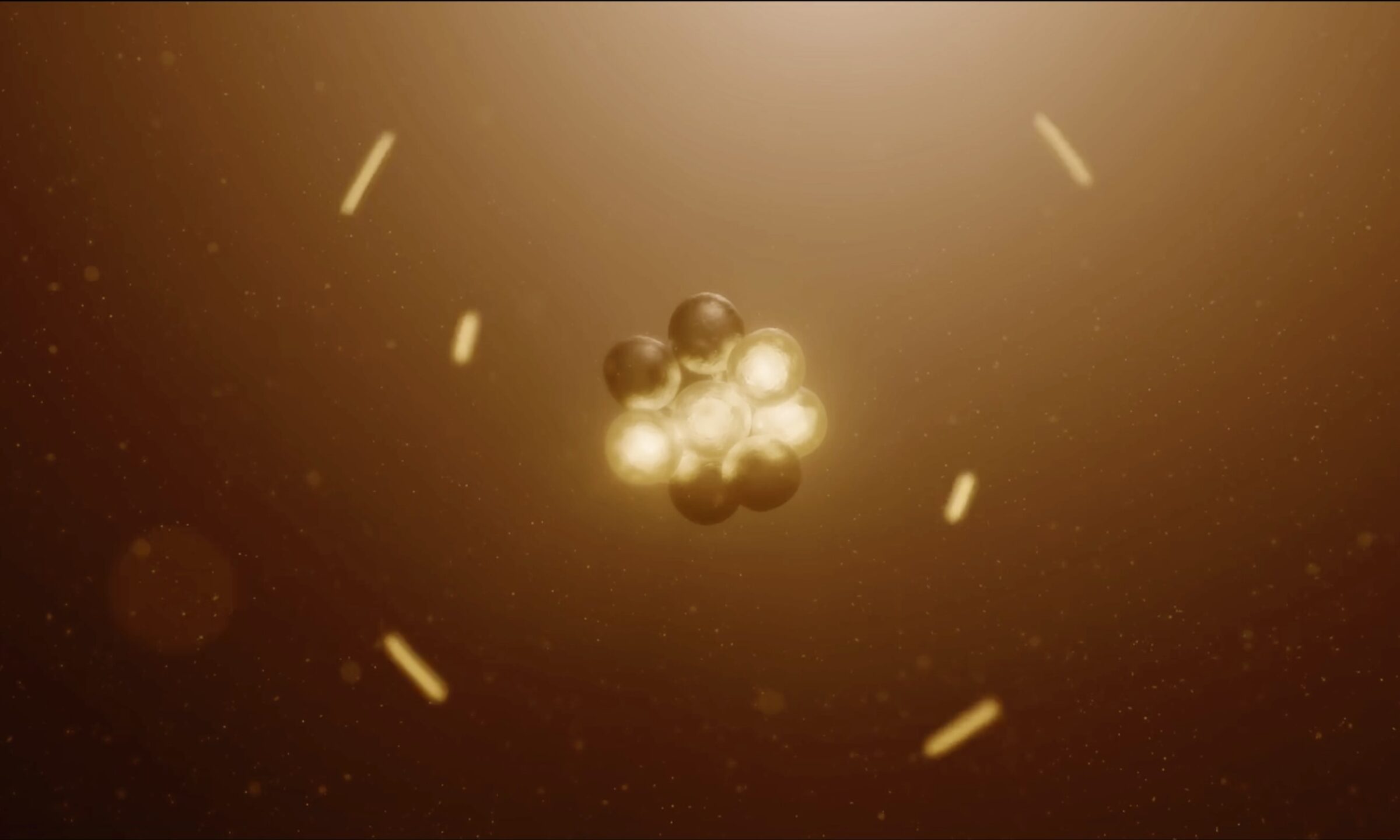
As I have often pointed out, if you don’t believe that intelligent design was involved somewhere in the origin or evolution of life, or the evolution of human intelligence, you essentially believe that a few unintelligent forces of physics alone could, under the right conditions, cause civilizations to arise on barren planets. Peter Urone, for example, in his 2001 text College Physics claims, “only four distinct forces account for all known phenomena.”
As the new theatrical documentary The Story of Everything points out, these forces are very cleverly designed and fine-tuned for life, and probably are clever enough to explain chemistry and stars and planets. However, are they clever enough, by themselves, to explain how civilization arose on Earth? Of course not, and the video “A Mathematician’s View of Evolution” dramatizes this by imagining a gigantic computer simulation to see if the four unintelligent forces alone really could have rearranged the fundamental particles of physics on Earth into computers and spaceships and smart phones.
Many people are not impressed by the simple argument of this video, but at the end I claim:
Mathematicians are trained to value simplicity. When we have a simple, clear argument, and a long, complicated, counterargument, full of unverified points, we accept the simple argument even before we find the errors in the complicated argument. We know the errors must exist and if we look for them, we will eventually find them.
A Long, Complicated Counterargument
If you are not satisfied with the simple, clear argument of this video, let’s look at the long, complicated counterargument of the materialists to see if we can find the errors or unverified points. Here are the major questions materialists must answer to explain how civilization could have arisen on Earth “naturally.”
- (Origin of life) How did chance chemical reactions produce the first living thing?
- (Reproduction) How are these living things able to self-replicate, passing their current complex structures on to their descendants, generation after generation, without significant degradation?
- (Evolution) How did the accumulation of replication errors over millions of years result in more and more complex plants and animals?
- (Evolution of intelligent humans) How did this process of evolution eventually produce intelligent, conscious, humans, who are able to design computers and spaceships and smart phones?
Let’s examine each of these questions.
Question 1
Almost all scientists recognize that we don’t yet understand how the first living thing arose from non-living matter. The debate between Rice University chemist James Tour and origin of life researchers, for example, is over whether or not we are “clueless” as to how this could have happened.
Question 2
We see living things self-replicate all the time so we may feel we understand how this happens, and materialists take self-replication for granted when trying to explain evolution. But even with all our advanced technology we are still not close to constructing any self-replicating machine ourselves. To appreciate why this is still pure science fiction, see my 2023 BioCosmos article “Human Engineered Self-Replicating Machines.” This paper includes a reference to a 2011 article in Robotica written by the inventors of RepRap, which has been over-hyped as “the 3D printer that prints itself.” Actually, the inventors only claim “RepRap has been designed to be able to print out a significant fraction of its own parts automatically. All its remaining parts have been selected to be standard engineering materials and components available cheaply worldwide.” They further write:
Autotrophic self-reproduction or self-replication: The ability of a system to make a direct copy of itself from raw materials without assistance. As yet, no artificial autotrophic self-reproducing kinematic machine has been made. However, examples exist in biology…. With limited success so far in the areas of self-assembly and self-manufacturing, an artificial autotrophic self-reproducer remains an unachieved utopia for the subject. Whilst theoretical work has been undertaken in the area, all the concepts presented so far are extremely vague on the engineering involved in artificial reproduction, being described by Dyson thus: “We don’t have the science yet; we don’t have the technology.”
That was 2011. My 2023 BioCosmos article quoted the Wikipedia article on self-replicating machines as saying, “Although suggested earlier than in the late 1940s by Von Neumann, no self-replicating machine has been seen until today.” Well, it did say that until January 1, 2024, when some Wikipedia editor changed this to “The concept, first proposed by Von Neumann no later than the 1940s, has attracted a range of different approaches…” (The editor warned me about quoting Wikipedia!)
While it is tempting to think we are close, and it is just a question of time until humans engineer a self-replicating machine, what makes this a fundamentally much more difficult problem than most realize is that when we add technology to such a machine to move it closer to the goal of reproduction we only move the goal posts, as now we have a more complicated machine to reproduce. Eric Anderson, in Chapter 3 of Evolution and Intelligent Design in a Nutshell, expresses the problem this way: “every time we include a new part or an additional mechanism to assist with this challenging self-replication process, that new part or mechanism also must be replicated.” And even if intelligent humans eventually design a self-replicating machine, that would not provide evidence that such machines could have arisen without design.
In any case, the main point here is that while nearly everyone (but not every scientist: see “The Paradox of Biological Reproduction”!) takes it for granted that biological reproduction is an entirely “natural” process, we really don’t understand how living species are able to pass their current complex structures on to their descendants, much less how they evolve even more complex structures.
Question 3
It is widely believed that Darwin’s theory of natural selection of random replication errors (mutations) explains evolution. But in fact, Darwin’s implausible theory becomes more implausible with every new biological and biochemical discovery.
In 1960 Harvard paleontologist George Gaylord Simpson wrote (quoted here): “It is a feature of the known fossil record that most taxa appear abruptly…. Gaps among known species are sporadic and often small. Gaps among known orders, classes and phyla are systematic and almost always large.”
If you think about what gradual transitions between major groups of animals would have looked like, you will understand why we generally don’t see them in the fossil record. Gradual development of the new organs or new systems of organs that gave rise to new orders, classes, and phyla would require the development of new but not yet useful features. The development of new organs through their initial useless stages obviously cannot be explained by natural selection, since new features present no selective advantage before they are useful. Features which are useless until they are well developed, or almost perfect, are said to be “irreducibly complex,” a term that was introduced by Lehigh University biochemist Michael Behe in his 1996 book, Darwin’s Black Box. Irreducibly complex features and processes are ubiquitous in living things, especially at the microscopic level. No reasonable person could look at the astonishing biochemical machinery at work in every living cell, as documented in Michael Kent’s videos 3, 4, 5, 6 and 10, without at least understanding why many good scientists are now convinced that chance and selection can never explain the biochemistry of the cell.
In fact, the development — gradual or not — of new organs or other irreducibly complex features through their useless stages could only be guided by a process with foresight, able to think ahead and envision their future uses. In other words, a mind. Indeed, Foresight: How the Chemistry of Life Reveals Planning and Purpose is the title of a 2019 book by Brazilian chemist and ID proponent Marcos Eberlin, which carries the endorsements of Nobel Prize winners.
Sections 2.3 and 2.4 of Christianity for Doubters have further documentation, including a New York Times News Service report on a 1980 meeting of “nearly all of the leading evolutionists” at Chicago’s Field Museum of Natural History, for the assertion that major new features generally do not appear gradually in the fossil record and could not be explained by natural selection even if they did. Here is a segment from the report on that 1980 meeting:
Darwin, however, knew he was on shaky ground in extending natural selection to account for differences between major groups of organisms. The fossil record of his day showed no gradual transitions between such groups, but he suggested that further fossil discoveries would fill the missing links. “The pattern that we were told to find for the last 120 years does not exist,” declared Niles Eldridge, a paleontologist from the American Museum of Natural History in New York. Eldridge reminded the meeting of what many fossil hunters have recognized as they trace the history of a species through successive layers of ancient sediments. Species simply appear at a given point in geologic time, persist largely unchanged for a few million years and then disappear. There are very few examples — some say none — of one species shading gradually into another.
A 2022 article in the Guardian, “Do We Need a New Theory of Evolution?”, retells the traditional Darwinian story for how eyes evolved and then says
This is the basic story of evolution, as recounted in countless textbooks and pop-science bestsellers. The problem, according to a growing number of scientists, is that it is absurdly crude and misleading. For one thing, it starts midway through the story, taking for granted the existence of light-sensitive cells, lenses and irises, without explaining where they came from in the first place…. And it isn’t just eyes that the traditional theory struggles with. “The first eye, the first wing, the first placenta. How they emerge. Explaining these is the foundational motivation of evolutionary biology,” says Armin Moczek, a biologist at Indiana University. “And yet, we still do not have a good answer. This classic idea of gradual change, one happy accident at a time, has so far fallen flat.”
In 2004, Michael Behe and David Snoke published a paper in Protein Science whose conclusions are summarized on p. 242 of Stephen Meyer’s 2013 book, Darwin’s Doubt:
They assessed how long it would typically take to generate two or three or more coordinated mutations. They determined that generally the probability of multiple mutations arising in close (functionally relevant) coordination to each other was “prohibitively” low — it would likely take an immensely long time, typically far longer than the age of the earth.
This explains why Darwinists insist that evolutionary progress must be assumed to have always been very gradual, despite the evidence that it was not.
Question 4
Explaining how intelligent, conscious, humans evolved is particularly difficult, and at the end of Section 2.2 of Christianity for Doubters, I described what seems to be an effective way to highlight the problem of human consciousness:
Here is a picture of three children in the 1950s. One of them is me, the other two are not. I saw the world from inside one of these children. I saw every picture that entered through his eyes, I heard every sound that entered through his ears, and when he fell on the sidewalk, I felt his pain. How did I end up inside one of these children? This is a question that rarely seems to trouble evolutionists. They talk about human evolution as if they were outside observers and never seem to wonder how they got inside one of the animals they are studying. They consider that human brains are just complicated computers, and so to explain how we got here they just have to explain how these mechanical brains evolved. But even if they could explain how animals with mechanical brains evolved out of the primeval slime, that would leave the most important question — the one evolutionists never seem to even wonder about — still unsolved: How did I get inside one of these animals?
Conclusions
The video “A Mathematician’s View of Evolution” makes a simple, clear argument that the origin and evolution of life on Earth could not have happened without design, and when we look at the long, complicated, counterargument, we see that it is full of dubious and unverified points, to put it very mildly.
Are you satisfied by the simple, clear, argument now? What? You thought maybe there really was a way that unintelligent forces of nature alone could rearrange the fundamental particles of physics on Earth into smart phones?