






































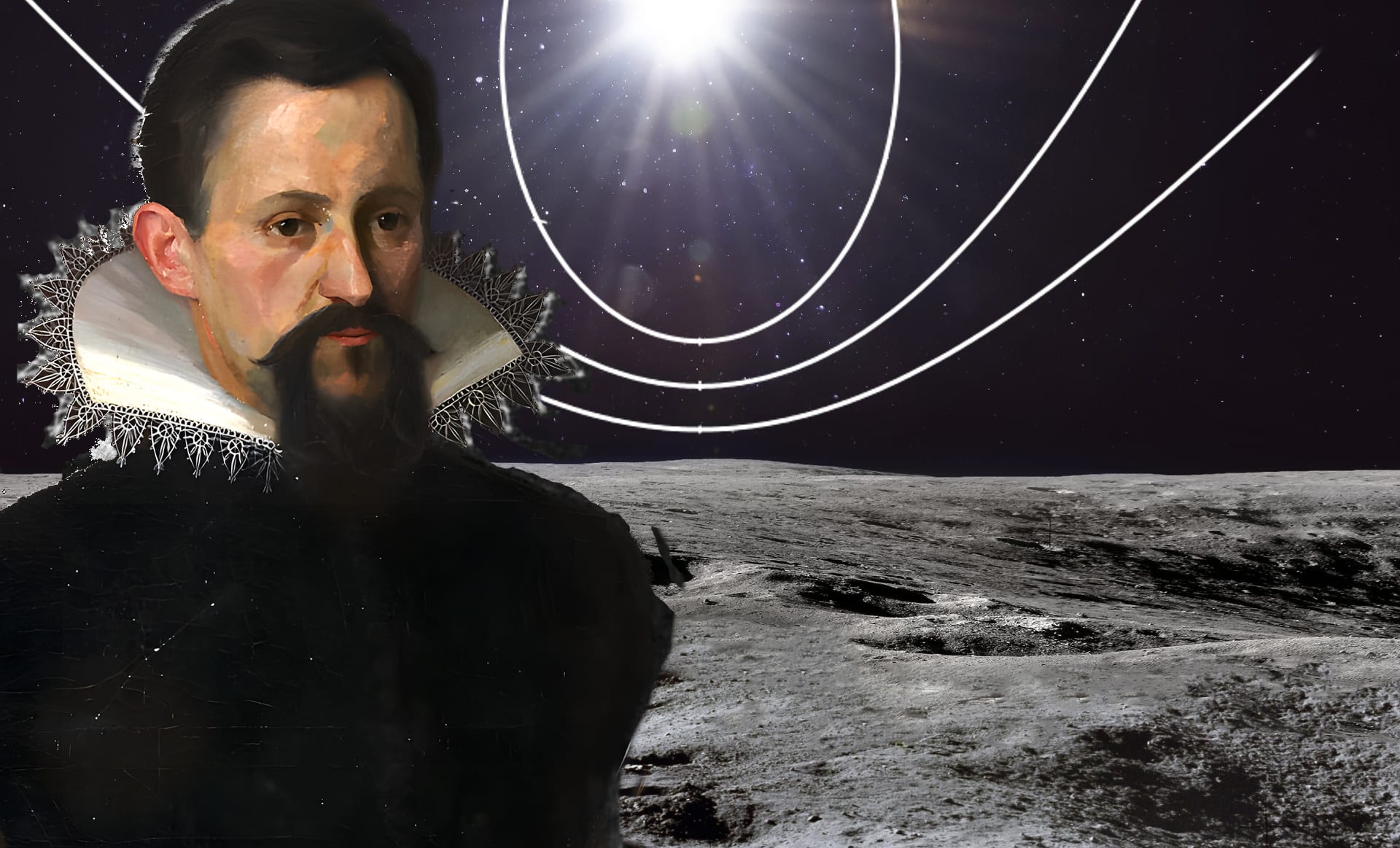
The 17th-century German astronomer Johannes Kepler lived at a pivotal time during the Scientific Revolution, as Europe’s older geocentric model of the universe was giving way to the newer heliocentric model, though not without resistance. The Polish astronomer Nicolaus Copernicus generally gets the credit for introducing the revolutionary idea that, rather than the Sun and planets revolving around the Earth, it’s actually the Earth and planets that revolve around the Sun. However, Kepler concluded that the Copernican revolution didn’t go far enough. The older view, which Copernicus himself still held to, was that the orbits of the planets formed perfect circles. Kepler, on the other hand, demonstrated that the planetary orbits are actually ellipses, with the Sun not at the absolute center of the orbit, but rather at one of the two focal points of the ellipse. This finding of modern astronomy has come to be known as Kepler’s First Law of Planetary Motion.
Kepler would also go on to discover two more laws of planetary motion. His Second Law states that any line drawn from the Sun to a planet at any point in its orbit will sweep out equal areas in equal amounts of time. Or put another way: as a planet gets closer to the Sun during its elliptical orbit, it starts to move faster, and as it moves away from the Sun, it slows down. Thus, equal orbital areas have equal orbital times. This is the same principle that was used to determine the best flight path for NASA’s recent Artemis II lunar flyby mission. As the Artemis crew approached the Moon, they capitalized on the higher velocity of their orbital approach, enabling them to perform a slingshot maneuver — or free-return trajectory — around the far side of the Moon, thus conserving fuel as they used the Moon’s gravitational pull to send them back on their way to Earth.
As groundbreaking as these two planetary laws were, Kepler considered his Third Law to be the crowning achievement of his career. This one is a bit more complex: it states that the square of the ratio of two planets’ orbital periods is equal to the cube of the ratio of their mean distances from the Sun. This means that if you know how long a year lasts on two different planets, and if you know the distance of one of those planets from the Sun, then you can also calculate the distance of the other planet from the Sun. Put simply, Kepler unlocked the mystery of the relationship between time and distance in the motion of the planets. He describes this astronomical epiphany in his 1619 work Harmonice Mundi, or Harmonies of the World.
Kepler’s Holy Grail
When Kepler discovered that his mathematical formula perfectly matched his experimental observations, he was euphoric. This was the Holy Grail which he had been seeking his entire adult life. Decades earlier, he had exclaimed, “Oh! that we could live to see the day when both sets of figures agree with each other.” And after the final confirmation of his third law, he could write, “We have lived to see this day after 22 years and rejoice in it…. I trust that … many other men will share in my joy!”
It may be hard to relate to Kepler’s ecstasy over obscure mathematical formulas. More relatable is the experience of delight in observing the vastness of a starry night sky, far removed from the lights of the city. Or other mesmerizing natural phenomena, such as a murmuration of starlings, flying together at dusk in rhythmic swirls of cloud-like patterns. I could multiply examples here, but the point is simply to underscore that we inhabit a beautiful universe. In fact, humanity’s encounter with natural beauty serves as one of the primary motivations behind the scientific enterprise. As the French theoretical physicist Henri Poincaré declared:
The Scientist does not study nature because it is useful to do so. He studies it because he takes pleasure in it; he takes pleasure in it because it is beautiful. If nature were not beautiful, it would not be worth knowing and life would not be worth living.
What accounts for the fact that we live in such a universe? Why should it be the case not only that the cosmos is filled with beauty, but also that it contains creatures capable of contemplating such beauty? In a series of posts, I will explore the view that the universe is the grand canvas of a divine Artist. The delight that human beings take in perceiving and studying natural beauty appears to be a signpost leading us to our Creator.
Science and Faith: A Deep Concord
In his book Where the Conflict Really Lies, the Christian philosopher Alvin Plantinga argues that, despite the superficial appearance of conflict, there is actually a deep concord between science and religion. He highlights the uncanny match between our cognitive powers on the one hand, and the intelligibility of the universe on the other. The match is like that between a gift and a recipient. The Medievals referred to this as the adaequatio intellectus ad rem — the correspondence of the intellect with reality. Given a purely naturalistic worldview, such a correspondence would be a surprising coincidence, resulting from a combination of impersonal physical laws and random chance. However, this correspondence is precisely what we would expect given a theistic worldview, in which God created humans in his image so that they might come to know him by means of the created order. If there’s a gift, then it’s reasonable to infer a Gift-giver.
We may extend Plantinga’s insight and appeal to an adaequatio intellectus ad pulchrum — the correspondence of the intellect with beauty. The fitness between science and beauty may reasonably be taken as evidence of divine design. Humanity’s aesthetic sense is not merely a brute contingent fact. It is a reflection of the artistry of the One who created us to delight in him and in the works of his hands.
To make this argument, we need a clear definition of beauty. Yet finding one turns out to be a surprisingly difficult task. Beauty is one of those words whose meaning we take for granted in our day-to-day speech, but when pressed to articulate a formal definition, we find ourselves at a loss. Beauty, in this regard, is a lot like love or justice. We may be tempted to just throw up our hands and define beauty after the manner of Supreme Court Justice Potter Stewart, who, speaking in a very different context, said, “I know it when I see it.”
However, we can do better than that. Humans have been studying beauty for millennia, so we may appeal to the wisdom of the past. The 13th-century theologian Thomas Aquinas proposed one of the most concise and widely accepted definitions of beauty: “Beauty is that which pleases upon being seen.” This definition is good as far as it goes, but it requires a couple of caveats.
Not Just Any Pleasure
First of all, the kind of pleasure elicited by beauty isn’t just any kind of pleasure. If I’m hungry and someone sets before me a plate of sloppy joes, I might experience a sense of pleasure in anticipation of a full stomach, but that doesn’t make the sloppy joes beautiful. Philosopher Emmanuel Kant clarified that beauty elicits a “disinterested” pleasure. That doesn’t mean uninterested or apathetic. Kant meant a pleasure not based on personal advantage, possession, or use. When I behold a beautiful painting, the pleasure I experience isn’t from the thought of eating the painting or even selling the painting. I simply delight in knowing that this painting exists, considering the world to be a better place because of it.
A second caveat is that when we say that beauty is “seen,” that doesn’t restrict beauty to purely visual stimuli. Beauty includes music and poetry, after all — and arguably also mathematical formulas and scientific theories. But according to Mortimer Adler, Aquinas’ definition can accommodate these forms of beauty if we understand “seeing” in the broader sense of contemplation — that is, seeing with our mind’s eye.
Tomorrow, “Science and Beauty: The Lens of Triperspectivalism.”
Editor’s note: This article was first delivered as a speech at the Spring 2026 conference of the Cornwall Alliance for the Stewardship of Creation in Memphis, Tennessee.