






































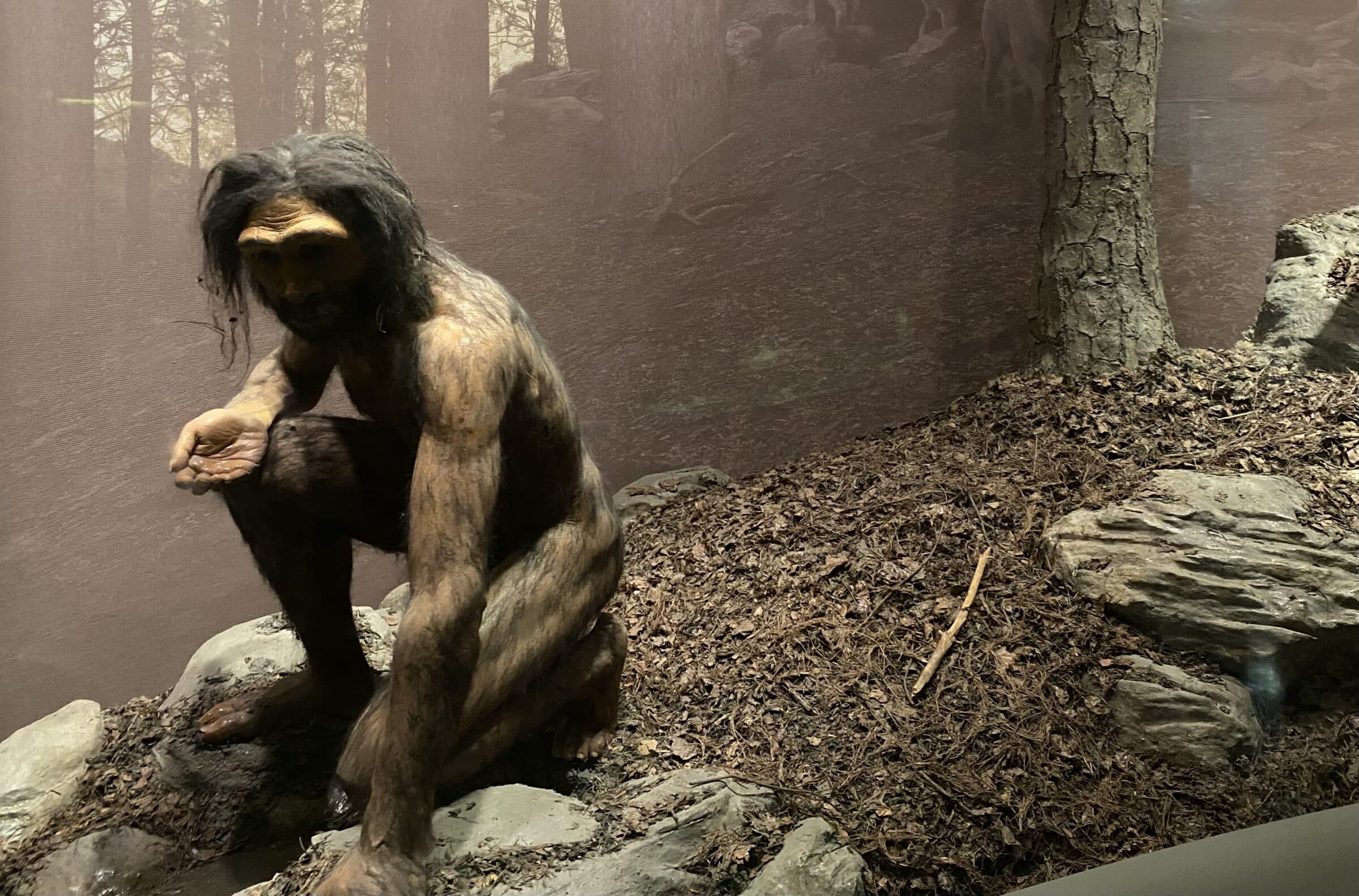
Recently, I caught up with research on Neanderthal man again. Quite honestly, I was astonished at how much he has learned in the last few years. Dentistry, backpacking … there is even a debate about whether he had got religion before he disappeared into the general human genome.
Surprisingly, other ancient humans have started to get smarter too. From my electronic clippings files:
- A tool found in Greece dated to 430,000 years ago may be the oldest wooden tool ever discovered, archaeologists say:
The items were likely used by early Neanderthals or a species known as Homo heidelbergensis during the Middle Pleistocene, an era of human evolution “characterized by increasing behavioral complexity and the first unambiguous evidence of plant-based technologies,” the researchers write in the journal PNAS, where their discovery was published this week.
Smithsonian Magazine, January 27, 2026
Hints of Symbolic Beliefs
Incidentally, also from Smithsonian, “News of the wooden artifacts’ discovery comes several days after researchers in England published a study analyzing a 480,000-year-old tool made from elephant bone — likely the oldest tool of its kind found in Europe.” (January 26, 2026) This paper is open access.
- The oldest known hand stencil was recently found in Indonesia, dated to 67,800 years ago. The artist appears to have modified the hand stencil to make the hand appear more like an animal claw, hinting at symbolic beliefs:
Researchers have uncovered the world’s oldest known cave art — a 67,800-year-old hand stencil in Indonesia. The unusual, claw-like design hints at early symbolic thinking and possibly spiritual beliefs. This discovery also strengthens the case that humans reached Australia at least 65,000 years ago. It offers rare insight into the creative lives of some of our earliest ancestors.
Griffith University, “This 67,800-year-old handprint is the oldest art ever found,” Science Daily, 22 March 2026
Indeed, “The findings also show that people continued creating art in this cave for a remarkably long time. Artistic activity spanned at least 35,000 years, lasting until around 20,000 years ago.” The paper is open access. The long history of the site implies that it was recognized as a special place for many generations.
Did Homo erectus Hire a Public Relations Firm?
You’d almost think so, reading an item on a recent find in Israel from Live Science: “Homo erectus’ tools include stunning geodes and fossils, possibly as a way to connect with the cosmos, study finds.”
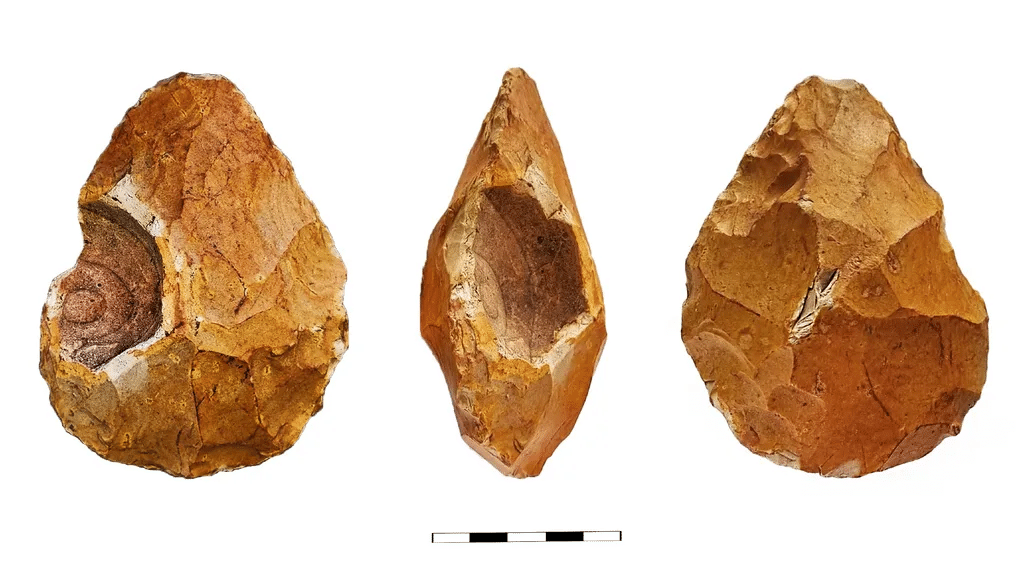 Photo: Red onion cells, by Edoardo Simon, CC BY-SA 4.0 <https://creativecommons.org/licenses/by-sa/4.0>, via Wikimedia Commons.
Archaeologists in Israel have unearthed 10 “extremely rare” prehistoric stone hand axes that were crafted to deliberately include geological features, including fossils and geodes, a new study finds.
The hand axes were probably made by Homo erectus between 500,000 and 200,000 years ago, likely because our human ancestors thought these objects were imbued with potency and cosmic significance, the study researchers suggested, although others argue further evidence would benefit the study…
The discovery contributes to a debate regarding whether early humans recognized or consciously noted geological features and fossils, or whether their occurrence in stone tools was merely accidental. However, the new discovery of multiple tools with these features in the same area suggests it was a deliberate act, the researchers said in the study.
Sandee Oster, “Connect with the cosmos,” April 13, 2026
The paper is open access.
My neighbor argues that none of these people got any smarter; rather, researchers have started looking at them differently in recent years — so they see things they didn’t see before.
That Makes Sense
At one time, we were encouraged to interpret ancient humans as a long, slow, Darwinian ascent of man. But maybe that didn’t really happen. It was the technology that ascended, not the man.
I’ve said this before: Neanderthal man could probably have imagined going to the moon. He could maybe tell a story to the gathering around the fire about a hero who fights moon monsters and marries the Moon Chief’s daughter. But NASA’s proposed moon base was many thousands of years of technology into the future. And it didn’t matter how smart he was — or wasn’t. He was on the wrong side of a timeline.
In other words, the human mind does not have a history. We see it when and where we see it. Technology does have a history — a history that matters. It is best not to confuse the two.
Cross-posted at Mind Matters News.