






































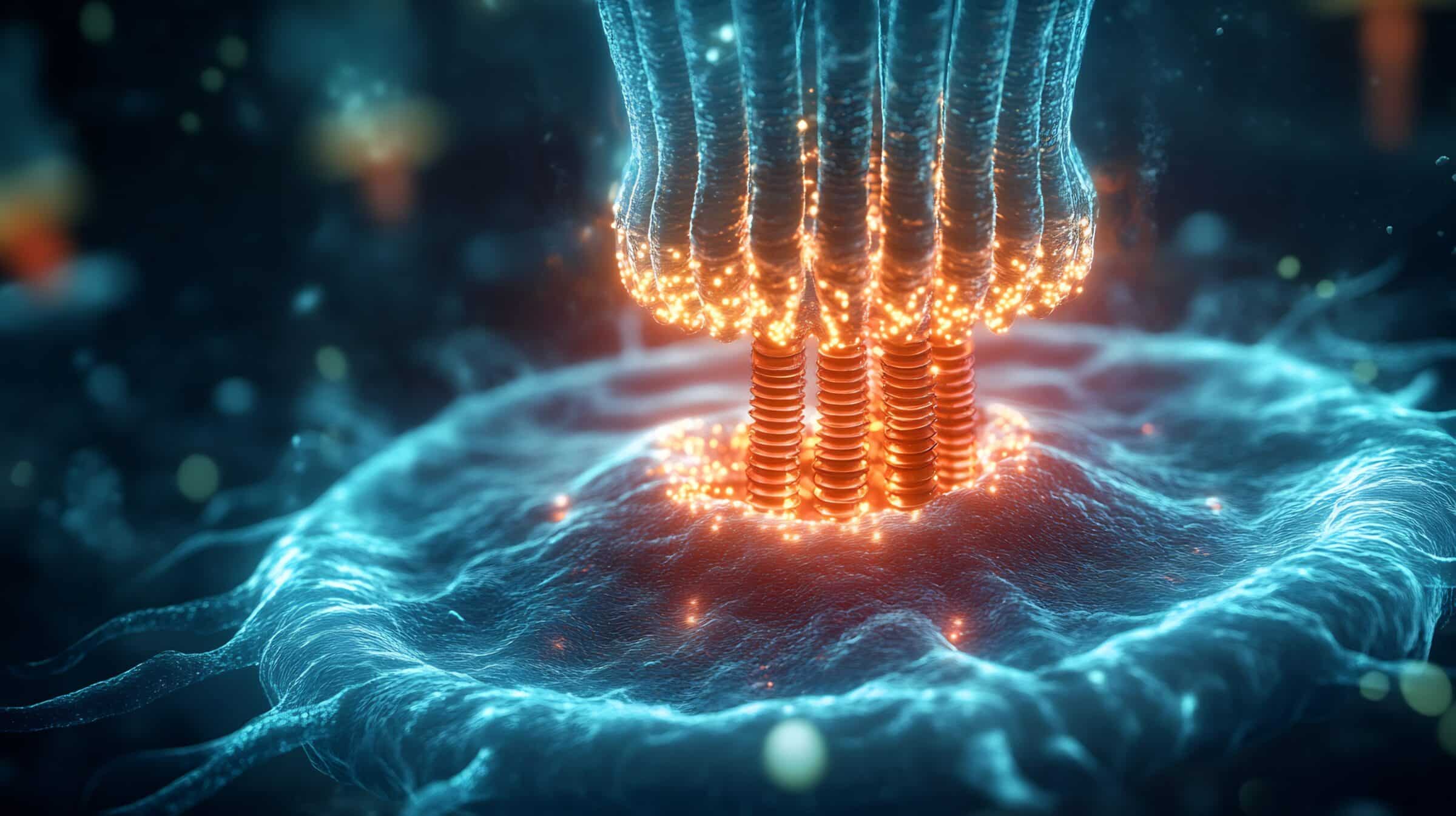
One of the original icons of intelligent design, the bacterial flagellum continues to astonish viewers shown a complex molecular motor in the “simplest” life-forms. As researchers peer deeper into its operations with super-resolution microscopy, they have revealed many more details since Michael Behe introduced his readers to its outboard-motor function in Darwin’s Black Box (1996), elaborating on it in more detail in his subsequent books. The bacterial flagellum played a starring role in Illustra Media’s film Unlocking the Mystery of Life in 2002. As recently as 2024, Destin Sandlin made a whole episode about it for his channel Smarter Every Day. To watch a modern animation of this elegant device is often enough to convince people of intelligent design. Here is an artifact clearly beyond the reach of unguided natural processes.
Torque Generation
One mystery remained, though: how did it generate torque? Rotating a propeller in fluid that feels more viscous at the nanometer scale requires significant turning force. A recent paper in PNAS1 by Basarab Hosu and two colleagues at Harvard — the same university where pioneering research was done on it by Howard Berg in the 1990s — helps answer that question: “Torque-generating units of the bacterial flagellar motor are rotary motors.” The flagellum is a rotary motor rotated by smaller rotary motors! Even more amazing, those small motors act like gears. ID advocates leaped on the discovery of planthopper nymphs that use gears to hop, but these are orders of magnitude smaller.
Switching Direction
Another mystery was how the flagellum could switch rotation from one direction to the other almost instantly. The new model by Hosu et al. pictures the inner motors rapidly flipping from inside to outside or back. To visualize this, think of a ring toothed on the inside and outside. Now think of four small motorized gears inside the larger ring, rotating the ring as they turn. If they could flip to the outside and engage the ring’s outer teeth, the ring would reverse direction. Something like that is what Hosu et al. confirmed: “The bacterial flagellar motor is driven by the first set of enmeshed gearwheels that has been described in any living cell.” That’s worth a big “Wow!”
Escherichia coli swims using helical flagellar filaments driven at their base by a rotary motor. Torque-generating “stator” units drive the bacterial flagellar motor by transmitting mechanical power to a cytoplasmic “rotor,” the C-ring. Each stator unit is a proton-conducting heteromer. A central dimer of two MotB proteins anchors to the cell wall. A surrounding pentamer of five MotA proteins transmits mechanical power to the C-ring. This asymmetrical 5:2 structure is consistent with rotation as the mechanism of torque generation. Here, we test the hypothesis that the MotA5MotB2 stator units are rotary motors themselves and interact with the rotor like intermeshed gearwheels, where rotation of the C-ring is directly coupled to MotA5 rotation around the MotB2.
A Moving “Stator”
Notice they put “stator” in quotes, because these move! In their diagrams, MotB proteins are anchored to the cell wall. Surrounding each MotB is a MotA that rotates clockwise, driven by proton motive force. The authors see a similarity of MotA with ATP synthase:
The MotA5/MotB2 stator has structural resemblance to another rotary motor, F1-ATPase, the enzyme that couples proton-conduction across the mitochondrial membrane to ATP synthesis. F1-ATPase drives its catalytic cycle—ADP + Pi ATP—by physically rotating a ring of globular subunits (α3β3) around a central stalk.
MotB corresponds to the central stalk, and MotA to the FO part of ATP synthase that is rotated by proton motive force. The heavier filament of the bacterial flagellum, therefore, is driven by up to 11 individual MotA5/MotB2 rotating motors that bear some resemblance to ATP synthase motors. What was considered part of the stator is therefore a rotating motor itself.
How do the spinning MotA stator units switch direction of the flagellum? The diagram shows that the large C-ring of the flagellum, looking somewhat like a flywheel, is rigidly attached to the MS-ring above it where the MotA5/MotB2 motors and the flagellar rod reside. The spinning MotA units contact Y-shaped arms of the C-ring. When contacting one arm of the Y, MotA drives the MS-ring and C-ring counterclockwise (CCW). A simple tilt of the MotA5/MotB2 complex makes it contact the other arm of the Y, driving the flagellum clockwise (CW). That’s how the flagellum can change direction so fast.
How Protons Drive the “Stator” Motors
Protons are pumped into the inner and outer membranes of the bacterial cell, creating a proton gradient. MotB proteins have channels to permit protons to flow in an orderly manner, turning the MotA motors like turbines in a dam. Another fascinating detail is found inside MotB: an automatic rectifier that keeps MotA spinning in only one direction:
Because 5:2 stoichiometry prevents both proton-conducting channels from simultaneously having the same configuration at the MotA5/MotB2 interface, only one channel can be open at a time. Geometric interplay between five-fold and two-fold symmetric structures predicts that pentamer rotation by 36° around the dimer would toggle the open and closed states of the proton channels. Another 36° rotation in the same direction would reverse the toggle. After two 36° rotations, each MotA subunit will occupy the initial position of its neighboring subunit (Fig. 1B). Thus unidirectional proton-conduction into the cell might directly couple to unidirectional rotation of MotA5 pentamer around MotB2 dimer.
This mechanism keeps MotA rotating clockwise. The flipping of its position relative to the MS-ring/C-ring complex allows the unidirectional MotA motor to drive the flagellum either CW or CCW.
An Ingenious Engineering Design
This looks like an ingenious engineering solution for the blind bacterium to be able to change direction rapidly in its watery medium. When spinning CCW, the flagellum will drive the cell in a straight line. When signals from sensors on the exterior of the cell indicate danger or food, a quick CW change sends it into a “tumble” that allows a change of direction. These rapid changes allow the bacterium to follow a concentration gradient in the fluid.
The mechanical power that drives flagellar motor rotation is transmitted to the C-ring by the cytoplasmic lobes of MotA subunits. The surface of the MotA cytoplasmic lobe has charge complementarity to the surface of the C-ring at specific amino acids on FliG subunits. These amino acids represent contact points where the MotA5 pentamer can interact with 34 FliG subunits along the C-ring perimeter. If these contact points are where stator and rotor are intermeshed as gearwheels, a conformational change in the C-ring offers a mechanism for bidirectional switching
In the Unlocking film, Jed Macosko said that even when spinning at 100,000 rpm, the flagellum can change direction in just a quarter-turn and then continue spinning 100,000 rpm in the opposite direction. Imagine a flywheel doing that in a car or airplane! What would be impossible for a human-scale engine is apparently achievable at the nanometer scale. Yet even at that scale, the laws of nature apply. The authors repeat that the flagellum is a mechanical device, driven by mechanical power to a mechanism of torque generation.
Emotional Reactions
The work by Hosu et al. gave Michael D. Manson a satisfying feeling of completion. Fascinated by Howard Berg’s original paper, Manson has studied the flagellum for five decades. “Flagellar rotation comes full circle,” he wrote in PNAS2 on February 2, 2026:
I chose the title for this commentary because this study represents closure of an adventure that began with Berg’s original proposal that bacterial flagella rotate. He published that idea long before we had any idea about the structure and operational properties of the flagellar motor. I recall my excitement as a graduate student in 1973 upon reading that paper. It set a new course for my scientific career in a direction for which I was totally unprepared. The rotation of the MotA ring in the CCW direction in response to an outward proton flow explains the mystery behind my observation that a reversed proton flow causes a normally CCW-locked mutant motor to rotate CW. With an outward proton flow, the MotA ring should rotate CCW and the C-ring CW. The publication of this paper fulfills the quest to which I devoted much of my scientific life: To understand how rotation of the flagellar nanomachine is generated.
Manson briefly refers to the flagellum, the ATP-driven archaellum, and ATP synthase as “independently evolved” biological rotary nanomotors, but otherwise both papers have no use for evolution.
Share the Awe
If scientific materialists can get this excited about the workings of biological motors,3 how much more should design enthusiasts stand in awe of engineering finesse coming to light in the smallest living things? Now we can share the wonder of a motor-driven rotary engine that is even more irreducibly complex than Dr. Behe argued in 1996. With more light entering Darwin’s black box, the bacterial flagellum is being revealed as a souped-up electric motor of motors with enmeshed gearwheels, a rectifier, sensors everywhere, and reversible automatic transmission. It’s like hoping to see a manual transmission Honda Civic and getting a self-driving electric Tesla.
Notes
- Hosu, Vrabioiu and Samuel, Torque-generating units of the bacterial flagellar motor are rotary motors. PNAS 3 Dec 2025, https://doi.org/10.1073/pnas.2515291122.
- Michael D. Manson, Flagellar rotation comes full circle. PNAS 2 Feb 2026, https://doi.org/10.1073/pnas.2533096123.
- In his video, Destin Sandlin is clearly excited by looking at this rotating molecular motor in the cell. The scientists he interviews at Vanderbilt show similar fascination, even when one states in passing that the motor evolved. Since fascination is expressed on both sides of the origins debate, it can be a launching point for discussions about how such a machine came to be.