






































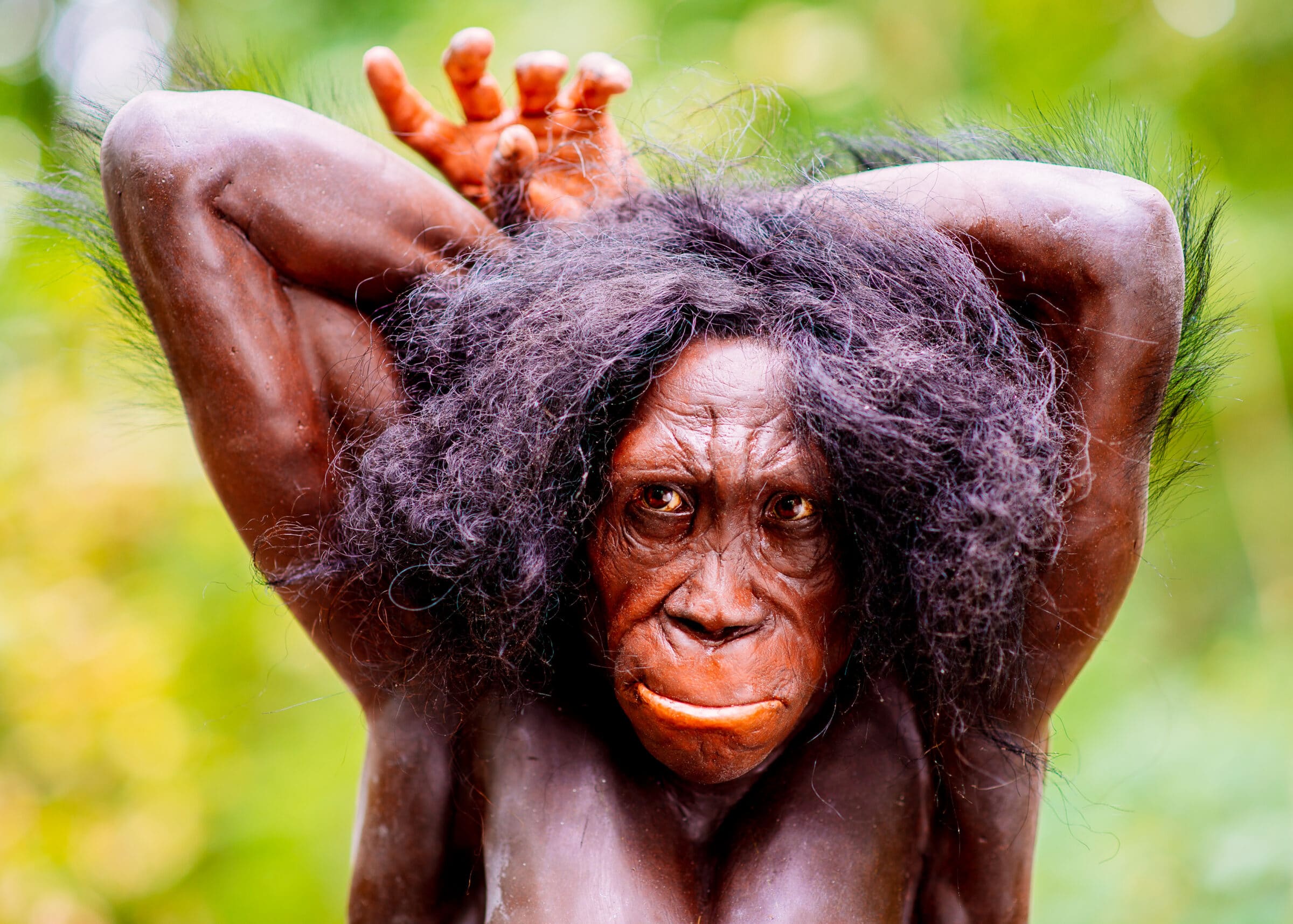
First Things is a thoughtful ecumenical magazine for Christians and Jews of various stripes, that, many years ago, was very open to publishing material from a pro-intelligent design (ID) perspective. However, as explained here, sometime in the 2000s it got co-opted by theistic evolutionists and ID critics, and became far less willing to publish ID-friendly material. Much of this was due to the influence of Stephen Barr, a physicist and Catholic scholar, who is a professor at the University of Delaware.
We’ve gone back and forth with Professor Barr many times in the past (see here, here, or here, for example), and he recently had an article at First Things titled “True Humans,” which is a glowing review of a couple new books arguing for the compatibility of Catholic theology and evolution. I’m not Catholic — so I dare not wade into debates over Catholic theology — but I do have close friends in the ID community who are Catholic. Some of them are represented in the fantastic volume God’s Grandeur: The Catholic Case for Intelligent Design, edited by Ann Gauger.
While I won’t comment on the theology, I do take issue with Professor Barr’s scientific claim about the nature of the hominid fossil record as it relates to human origins. Here’s what he says:
Homo sapiens as a biological species arose (as all species do) in a gradual way by the spread of new traits within populations
First, I’d like to know how Professor Barr knows this is true? Really, how does he know this?
Non-Gradual Origins
Second, I’ve documented many times that the literature recognizes the non-gradual nature of the origin of our genus Homo. In 2023 I wrote a review about human origins in the journal Religions, and while assessing the theistic evolution view noted what the literature says on this point:
[T]he fossil record shows a distinct break between the apelike australopithecines, which are supposedly directly ancestral to our genus Homo, and the first humanlike members of the genus Homo (Luskin 2022). Such evidence has led to observations from mainstream evolutionists conceding that there is a “large, unbridged gap” between humanlike members of Homo and the australopithecines (Mayr 2004, p. 198), which required a “genetic revolution” since “no australopithecine species is obviously transitional” (Hawks et al. 2000, p. 4), and implies a “big bang” model of human origins (University of Michigan News Service 2000). While evolutionary paleoanthropologists generally believe that “the transition from Australopithecus to Homo was undoubtedly one of the most critical in its magnitude and consequences,” they admit that “many details of this transition are obscure because of the paucity of the fossil and archaeological records” (Lieberman et al. 2009, p. 1). This lack of fossil evidence for the evolution of the humanlike body plan in the fossil record weakens the necessity of adopting standard evolutionary explanations of human origins.
And there are additional sources which acknowledge the abrupt appearance of the humanlike body plan in the fossil record. One Nature paper observed that early Homo erectus shows “such a radical departure from previous forms of Homo (such as H. habilis) in its height, reduced sexual dimorphism, long limbs and modern body proportions that it is hard at present to identify its immediate ancestry in east Africa” (Dennell and Roebroeks, 2005) — or anywhere else for that matter. Another review similarly notes, “…it is this seemingly abrupt appearance of H. erectus that has led to suggestions of a possible origin outside Africa.” (Turner and O’Regan, 2015)
It’s also worth elaborating on a couple of quotes and citations from my reviewnoted above. Ernst Mayr wrote in 2004:
The earliest fossils of Homo, Homo rudolfensis and Homo erectus, are separated from Australopithecus by a large, unbridged gap. How can we explain this seeming saltation? Not having any fossils that can serve as missing links, we have to fall back on the time-honored method of historical science, the construction of a historical narrative.
The paper by Hawks et al. found that Homo and Australopithecus differ significantly in brain size, dental function, increased cranial buttressing, expanded body height, visual, and respiratory changes, stating:
We, like many others, interpret the anatomical evidence to show that early H. sapiens was significantly and dramatically different from… australopithecines in virtually every element of its skeleton and every remnant of its behavior.
A Genetic Revolution
Noting these many differences, the study called the origin of humans “a real acceleration of evolutionary change from the more slowly changing pace of australopithecine evolution.” It stated that such a transformation would have required radical changes: “The anatomy of the earliest H. sapiens sample indicates significant modifications of the ancestral genome and is not simply an extension of evolutionary trends in an earlier australopithecine lineage throughout the Pliocene. In fact, its combination of features never appears earlier.” As I noted above, these rapid and unique changes are termed “a genetic revolution” where “no australopithecine species is obviously transitional.”
The point here is that Barr wants to portray human origins as “gradual,” as if it reflects the standard Darwinian expectation, when in fact the literature paints a very different story. Mainstream paleoanthropologists acknowledge that the origin of humans is sudden and abrupt. One can try to spin that evidence to fit it within some kind of an evolutionary model, and certainly this has been done. But the evidence lends itself very cleanly to a non-evolutionary model.
If First Things is open to authors writing from a non-evolutionary perspective, I would be more than happy to help their readers understand what the literature says on this topic, and how it is strikingly different from how their science-faith expert, Stephen Barr, has characterized it.